designcoding
About Table of Contents Keywords
Support designcoding!

#rhinoceros

104 posts

Modeling a Geodesic Sphere

May 23, 2012
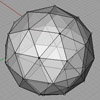
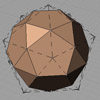
Not all of them, but when you get the idea, you’ll see there are lots of different alternatives for creating Fuller’s famous Geodesic Domes (Although in fact, he is not the inventor of it). I was playing with Platonic Solids in Rhino and realized that the “Pull” command is very useful in subdividing objects. I modeled this in Rhino 4. First, take a regular Icosahedron and divide it. Because, this is the simplest way for modeling a Geodesic sphere, by…
Tetrahedron Quick Way

May 20, 2012

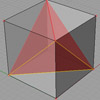
The tetrahedron is a popular platonic solid for designers. We’ve explained how to draw them using equilateral triangles here before. Recently I’ve found (sorry, lost the web address) a much quicker way of modeling a Tetrahedron using a cube. It’s very simple, just connecting the three opposite corners of the cube automatically makes them equal, resulting in the four equal faces. Of course this time you’ll have to calculate the actual edge length, but if you use the “box diagonal”…

Paneling a Surface Manually

May 11, 2012

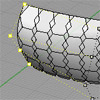
Digging out with Grasshopper, Rhinoscript, and Paneling Tools, everything seems to be more and more automated and fast. However my colleagues Mete, Benay and Elif reminded me that, we can always do much with those high-end architectural geometry tools, but we still have to understand and follow the roots, probably best described by the “manual ways”. Sometimes using these methods would be much more intuitive as they are SLOW enough for designers to think about what is going on there……

Parametric Muqarnas

March 13, 2012

This was an interesting topic in design computing class. Geometric constructions based on strict relationships are becoming exciting in parametric modeling environments. I think muqarnas includes such a relationship. There is a primary method of modeling this shape, introduced by Mete Tüneri. His solution to a simple parametric muqarnas object includes a surface with six reference points, with two boolean differences (one cylinder and one box) creating the component. In Grasshopper, I tried to simulate his process by adding real-time…

Some Rhino Tips

February 15, 2012

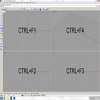
Here are three technical tips, that might help you model in Rhinoceros faster. Please note that, in most cases, you’ll find CTRL+F1,F2,F3 and F4 very helpful in modeling and transforming objects in digital space. These key combinations will focus you on Top, Front, Left and Perspective views (maximized) respectively. Also, when you try to express your design process (especially supporting geometries) using different linetypes, it’s possible that you’ll never like those preset linetypes. By choosing Tools / Options, you’ll have the opportunity to change…

Modular Roof Project

January 25, 2012

This was a design competition of a precast concrete roof system. My design proposal was a modular and variable structure for İstanbul’s old bus station, converted to art galleries. However, this project was developed purely by hand-sketches, I’m planning to create an envelope of alternatives by creating a parametric model. Each module is proposed to be converted differently in order to meet various functions such as single or double module galleries, shopping and restaurant, and a theater also. The varying…

Drawing and Unrolling Octahedron

December 29, 2011

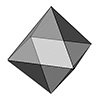
An octahedron is a polyhedron and platonic solid with 8 faces of identical equilateral triangles. In this post, I will try to explain the drawing and unrolling process of the octahedron. It has a close relationship with the cube as it’s dual. In order to construct an octahedron, we first have to create a square. The main problem of drawing the square is determining the right angle (perpendicular axis) to any point in Euclidean space. We’ll draw it here as…

Recording History in Rhinoceros

December 24, 2011

Recording History in Rhinoceros3D has interesting potential. You might utilize it in the process of design exploration. We’ll try to show its concept and limitations; First, build two surfaces; one is planar at the world XY plane, and the other represents the “initial” form of your design. Put another surface on the planar one, as if it’s an ideal “component” of the finished geometric composition. Activate the “Record History” button at the bottom of the Rhinoceros window, then array your…

Dodecahedron: Drawing and Unrolling

December 23, 2011

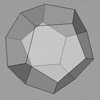
The dodecahedron is a Platonic Solid with 12 equilateral pentagonal faces. It has a close relationship with its 20-sided dual, Icosahedron. Mete Tüneri showed the following method of Dodecahedron construction, using only distances, corners of the pentagon, and a visionary equilateral triangle underneath. We’ll construct Dodecahedron, assuming that we’ve drawn an initial equilateral pentagon. We need to find out the pentagon’s angle of 3d rotation. First, put spheres at points a and c, with a radius of a to c. The…

Icosidodecahedron

December 22, 2011

Icosidodecahedron is an Archimedian Solid, a thing in between the Platonic Solids of Icosahedron (d20) and Dodecahedron (d12). It is a rectified version of an Icosahedron, constructed by dividing every edge into two equal segments and joining these segments to create a composition of equilateral pentagons and triangles. Archimedian Solids consist of at least two equilateral polygons, whereas Platonic Solids are constructed by only one. We’ll deduce an Icosidodecahedron from Icosahedron below; First, you should create an Icosahedron, the Platonic…

« 1 2 3 4 5 6 7 8 9 10 11 »
  • Chapters

    • Algorithms
    • Discourses
    • Fabrications
    • Studios
  • Explore

    • #revit
    • #curvature
    • #tiling
    • #processing
    • #graph-mapper
    • #stellated-solid
    • #hotwire-cutting
    • #rhombicosidodecahedron
    • #spiral
    • #random
    • #enneahedron
    • #golden-ratio
    • #text
    • #exhibition
    • #space-syntax
    • #hilbert
    • #attractor
    • #b-spline
    • #eps-foam
    • #lissajous
    • All Keywords
    • Table of Contents
    • Monthly Archive
  • Search

  • Patreon

    Support designcoding!

    Enjoying designcoding? Support its future with a small donation on Patreon. Thank you!


    copyright 2026 designcoding.net | about | privacy policy | end user license agreement