designcoding
About Table of Contents Keywords
Support designcoding!

#rhinoceros

104 posts

Modeling and Unrolling Octahedron

December 12, 2024
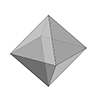
An octahedron is a three-dimensional polyhedron with eight triangular faces, six vertices, and twelve edges. It is one of the Platonic solids and has high symmetry, with all of its faces being equilateral triangles. A regular octahedron can be visualized as two pyramids joined at their bases. It has the same number of faces as a cube has vertices, and the same number of vertices as a cube has faces. The octahedron is also dual to the cube, meaning that…
Modeling and Unrolling Tetrahedron

December 12, 2024

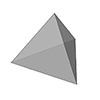
A tetrahedron is a three-dimensional shape with four triangular faces, four vertices, and six edges. It is the simplest polyhedron and, in its regular form, has equilateral triangles as faces, with all edges of equal length. Thus, known as one of the Platonic solids, a regular tetrahedron is highly symmetrical, and its shape is considered stable and efficient in many natural and man-made structures. In this short tutorial video, I am modeling and unrolling a tetrahedron. I studied this platonic…

Drawing Lattice Deformation

December 11, 2024

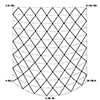
Lattice deformation in parametric design refers to the process of manipulating a grid or mesh structure so that it changes shape in response to specific inputs or parameters. We use this approach widely in computational design for creating complex, organic forms and adaptive systems. Also, lattice deformation can be applied in architectural facades, structural systems, and product design where adaptability and aesthetic fluidity are desired. In this short tutorial video, I am drawing a lattice deformation in the Rhinoceros. It…

Drawing Crosswise Deformation

December 11, 2024

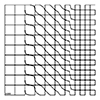
Parquet deformation refers to a transformation technique applied to a grid or tiling pattern, particularly one that resembles traditional parquet flooring, to create visually interesting and dynamic patterns. This concept is used in parametric design to alter repeating geometric tiles, producing effects such as warping, bending, or otherwise deforming the original pattern while maintaining an overall cohesive layout. In this short tutorial video, I am explaining the drawing of Crosswise deformation. This is a beginner-level drawing exercise that utilizes basic…

Constructing Irregular Tiling

December 11, 2024

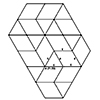
Using a compass and straightedge enables precise geometric constructions, allowing for the creation of complex tessellations. To begin these constructions, a single starting point is sufficient. Circles, which represent a collection of points at a specific distance from the center, and straight lines, which represent a collection of points in a particular direction, are utilized for geometric constructions. In this short tutorial, we move on with the beginner-level drawing exercises. This time, I am drawing an irregular tiling with triangles…

Drawing Escher-like Tiling

December 11, 2024

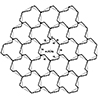
Escher tilings, inspired by the work of Dutch artist M.C. Escher, are inspiring tessellations that cover a plane using repeated geometric shapes without gaps or overlaps. He often used interlocking, recognizable figures like animals and birds to create these patterns, blending art with mathematical precision. His tilings explore symmetry, transformations, and the interplay between two- and three-dimensional space. Escher’s work has influenced both artistic and mathematical fields, particularly in the study of tessellations and geometry. Thus, In this short tutorial,…

Constructing Snub Square Tiling

December 11, 2024

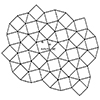
Snub Square Tiling is a semi-regular tessellation of the plane, composed of two squares and three regular triangles at each vertex. The arrangement of these two regular shapes seamlessly covers the plane without any gaps or overlaps. It is one of the eight semi-regular tessellations known in geometry. The dual of Snub Square Tiling is Cairo Pentagonal Tiling, which we will explore later. In this short tutorial, I am drawing and constructing the Snub Square Tiling by using an abstract…

Drawing Hexaflake

December 11, 2024

The term “hexa” generally refers to the number six, derived from the Greek word. It is commonly used in mathematics, geometry, and other scientific fields to indicate six-sided shapes or structures. A hexagon is a polygon with six sides and six angles. It is one of the regular polygons, meaning all of its sides and angles are equal. A hexahedron is a polyhedron with six faces. The most well-known example is the cube, which has six square faces, twelve edges,…

Drawing Koch Pentagon

December 11, 2024

The Koch pentagon is a fractal shape that starts with a regular pentagon. Here, we divide each side of the pentagon into three equal parts. Then, we replace the middle with two sides of an outward-pointing equilateral triangle. We repeat this process for every new side in each iteration, creating a self-similar pattern. Helge von Koch (1870–1924) was a Swedish mathematician known for his analysis and number theory work. He is most famous for introducing the Koch snowflake, one of…

Constructing Tangent Circles

December 11, 2024

In geometry, “tangent” refers to a scenario where a line, curve, or surface touches another at exactly one point without crossing or leaving a gap. A tangent line to a circle is a straight line that touches the circle at only one point, and it is perpendicular to the radius at that point. Two circles can be tangent either internally or externally. Geometric constructions using a compass and straightedge can help accurately calculate tangent circles. Thus, the “constructing tangent circles”…

« 1 2 3 4 5 6 7 8 9 10 11 »
  • Chapters

    • Algorithms
    • Discourses
    • Fabrications
    • Studios
  • Explore

    • #stellated-solid
    • #parametric-curve
    • #sphere
    • #virtual-studio
    • #simulation
    • #puzzle
    • #hyperbolic
    • #vector-field
    • #macro
    • #non-euclidean
    • #eps-foam
    • #euclidean-construction
    • #tiling
    • #terrain
    • #brick
    • #galapagos
    • #hotwire-cutting
    • #gyroid
    • #semi-regular
    • #deformation
    • All Keywords
    • Table of Contents
    • Monthly Archive
  • Search

  • Patreon

    Support designcoding!

    Enjoying designcoding? Support its future with a small donation on Patreon. Thank you!


    copyright 2026 designcoding.net | about | privacy policy | end user license agreement