designcoding
About Table of Contents Keywords
Support designcoding!

#rhinoceros

104 posts

Modeling an Icosahedron

December 21, 2011
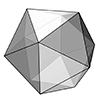
Today’s polyhedra is the beautiful icosahedron. It is one of the five Platonic Solids with twenty equilateral triangular faces. Its dual is the dodecahedron, which has pentagonal faces. Here, I explained the process of modeling an icosahedron. After creating a regular pentagon, you should find the “tip” point of the Icosahedron by intersecting spheres from at least three of the corner points with a radius of the pentagon’s edges. You can exercise Tetrahedron to understand how we find a point…

Truncated Tetrahedron

December 21, 2011

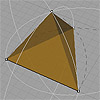
A truncated tetrahedron is an Archimedean solid, created by slicing a tetrahedron. Its faces are regular hexagons and triangles. Assuming you’ve created a tetrahedron, first join its faces to create a closed polysurface. Now, you may recreate the lines of the tetrahedron’s edges, either by drawing them or generating them (Curve / Curve from Objects / Duplicate Edge). While the edge lines are selected, hit (Curve / Point Object / Divide Curve / Number of Segments) and type 3 to create…

Construction of Tetrahedron

December 19, 2011

The tetrahedron is a platonic solid with four equal triangular faces (equilateral), six equal edges, and four vertices. In the construction of a tetrahedron, we will look closer at length transfers using compass-like tools in two- and three-dimensional space. To define the edge length of the first triangle, start with any two points in Cartesian space. Using a compass (arc or circle), draw two arches (or circles) using your initial points as corners and the distance between your points as…

Emergent Polygons

November 14, 2011

This is my first post in designcoding, dated 14.11.2011. I revisited the code and decided to re-publish it in 2024. Hello World! This is the Emergent Polygons definition, one of the first Grasshopper studies I made while learning the language. This is a very efficient programming language for designers and architects since it utilizes geometric relationships very intuitively. I think it will be more popular and widely used in the upcoming years. Last year, I started my experiments on this….

« 1 2 3 4 5 6 7 8 9 10 11
  • Chapters

    • Algorithms
    • Discourses
    • Fabrications
    • Studios
  • Explore

    • #text
    • #3d-max
    • #fourier
    • #spiral
    • #tensegrity
    • #archimedean-solid
    • #kuka-prc
    • #contouring
    • #design-competition
    • #hilbert
    • #visualization
    • #weaire-phelan
    • #permaculture
    • #animation
    • #photoshop
    • #geodesic
    • #anemone
    • #chaos
    • #kangaroo
    • #data-flow
    • All Keywords
    • Table of Contents
    • Monthly Archive
  • Search

  • Patreon

    Support designcoding!

    Enjoying designcoding? Support its future with a small donation on Patreon. Thank you!


    copyright 2026 designcoding.net | about | privacy policy | end user license agreement