designcoding
About Table of Contents Keywords
Support designcoding!

#rhinoceros

104 posts

Modeling The Gyroid

May 16, 2023
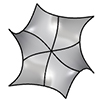
Here is the method I used for approximately modeling the Gyroid, a triply-periodic minimal surface. It is very popular in architecture because the symmetrical solids and voids it generates are interesting. I modeled this for the Common-action Wall project we exhibited together with Fulya Akipek in 2017. After several attempts to generate it in Grasshopper, I decided to model it in Rhino. There are some sources on the internet, explaining the geometric modeling process. However, none of them was giving…
Folding a Truncated Tetrahedron

February 12, 2023

While digging through the lecture archive, I found this video I made in 2017. We introduce Platonic solids and Archimedean solids in the Design Geometry course at Istanbul Bilgi University. This video shows how we can create an Archimedean solid, the Truncated Tetrahedron, by folding it from a flat sheet. While doing this, I intersected the spheres by using the relations between the side lengths of the solid, and I calculated the rotation angles accordingly. First of all, I drew…

Strange Start Startling Stop

November 26, 2022

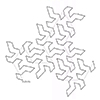
“Strange Start Startling Stop” was designed by Mary Purdy at the State University of New York in 1985. The composition is based on a hexagonal lattice (above figure). There are four prototiles, marking the four key moments in the shape-shifting process. The first prototile is a regular hexagon, which is also the first tile of the composition. This prototile morphs into a shape that is a composition of four smaller hexagons, creating the second prototile. This morphing process finishes at…

Compass only Construction of Bézier Curves

September 2, 2021

This is a new paper published in Nexus Network Journal. I tried to implement euclidean constructions by compass in the approximation of famous parametric curves; Bézier curves, and B-Splines. Then, I created the algorithms to calculate the number of steps on a compass-only construction of Bézier curves. I developed a simple Python script to simulate the geometric constructions. However, I have been studying this topic for nearly four years. In the future, I wish that it would be a good…

Dividing a Line with Compass Only

June 4, 2018

This video shows the method of constructing equal segments on a line by only using compass operations. Here, you can see that there is a pattern in the number of required compass operations. For example, if you need to divide the distance by 3, you need 13 circles (or compass operations). This reveals a simple equation of c = 2 * n + 3 where n is the desired number of segments and c is the number of required compass…

Drawing a Basis Spline with Cubic Bézier Spans

May 1, 2018

I realized this method of constructing basis splines from given control points while searching for a way to teach students about basis splines. I couldn’t find an easy and visual method to create clamped basis splines by connecting simple cubic Bézier spans. It is a tough job and requires lots of complex equations. However, I suddenly realized that there is a special way of doing that. So I decided to share this with the people searching for an easy way…

Common-action Gardens #2

January 8, 2018

It has been nearly 2 years since we designed and produced this garden. Similar to the first version, Common-action Gardens #2 is injected in formal park layouts. We build it for recreation as garden structures with an aim to support the “preserve, sustain, and share” idea. Thus, we expect to bring people together while producing. These gardens organize sustainable models for communal living by integrating raised beds, planting holes, water bowls, compost holes, seedboxes, tool pots, niches for animals, and…

Gosper-Peano Fractal Curves

January 8, 2018

Introducing the new YouTube channel for designcoding! The architectural Geometry playlist will contain video tutorials on several topics of basic geometry exercises for designers. Below are the introductory exercises of polyline drawing and some planar transformations such as scale and rotation. It is also an interesting plane-filling fractal you know I like it very much.

Escher Patterns in the Classroom

August 22, 2017

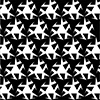
Here is one of the exercises I tested with a few students in Architectural Geometry. The exercise is about creating Escher-like patterns. It is an introductory topic on the designerly utilization of regular tessellations. We use square, hexagonal, or triangular tessellations as underlying structures of complex patterns. Below are some of the student works from this exercise. I think the black-and-white coloring helps in terms of reducing the requirements. Although the patterns designed in this exercise are not Escher patterns,…

Low-Poly Habitat

August 7, 2017

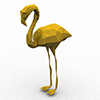
Below is a simple tutorial class we studied in Rhino in 2015 and 2016. The exercise is called “A Low-Poly Habitat”. The aim is to create simple polygon models by analyzing the overall geometric topology of an animal body. First-year design students attended the exercise and they are encouraged to create these models using blueprints from www. They used simple commands such as point, line, and surface from 3 or 4 points and that’s all. Such exercises (hopefully) help them…

« 1 2 3 4 5 6 7 8 9 10 11 »
  • Chapters

    • Algorithms
    • Discourses
    • Fabrications
    • Studios
  • Explore

    • #ice-ray
    • #icosidodecahedron
    • #wave
    • #euclidean-construction
    • #terrain
    • #rammed-earth
    • #polygon
    • #unity
    • #processing
    • #stellated-solid
    • #fractal
    • #dodecahedron
    • #golden-ratio
    • #complex-number
    • #anemone
    • #hotwire-cutting
    • #data-flow
    • #hoopsnake
    • #timer
    • #buckyball
    • All Keywords
    • Table of Contents
    • Monthly Archive
  • Search

  • Patreon

    Support designcoding!

    Enjoying designcoding? Support its future with a small donation on Patreon. Thank you!


    copyright 2026 designcoding.net | about | privacy policy | end user license agreement