
Strange Start Startling Stop
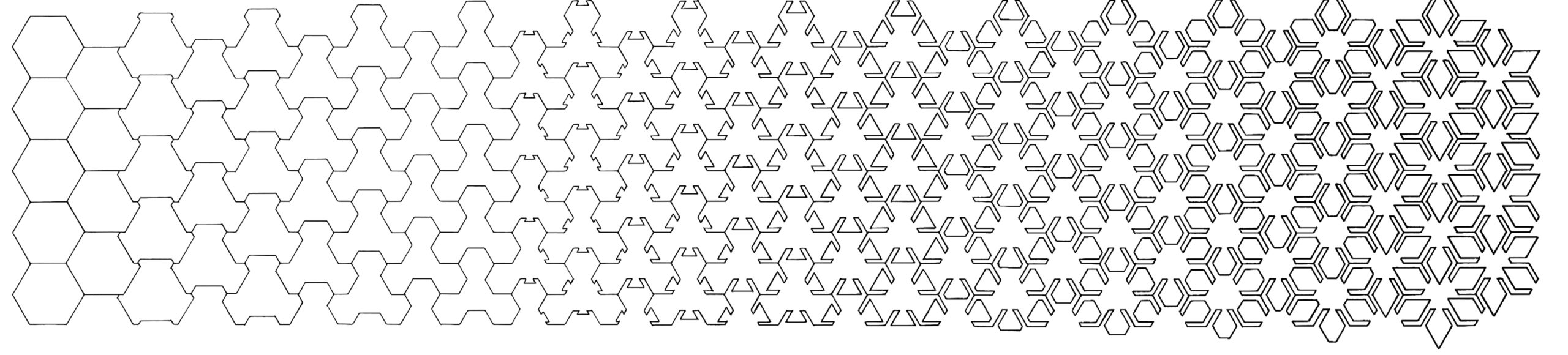
“Strange Start Startling Stop” was designed by Mary Purdy at the State University of New York in 1985. The composition is based on a hexagonal lattice (above figure). There are four prototiles, marking the four key moments in the shape-shifting process. The first prototile is a regular hexagon, which is also the first tile of the composition. This prototile morphs into a shape that is a composition of four smaller hexagons, creating the second prototile. This morphing process finishes at the 9th tile from the left. The third prototile is then, slowly erected by enlarging a portion of every edge. This morphing process finishes at the 17th tile from the left. The fourth and last prototile is a continuation of the previous one. It expands the parts more and creates snowflake-like spikes to finalize the composition.
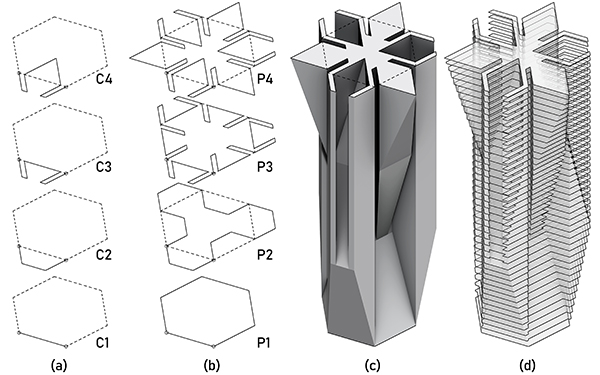
This final prototile expands the edges and changes their directions, and the opposing edges merge into single vertices at the end. We re-created these prototiles by four fundamental curves. You can see the fundamental curves and corresponding prototiles shown in above Figures a and b. The designer would probably think of these four prototiles while designing “Strange Start Startling Stop”. One of the important qualities of Parquet Deformations is that they allow partial deformations on single tiles. In the example, the 10th and 18th tiles from the left show this kind of partial deformation. Therefore, we propose this 3D reconstruction methodology to simulate this behavior. After we define prototiles, we match the vertices to create the lofting operation (above Figure c). Then, the 3D prototile is created by utilizing the p31m symmetry operation. This operation repeats several rotation and reflection transformations to create the closed polyhedron.
You can read the rest of this chapter here.
Cite this post
Related Posts
Deformation of Islamic Patterns
March 2, 2024
This is the new version of my previous study on the deformation of Islamic Patterns. I love the purity and simplicity of the geometric construction processes of these patterns. It is possible to observe them in many places in many different forms. By continuing this work, I aimed to highlight the pattern deformations that map out all the variation possibilities of these patterns. Unlike previous versions, this time I aimed to achieve results ready for laser-cutting production. As you will…
Drawing Lattice Deformation
December 11, 2024
Lattice deformation in parametric design refers to the process of manipulating a grid or mesh structure so that it changes shape in response to specific inputs or parameters. We use this approach widely in computational design for creating complex, organic forms and adaptive systems. Also, lattice deformation can be applied in architectural facades, structural systems, and product design where adaptability and aesthetic fluidity are desired. In this short tutorial video, I am drawing a lattice deformation in the Rhinoceros. It…
Drawing Crosswise Deformation
December 11, 2024
Parquet deformation refers to a transformation technique applied to a grid or tiling pattern, particularly one that resembles traditional parquet flooring, to create visually interesting and dynamic patterns. This concept is used in parametric design to alter repeating geometric tiles, producing effects such as warping, bending, or otherwise deforming the original pattern while maintaining an overall cohesive layout. In this short tutorial video, I am explaining the drawing of Crosswise deformation. This is a beginner-level drawing exercise that utilizes basic…
Pattern Deformations Extended
February 8, 2014
Unlike the classical Pattern Deformations assignment discussed here and here, this time we asked Design Geometry students in 2014 to explore deformations by using referential systems as a secondary space. We wanted them to create variations on a regular pattern only by deforming its underpinning lattice. Below are three examples of this alternative assignment. I’m thinking about improving this exercise to three dimensions, seems possible to implement by using the cage editing commands of Rhino. Selin Işıldar Serra Uludağ Mine Güvenç…
Pattern Deformations Student Works
November 18, 2013
Below is some student works from this year’s Architectural Geometry / Pattern Deformations assignment. Students developed their own pattern deformation sequences mostly on regular tessellations. Based on the classical Parquet Deformation exercise, we tried to implement a rule-based approach in order to explore emergent patterns. The exercise seems to reveal endless improvisation potential. The exercise requires students to design a pattern deformation on a 28cm by 28cm area. It should include at least 100 cells. First, we explained several classical…