
Drawing Lattice Deformation
Lattice deformation in parametric design refers to the process of manipulating a grid or mesh structure so that it changes shape in response to specific inputs or parameters. We use this approach widely in computational design for creating complex, organic forms and adaptive systems. Also, lattice deformation can be applied in architectural facades, structural systems, and product design where adaptability and aesthetic fluidity are desired. In this short tutorial video, I am drawing a lattice deformation in the Rhinoceros. It is based on beginner-level commands and procedures. However, the result is a good example of using referential lattices as the basis of the more complex tessellations.
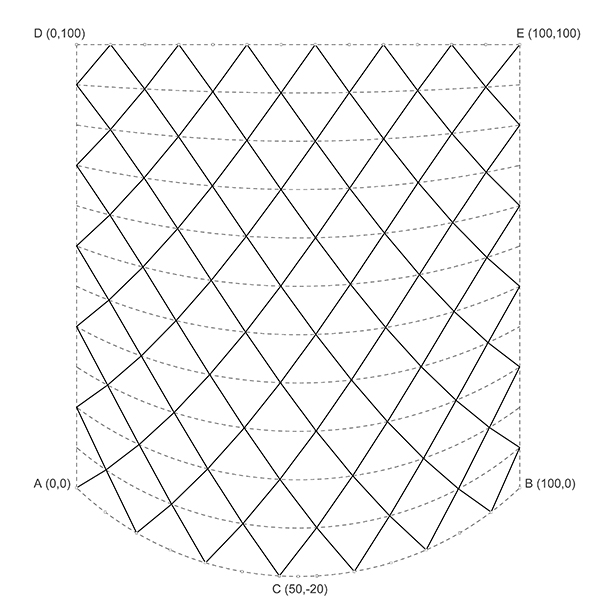
In this video series, I present a variety of in-class exercises from my first-year Architectural Geometry course. Using Rhinoceros software, we delve into Euclidean constructions, basic drawing and transformation commands, introductory fractals, regular and semi-regular tessellations, patterns, modeling, and unrolling polyhedra. These concise drawing exercises are beneficial for junior architects, interior designers, industrial designers, and enthusiasts from other disciplines. I’ll be sharing exercises each week on my blog and other platforms. Here is the exercise: Drawing the Lattice Deformation.
The software used in this course is Rhinoceros 3d (www.rhino3d.com). However, if you want to find out more and see the whole list of this video series, you can check my YouTube channel at www.youtube.com/@designcodingnet. The music of this video is ‘In Search Of Solitude’ by Scott Buckley (CC-BY 4.0). www.scottbuckley.com.au
Cite this post
Related Posts
Drawing Crosswise Deformation
December 11, 2024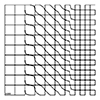
Parquet deformation refers to a transformation technique applied to a grid or tiling pattern, particularly one that resembles traditional parquet flooring, to create visually interesting and dynamic patterns. This concept is used in parametric design to alter repeating geometric tiles, producing effects such as warping, bending, or otherwise deforming the original pattern while maintaining an overall cohesive layout. In this short tutorial video, I am explaining the drawing of Crosswise deformation. This is a beginner-level drawing exercise that utilizes basic…
Deformation of Islamic Patterns
March 2, 2024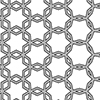
This is the new version of my previous study on the deformation of Islamic Patterns. I love the purity and simplicity of the geometric construction processes of these patterns. It is possible to observe them in many places in many different forms. By continuing this work, I aimed to highlight the pattern deformations that map out all the variation possibilities of these patterns. Unlike previous versions, this time I aimed to achieve results ready for laser-cutting production. As you will…
Pattern Deformations Extended
February 8, 2014
Unlike the classical Pattern Deformations assignment discussed here and here, this time we asked Design Geometry students in 2014 to explore deformations by using referential systems as a secondary space. We wanted them to create variations on a regular pattern only by deforming its underpinning lattice. Below are three examples of this alternative assignment. I’m thinking about improving this exercise to three dimensions, seems possible to implement by using the cage editing commands of Rhino. Selin Işıldar Serra Uludağ Mine Güvenç…
Pattern Deformations Student Works
November 18, 2013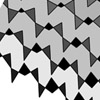
Below is some student works from this year’s Architectural Geometry / Pattern Deformations assignment. Students developed their own pattern deformation sequences mostly on regular tessellations. Based on the classical Parquet Deformation exercise, we tried to implement a rule-based approach in order to explore emergent patterns. The exercise seems to reveal endless improvisation potential. The exercise requires students to design a pattern deformation on a 28cm by 28cm area. It should include at least 100 cells. First, we explained several classical…
3D Pattern Deformation
December 12, 2012
These are examples of 2.5D exercises in the design geometry course in my freshman year of architecture. We asked students to create extruded or referenced solids referenced from their previous exercise of pattern deformations, (examples are here and here). We also started to inject some of the most used concepts of design computing here, by perceiving each tessellation cell as the variation of a predefined algorithm, such as a relationship with an attractor object (a distance value with a point)….