
Pattern Deformations Extended
Unlike the classical Pattern Deformations assignment discussed here and here, this time we asked Design Geometry students in 2014 to explore deformations by using referential systems as a secondary space. We wanted them to create variations on a regular pattern only by deforming its underpinning lattice. Below are three examples of this alternative assignment. I’m thinking about improving this exercise to three dimensions, seems possible to implement by using the cage editing commands of Rhino.
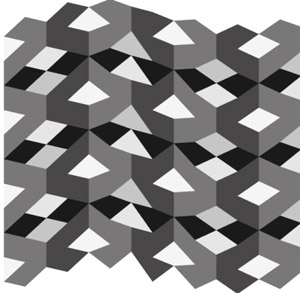
Selin Işıldar
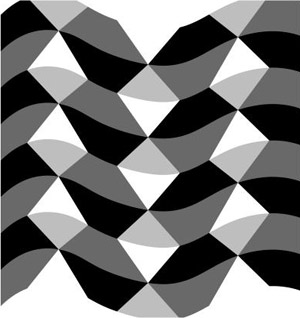
Serra Uludağ
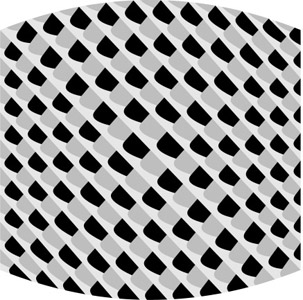
Mine Güvenç
The exercises such as Pattern Deformations make it easy for students to learn to use the CAD tool. At the same time, they introduce the mentality of geometric systems into this training. Therefore, it is becoming a significant research topic to introduce students of architecture to systems thinking. This can be done in the form of patterns and their deformations. Zaera-Polo (2019) depicts, the history of pattern studies in architecture, emphasizing a conceptual shift in the “Computational Design Era”. This conceptual shift can be explained by the development of digital design technology. That is “making it possible to process multiple layers of patterns such as social, economical, cultural, formal, etc., and their deformations simultaneously with desired precision” (Oxman and Oxman, 2019).
The integration of these exercises with the interdisciplinary roles of the architect continues to be one of the issues of every curriculum, studio, and instructor. Thus, it is an open question of how future design studios will take over this issue. Especially from the point left by William Huff and the Parquet Deformation.
Alejandro Zaera-Polo, “Patterns, Fabrics, Prototypes, Tessellations”, Architectural Design 79, Wiley (United Kingdom, 2009): pp. 18-27.
Rivka Oxman and Robert Oxman, “The New Structuralism: Design, Engineering, and Architectural Technologies”, Architectural Design 206, Wiley (United Kingdom, 2019): pp. 15-24.
Cite this post
Related Posts
Drawing Lattice Deformation
December 11, 2024
Lattice deformation in parametric design refers to the process of manipulating a grid or mesh structure so that it changes shape in response to specific inputs or parameters. We use this approach widely in computational design for creating complex, organic forms and adaptive systems. Also, lattice deformation can be applied in architectural facades, structural systems, and product design where adaptability and aesthetic fluidity are desired. In this short tutorial video, I am drawing a lattice deformation in the Rhinoceros. It…
Drawing Crosswise Deformation
December 11, 2024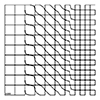
Parquet deformation refers to a transformation technique applied to a grid or tiling pattern, particularly one that resembles traditional parquet flooring, to create visually interesting and dynamic patterns. This concept is used in parametric design to alter repeating geometric tiles, producing effects such as warping, bending, or otherwise deforming the original pattern while maintaining an overall cohesive layout. In this short tutorial video, I am explaining the drawing of Crosswise deformation. This is a beginner-level drawing exercise that utilizes basic…
Pattern Deformations Student Works
November 18, 2013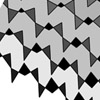
Below is some student works from this year’s Architectural Geometry / Pattern Deformations assignment. Students developed their own pattern deformation sequences mostly on regular tessellations. Based on the classical Parquet Deformation exercise, we tried to implement a rule-based approach in order to explore emergent patterns. The exercise seems to reveal endless improvisation potential. The exercise requires students to design a pattern deformation on a 28cm by 28cm area. It should include at least 100 cells. First, we explained several classical…
3D Pattern Deformation
December 12, 2012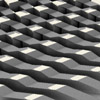
These are examples of 2.5D exercises in the design geometry course in my freshman year of architecture. We asked students to create extruded or referenced solids referenced from their previous exercise of pattern deformations, (examples are here and here). We also started to inject some of the most used concepts of design computing here, by perceiving each tessellation cell as the variation of a predefined algorithm, such as a relationship with an attractor object (a distance value with a point)….
Pattern Deformations Exercise
November 17, 2012
Last week, the first-year architectural geometry course was about pattern deformations. Students are expected to familiarize themselves with 2d drawing, transformation, and control point editing commands while trying to design a deformation. After studying regular and semi-regular tessellations of the plane, they are expected to develop reasoning on the rule-based and iterative processes. This also constructed an underpinning for Basic Design’s “Metamorphosis” study, where they have discussed more conceptual frameworks derived from such systems. Below are some of the results…