
Dividing a Line with Compass Only
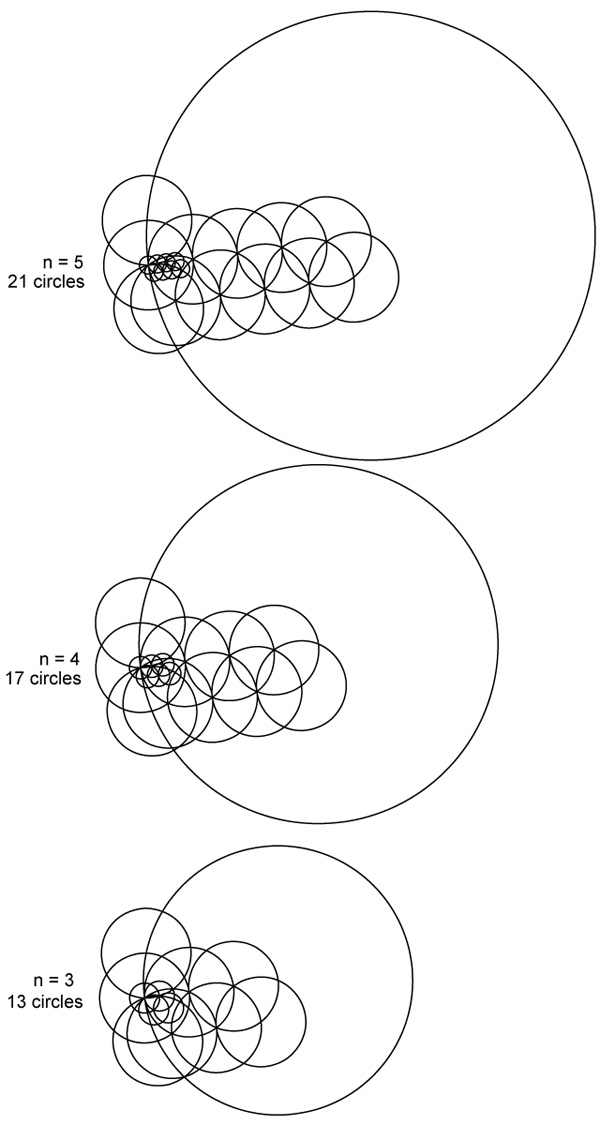
While working on an article today, I wanted to share a method I used. What ancient geometry achieved with just a compass and a straightedge is truly amazing. I’m going to show you how you can use a compass to divide a line into any number of equal parts. This video shows the method of constructing equal segments on a line by only using compass operations. Here, you can see that there is a pattern in the number of required compass operations. For example, if you need to divide the distance by 3, you need 13 circles (or compass operations). This reveals a simple equation of
c = 2 * n + 3Here, n is the desired number of segments and c is the number of required compass operations. Today, I learnt that these kind of compass-only constructions are also called Mohr-Mascheroni constructions. Because in 1797, Mascheroni (after Mohr) proved that all compass-straightedge (Euclidean or geometric) constructions are possible with a compass only.
Cite this post
Related Posts
Constructing Irregular Tiling
December 11, 2024
Using a compass and straightedge enables precise geometric constructions, allowing for the creation of complex tessellations. To begin these constructions, a single starting point is sufficient. Circles, which represent a collection of points at a specific distance from the center, and straight lines, which represent a collection of points in a particular direction, are utilized for geometric constructions. In this short tutorial, we move on with the beginner-level drawing exercises. This time, I am drawing an irregular tiling with triangles…
Constructing Snub Square Tiling
December 11, 2024
Snub Square Tiling is a semi-regular tessellation of the plane, composed of two squares and three regular triangles at each vertex. The arrangement of these two regular shapes seamlessly covers the plane without any gaps or overlaps. It is one of the eight semi-regular tessellations known in geometry. The dual of Snub Square Tiling is Cairo Pentagonal Tiling, which we will explore later. In this short tutorial, I am drawing and constructing the Snub Square Tiling by using an abstract…
Drawing Koch Pentagon
December 11, 2024
The Koch pentagon is a fractal shape that starts with a regular pentagon. Here, we divide each side of the pentagon into three equal parts. Then, we replace the middle with two sides of an outward-pointing equilateral triangle. We repeat this process for every new side in each iteration, creating a self-similar pattern. Helge von Koch (1870–1924) was a Swedish mathematician known for his analysis and number theory work. He is most famous for introducing the Koch snowflake, one of…
Constructing Tangent Circles
December 11, 2024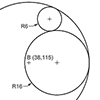
In geometry, “tangent” refers to a scenario where a line, curve, or surface touches another at exactly one point without crossing or leaving a gap. A tangent line to a circle is a straight line that touches the circle at only one point, and it is perpendicular to the radius at that point. Two circles can be tangent either internally or externally. Geometric constructions using a compass and straightedge can help accurately calculate tangent circles. Thus, the “constructing tangent circles”…
Constructing Irregular Polygons
December 11, 2024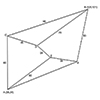
The geometric shapes constructed using only a compass and straightedge have significantly influenced the development of reasoning and logic that underpin modern science. This non-numerical approach is also known as the Synthetic Geometry. Before René Descartes introduced Analytic Geometry, this method was widely studied and practiced. In “Elements”, Euclid explores fundamental rules, such as ‘The straight line between two points is the shortest,’ and derives all geometric truths from simple, observable principles, built up step by step through logical deduction….