designcoding
About Table of Contents Keywords
Support designcoding!

#rhinoceros

104 posts

Drawing Herschels Enneahedron

July 26, 2017
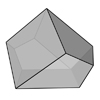
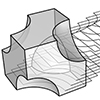
Exercising the “folding” process of a nine-faced solid. Start from its net, and analyze the matching edges. Then, use sphere intersections to calculate the rotation angles. Visit here for more information about this solid: http://aperiodical.com/2013/10/an-enneahedron-for-herschel/

Gaudi Column Macro

March 7, 2015

Gaudi-like columns are generated as part of the “boolean” classes of Design Computing. The most inspiring, beautiful, and ugly variations are often done by boolean intersection, as this operation is the surprising one of the three brothers. While the class deals with the concept of emergence once again via solid and void relationships, constructive solid modeling techniques are introduced. Although it is widely used as a spatial analysis approach in architecture, there are some examples of using boolean algebra in…

Shear Magic

March 7, 2015

This video is dedicated to Design Computing and Basic Design students, who “contour” and then move each section by hand in Rhino. They do it individually to fabricate their laser-cut homework from cardboard. It could also be a macro but I prefer this. Because it does not work in all conditions. Maybe you should orient your contouring results similar to those shown in the video, and then use the shear command to spread them. I called this method “shear magic”. Let’s…

Design Geometry Final Works

February 2, 2015

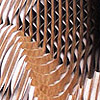
Classical folding methods were subjects to be tested and studied in this semester’s design geometry classes. This has been very useful in introducing first-year students to 3d euclidean constructions and using physical objects as references to a digital model. Groups of students studied different folding methods and made both physical and digital models. Two of these methods were dominant in the class however, one of them was the variations of Miura-Ori, and the other one was Ron Resch’s famous folding pattern. Below…

A Text Effect

January 2, 2015

This is a macro exercise in Rhino, showing that Rhino is pretty much capable of automating some cool text effects. Just copy and paste the below code into the command bar of the Rhino, or open the macro editor by typing macro edit, then paste it there and press play. You’ll enter any string when prompted, then the macro handles the rest of the process. You can play with the parameters by changing the numeric values you see in the…

Waffle Macro

May 7, 2014

Here are two macros that automate some of the classical structural styles in today’s architectural geometry. They could be developed more to include joint details, however. It is a relaxing experience to study macros when the process doesn’t have algorithmic expressions (such as recursion, iteration, or conditionals). It is today’s subject in the first-year design computing course at İBU. The first one requires at least two curves already present in order to define a lofted surface (to be “waffled”): ! ;…

Contouring Student Works

April 7, 2014

Design Computing classes conducted a “voluntary” assignment; a “contouring” fabrication, that outputs physical prototypes of the previous parametric wall assignment. They worked very well with the corrugated cardboard in fact and extended the simple contouring exercise in Rhinoceros into a design study of patterning and transparency. It seems that corrugated cardboard is a perfect material to study the shift from digital to the material. Below are some of the student works that study various angles of contouring on different seamless surface…

Modeling a Baldequin

March 18, 2014

It is Baldequin (or Baldachin) in English, Baldeken, or Baldöken in Turkish. I don’t know which one is correct, but it is the name of a structural system of arches and pendentives that carry a dome. Sinan experimented with square, hexagonal, and octagonal variations in his mosque designs (as I developed parametric definitions of them in my 2003 master thesis (here)). Today, together with students we’ve modeled the system and tried to generate some variations by manipulating its parameters. Below…

Some more Patterns

February 16, 2014

While preparing the Geometry yearbook, I picked these four patterns from the 4th week’s assignment, “Seamless Patterns”. I still love to see how these patterns are generated by students with very limited knowledge of computers and geometry. There are other posts about this assignment here and here. Below are four from this semester; Ceren Atik Zeynep Dutipek Ceren Atik Meltem Bayrak

Pattern Deformations Extended

February 8, 2014

Unlike the classical Pattern Deformations assignment discussed here and here, this time we asked Design Geometry students in 2014 to explore deformations by using referential systems as a secondary space. We wanted them to create variations on a regular pattern only by deforming its underpinning lattice. Below are three examples of this alternative assignment. I’m thinking about improving this exercise to three dimensions, seems possible to implement by using the cage editing commands of Rhino. Selin Işıldar Serra Uludağ Mine Güvenç…

« 1 2 3 4 5 6 7 8 9 10 11 »
  • Chapters

    • Algorithms
    • Discourses
    • Fabrications
    • Studios
  • Explore

    • #text
    • #mosque
    • #space-syntax
    • #cube
    • #regulations
    • #octahedron
    • #revit
    • #cuboctahedron
    • #buckminster-fuller
    • #unity
    • #macro
    • #permaculture
    • #interlocking
    • #paneling
    • #dodecahedron
    • #curvature
    • #simulation
    • #robot-tool
    • #hotwire-cutting
    • #rubber
    • All Keywords
    • Table of Contents
    • Monthly Archive
  • Search

  • Patreon

    Support designcoding!

    Enjoying designcoding? Support its future with a small donation on Patreon. Thank you!


    copyright 2026 designcoding.net | about | privacy policy | end user license agreement