
Shear Magic
This video is dedicated to Design Computing and Basic Design students, who “contour” and then move each section by hand in Rhino. They do it individually to fabricate their laser-cut homework from cardboard. It could also be a macro but I prefer this. Because it does not work in all conditions. Maybe you should orient your contouring results similar to those shown in the video, and then use the shear command to spread them. I called this method “shear magic”. Let’s watch it below:
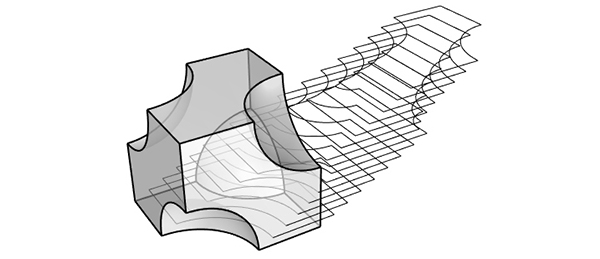
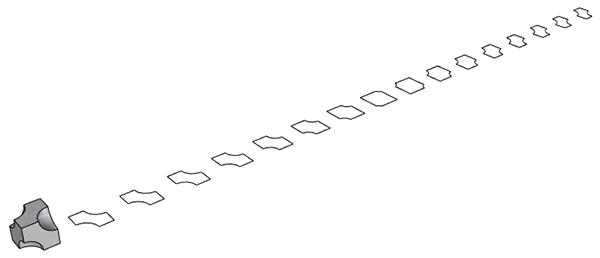
You can see an example of the process above. First, we create the contour curves by using the Contour command of Rhino. You can define the contour plane, direction, and the distance between the contours as the options of this command. Then, we jump to any side view. You can hit CTRL+F2 to do this quickly. After that, while the contour curves are still selected, we run the “Shear” command. We set the “Rigid” option to “Yes”. Then, I choose any bottom corner of the shape as the origin point. While you drag the mouse, you will see that the curves will spread. Although this may deform the curves, it looks like it is not deforming them due to the Rigid=Yes option. After you have enough space between the curves, still selected, run the “ProjectToCplane” command, type “y” into the delete option, and hit enter. You will see that you separated and aligned the curves to Z=0.
Cite this post
Related Posts
Terrain Modeling
July 19, 2023
Here is a short tutorial on getting help from Grasshopper in physical terrain modeling. It is a classical architectural terrain modeling process. Let’s see how Grasshopper can help us with this. Part 1: Terrain modeling for Laser cutter The terrain model entered in the Brep data store in this application is a closed/solid model. For now, you can also use ready-made components such as Cone or Sphere (Sph) to quickly produce a solid model. In this application, after we obtained…
Site Modeling
March 26, 2015
Site models could be calculated for laser cutting easily using Grasshopper’s native components. This definition was a practical one we created in the Parametric Modeling course to see that Grasshopper could also be utilized to prepare fabrication documents not generating design outcomes. However, this definition is a draft one and could be improved more by putting labels inside of each cut piece, trimming the edges properly and so on. It is good news for students at least that they have a…
Contouring Student Works
April 7, 2014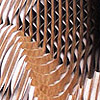
Design Computing classes conducted a “voluntary” assignment; a “contouring” fabrication, that outputs physical prototypes of the previous parametric wall assignment. They worked very well with the corrugated cardboard in fact and extended the simple contouring exercise in Rhinoceros into a design study of patterning and transparency. It seems that corrugated cardboard is a perfect material to study the shift from digital to the material. Below are some of the student works that study various angles of contouring on different seamless surface…
Spacebound
September 24, 2026
Let’s take a closer look at the midterm jury assignment for our “Field & Matter”- themed Computation-based Basic Design 2 studio, which I conducted last year alongside Serkan Uysal, İpek Kuran, and Sinan Logie. I shared the studio’s final project, Earthbound, in a previous post. In this post, we will focus on our process-oriented midterm project named Spacebound. Topography as a Data Field In this first major phase of the “Field & Matter” studio, we examined how moving and stationary…
Common-action Gardens #2
January 8, 2018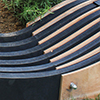
It has been nearly 2 years since we designed and produced this garden. Similar to the first version, Common-action Gardens #2 is injected in formal park layouts. We build it for recreation as garden structures with an aim to support the “preserve, sustain, and share” idea. Thus, we expect to bring people together while producing. These gardens organize sustainable models for communal living by integrating raised beds, planting holes, water bowls, compost holes, seedboxes, tool pots, niches for animals, and…