designcoding
About Table of Contents Keywords Monthly Archive
Support designcoding!

Algorithms

259 posts

Display Method for Vector Class

August 17, 2021

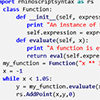
Let’s continue from the Vector class that started yesterday. Previously, I defined this class to store three numbers (coordinates), named as “components”. I defined a method named __init__ for this. Similarly, I am adding a display method to the Vector class today. Note that I am using Rhino 6 in this code, but it should also work in Rhino 5 or 7. The code Below is the line-by-line explanation of the method: Line Explanation 1-4 Already explained before. 5 Start…

Vector Class in Rhino Python

August 16, 2021

In this new series, I will be using Rhino Python to create some of the fundamental mathematical objects in Rhino. We will learn how to code in Python, and also try to get deeper into the intuition behind some of the fundamental concepts we use every day in Rhino and Grasshopper. The Vector class in Rhino Python is the starting point of this journey. Just like vectors, most of the topics are already built-in object classes in RhinoPython. But I…

Inverse Kinematics in Rhino Python

May 22, 2019

This is a simple inverse kinematics solution developed by Andreas Aristidou and Joan Lasenby in 2011. They call it Forwards and Backwards Reaching Inverse Kinematics (FABRIK in short). It was quite interesting the learn this technique because it is a fast and accurate approximation of a kinematic chain. There are very interesting potentials of this technique in terms of architectural simulations. I tried to develop a Rhino Python script in Rhino 6. It seems to be working properly. Here is…

The Golden Ratio in Grasshopper

April 12, 2019

I like to deal with possible small computational geometry problems. These fun games are taking 2-3 hours. In addition, these are also memorable exercises. I was reviewing the Anemone plugin last week. I noticed that the Golden Ratio in Grasshopper was not geometrically generated before. Some of the greatest mathematical minds of all ages, from Pythagoras and Euclid in ancient Greece, through the medieval Italian mathematician Leonardo of Pisa and the Renaissance astronomer Johannes Kepler, to present-day scientific figures such as Oxford physicist Roger Penrose, have spent endless hours…

Cubic Bézier Curve with Rhino Python

April 30, 2018

Below is the Python code you can run in Rhino, that draws a cubic Bézier curve (degree 3). As you can see, the Rhino Python code is very slow and inefficient because we calculate every point with lots of computations. Instead, we can use the spline formulae to make this quicker but I wanted to show that the mathematical construction is parallel to the geometric one. This is a nested set of linear interpolations. In fact, the linterp function in…

Rumi Improvizations

April 30, 2018

In this short study, I generated Rumi Improvizations. The rumi motif, prevalent in traditional Turkish decorative arts like tilings, window lattices, and fabrics, features a round shape with a comma-like body. Despite resembling stylized leaves, rumis have zoomorphic origins. Rumi compositions depicted stylized animal figures, including birds, lions, deer, fish, and mythical creatures like dragons and Simurg. They symbolized strength, fertility, and the eternal struggle between good and evil. The oldest rumî-like animal shapes were discovered on rugs found in…

Derivative and Slope

April 6, 2018

Yes, interesting topics started to reveal themselves, when I dig into the function curves, especially in the parametric representation. The first interesting application is the “derivative”. Nobody in high school told me that the derivative of a function at a given point gives the slope of the graph at that point. Moreover, it is possible to convert the slope value into an angle in degrees, showing the angle of the tangent line to the x-axis at that point. They are…

Graph of Parametric Functions

April 6, 2018

This RhinoPython script handles the simple graphs of two-dimensional parametric functions. Therefore, it approximates these functions by drawing parametric curves. It generates many points by solving the functions. The graph of parametric functions is a major topic in most Design Mathematics courses. Because it looks like the building block of many concepts of CAD. However, there is much more to learn before saying that the third degree NURBS is a degree-3 polynomial function. I am curious about learning the underlying…

Gosper-Peano Fractal Curves

January 8, 2018

Introducing the new YouTube channel for designcoding! The architectural Geometry playlist will contain video tutorials on several topics of basic geometry exercises for designers. Below are the introductory exercises of polyline drawing and some planar transformations such as scale and rotation. It is also an interesting plane-filling fractal you know I like it very much. I studied this particula fractal (Gosper-Peano) earlier here, and here. I find it very inspiring and educational.

Parametric Wall Revisited

August 20, 2017

This exercise was a popular one in the 2015 and 2016 Architectural Geometry classes. Recently, I found these images of student works. However, some of the students’ names are missing (please e-mail me if one of them is yours). I love this exercise because it is a quick and efficient way of explaining and experimenting with the workflow of digital to physical production. In this particular exercise, students created Rhino Macro codes to develop these 3d pattern deformations. It is…

« 1 2 3 4 5 6 7 8 9 10 11 12 13 14 15 16 17 18 19 20 … 24 25 26 »
  • Chapters

    • Algorithms
    • Discourses
    • Fabrications
    • Studios
  • Explore

    • All Keywords
    • Table of Contents
    • Monthly Archive
    • #music
    • #graph-mapper
    • #tiling
    • #paper
    • #growth
    • #regulations
    • #optimization
    • #rhombicosidodecahedron
    • #simulation
    • #tangent
    • #unity
    • #relief
    • #kangaroo
    • #metaball
    • #tetrahedron
    • #hyperbolic-paraboloid
    • #hoopsnake
    • #linear-algebra
    • #cycloid
    • #shape-grammars
  • Search

  • Support designcoding!

  • Enjoying designcoding? Support me on Patreon to keep it growing. Thank you!

  • copyright 2026 designcoding.net | about | privacy policy | end user license agreement