designcoding
About Table of Contents Keywords Monthly Archive
Support designcoding!

Algorithms

259 posts

Trifoliolate

April 30, 2013

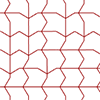
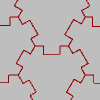
The Parquet Deformation exercise is generally originated with William Huff. Huff conducted it at several schools of architecture since the 1960s. Huff defines the exercise as rooted in two analytical disciplines; monohedral tilings in geometry, and the continuous deformations in biological morphology. This is generally exemplified by D’Arcy Thompson’s and Albrecht Dürer’s studies. One of the student’s works of Huff, Trifoliolate is a single-axis, single-prototile hexagonal parquet deformation. It was designed by Glen Paris at the studio of William Huff…

Force Fields

April 26, 2013

I’ve seen beautiful examples of similar compositions made using vector field components in Grasshopper. I just tried to make my own animate field lines to see how they float over force dynamics. In essence, these compositions could also be done using regular vector components but the field components make life much easier by merging different forces together rather quickly. As you see below, it is a quite small definition that creates beautiful complexity. Although we know every single parameter of a…

Macroforming WFC Shanghai

April 19, 2013

WFC Shangai is a design exercise in our first-year Design Computing class introduced by Onur Yüce Gün. This exercise emphasizes both analytical thinking and associative geometry and aims to utilize boolean operations as solid and void references in creating forms. We asked students to develop variations of this building. In order to discuss this formation in class, I studied a simple algorithm to test variations in real-time. The initial shape, developed by a boolean intersection of a rectangular prism and…

Parametric Wall Exercise

April 19, 2013

This is a first-year design computing problem we studied last month. It is a simple parametric wall exercise introduced by Mete Tüneri. Creating a simple definition of a building brick to be placed on a straight path, and then manipulating the path to reform different variations of the brick. This aims to introduce a fundamental concept of associativity in contemporary architectural geometry and design computing. Students are then encouraged to develop their own parametric brick to be tested in different…

Binary Branching using Macro

April 15, 2013

Today’s design computing class was about fractals. In Rhino, writing macro statements are very easy to learn as it just mimics your behaviors in a sequential text. There are a few syntactic rules that we should know. First, you should watch the command line carefully to understand the steps of your design process. Each command in Rhino requires different inputs from the user. In macro, you may enter these values or tell the macro to ask the user by typing…

Maxscript Table

March 20, 2013

Maxscipt can be used to automate specific modeling tasks in a sequential-parametric way. This example, developed in 2005 shows an example of that. It creates various table designs by polygon modeling operations and asks the user various parameters. Below is the interface of the script; There are preset parameters in a dropdown box, and all other available parameters are organized in rollouts. Here are some default results of the script. It is not as fast and smart as the Grasshopper…

Truchet Tiling

March 13, 2013

This elegant and straightforward tiling geometry is credited to Dominican priest Sebastien Truchet in 1704 and was documented in a book titled “Memoir sur les Combinasions” (A Memoir on Combinations). After delving into the renowned Truchet Patterns in 2013, I revisited their three-dimensional tiling counterparts today. This served as a valuable exercise in geometry during my previous Design Geometry course. I believe it enhances one’s proficiency in mastering the technical aspects of Rhino software and in creating seamless tilings through…

Snub Square Surface

February 20, 2013

For the last 10 days, I’ve been searching for a proper algorithm for representing surfaces using planar shapes. It is obvious that triangulation is an answer but there is an interesting research topic of planar remeshing using shapes other than quads, hexagons, or any other regular polygons. Especially in computer graphics, such things refer to the optimization of models to decrease the load of GPUs. In the Grasshopper community, this has also been discussed and there is a great implementation…

Minimal Parquet Deformations

January 28, 2013

Is it possible to model a two-way parquet deformation using only native components of Grasshopper? In this definition, I limited myself to 10 of them. Parquet deformations are a very interesting and pedagogical topic to teach some of the basics of contemporary parametric modeling. This post explains a minimal parquet deformations algorithm in Grasshopper. However, this has its own limitations. You will see that the definition generates the attractor graph curve. Because the graph input tool creates the magic here….

Breaststroke Surface Revisited

January 24, 2013

Previous studies on trigonometric surface equations showed me an interesting alternative. This is the modification of the breaststroke surface definition. This time, I’m trying to fix the equation and change input values in a fashion that the waves of the surface are not symmetrical. Here are a few experiments on it; (Size, 44.8, X=10, Y=5, animating X’s from 0 to 32) (Size: 42, X=7, Y=5, animating X’s from 0 to 32) The equation is (cos(y²) – sin((x/5)-y²)) * 10. This…

« 1 2 3 … 7 8 9 10 11 12 13 14 15 16 17 18 19 20 21 22 23 24 25 26 »
  • Chapters

    • Algorithms
    • Discourses
    • Fabrications
    • Studios
  • Explore

    • All Keywords
    • Table of Contents
    • Monthly Archive
    • #spiral
    • #music
    • #stone
    • #data-flow
    • #folding
    • #arduino
    • #simulation
    • #unity
    • #weaire-phelan
    • #truchet
    • #octahedron
    • #frege
    • #firefly
    • #dürer
    • #maxscript
    • #eps-foam
    • #wave
    • #sphere
    • #grid
    • #computational-geometry
  • Search

  • Support designcoding!

  • Enjoying designcoding? Support me on Patreon to keep it growing. Thank you!

  • copyright 2026 designcoding.net | about | privacy policy | end user license agreement