designcoding
About Table of Contents Keywords Monthly Archive
Support designcoding!

Algorithms

263 posts

I at the Center

September 30, 2013

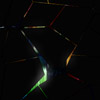
I at the Center is a multiple-axes vertex deformation based on a quadrangular hyperframe, designed by David Oleson at the studio of William Huff in 1964. Below, you see the original drawing and my Grasshopper animation based on a single-point attractor, creating the “I” wherever it is. It was a pleasure to read and repeat this deformation, which is a nice exercise in data tree operations and also one of the first examples I see about point attractor algorithms in design…

Manage Rhino Viewport in Grasshopper

September 13, 2013

This simple vb.net component controls the Rhino viewport background without a need to enter its options panel. It is used to change the viewport background color and grid visibility quickly within Grasshopper. Here is the definition file: [GHX: 0.9.0056]. In order to be able to return to default settings, I put a “default” toggle. Just click on it to “false” state, then the Rhino background color can be changed by the B input. This component also handles the grid. However I…

Testing Spatial Deformation

September 13, 2013

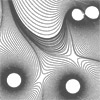
Instead of searching for an iterated and rule-based variety, this method captures instances of spatial deformation by transforming the hyperframe. This liberates us from a classical understanding of pattern deformations that are enframed within regular polygons, mostly rectangles or hexagons. Grasshopper has a built-in component to study such variety. The spatial Deform component gets vectors as inputs and transforms any given geometric object according to it. This website has also another nice use of this component.

Fracture

September 2, 2013

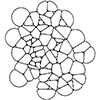
Fracture is a simple effect experiment on Grasshopper. Although it is not the best tool for an interactive media installation regarding its performance, I tried to use it as a simple sketching tool for concept development. It is the sketch of a material system we are working on nowadays for an Exhibition. The initial diagram of Grasshopper includes a nested Voronoi subdivision broken by moving attractor points. It is not fast enough for a real-time interaction yet, because of the…

Detecting Closed Shapes

August 26, 2013

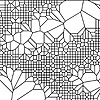
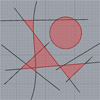
Again, I continue with some simple solutions for Grasshopper. The surface split component gives all possible surfaces sliced with given curves. And it creates “invalid” curves with at least one open edge. I used this to perceive the closed regions within a given complex curve set. Just put the “Clean” component to erase the outer invalid surfaces and there remain the closed ones. However this time the question was where to put the circle and what its radius of it…

Detecting Inner Regions in Grasshopper

August 26, 2013

This is a simple trick that shows the utilization of the “surface split” component in Grasshopper. It is used for detecting the inner regions of any given two-dimensional linework. Thus, it resembles the hatch boundary detection of AutoCAD and similar software. There is no built-in hatch component in Grasshopper. But maybe you can use this as a starting point if you want to develop it. The definition starts with drawing a circle around a point large enough. The size of…

Curve Farthest Point

August 26, 2013

Today’s tip is about two-dimensional curve-point calculations. It is very handy to use “closest point” components in Grasshopper. You can calculate distances and directions between curves, surfaces, and points. Then, place point objects in relation to the proximity of another object. However, there is no “farthest point” implemented yet. I tried to calculate the farthest point from a curve. First, I tried to translate the curve in a fashion that would result in the opposite of the closest point calculation….

Crossover Parquet Deformation

August 20, 2013

It has been a while since I didn’t post any patterns. Here is a beautiful one from the iconic design studio of William Huff. Crossover Parquet Deformation is a single-axis, line-based deformation algorithm, constructed on a regular quadrangular hyperframe, designed by Richard Lane at the Basic Design studio of William Huff in 1963. It presents two different parquet deformation sequences linked together. Thus, the designer created a transition between the borders and inner cross-shapes gradually. This transition is visually smooth…

Revisiting RhinoScript

July 19, 2013

Recently, I returned to old fashion RhinoScripts in order to recapture its idea and functionalities again. After almost 10 years, this is my first experiment on creating a custom function that draws hexagonal grids. I tried to implement a fast process for it, however, there could be much faster ones. This script focuses on using functions, variables, and object arrays. I’ll continue to make more of these simple exercises and revisit some of the older studies on this blog page…

Delaunay Exercise

June 28, 2013

After becoming a ready-made component in Grasshopper, the Delaunay triangulation lost its popularity quickly. It used to be a nice problem of computational geometry for designers obsessed with scripting.  Last month, Benay reminded me of the method of circle checking. She showed her Rhinoscript that creates circles from point triplets and checks if a point is inside or not. Today I studied this in Grasshopper to see if I can handle the required point combinations quickly. However, my first attempt…

« 1 2 3 … 6 7 8 9 10 11 12 13 14 15 16 17 18 19 20 21 22 23 24 25 26 27 »
  • Chapters

    • Algorithms
    • Discourses
    • Fabrications
    • Studios
  • Explore

    • All Keywords
    • Table of Contents
    • Monthly Archive
    • #voronoi
    • #dürer
    • #eps-foam
    • #grid
    • #icosidodecahedron
    • #icosahedron
    • #cuboctahedron
    • #philosophy-of-language
    • #geodesic
    • #solar-analysis
    • #rhombicosidodecahedron
    • #kuka-prc
    • #snub-square
    • #minimal-surface
    • #dual
    • #regulations
    • #paneling
    • #stellated-solid
    • #semi-regular
    • #mosque
  • Search

  • Support designcoding!

  • Enjoying designcoding? Support me on Patreon to keep it growing. Thank you!

  • copyright 2026 designcoding.net | about | privacy policy | end user license agreement