designcoding
About Table of Contents Keywords Monthly Archive
Support designcoding!

Algorithms

263 posts

Basic Curve Attractor

January 31, 2012

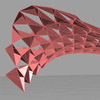
This study includes three main topics related to the basics of Grasshopper. The first one is the surface subdivision, the parametric definition of a surface component, that is, in this case, a simple pyramidal object. The second thing is the associative behavior of surface components with an external parameter, that is another entity in space; a curve. Traditionally, this is simply demonstrated by The important thing here is to find a method to compare each object (here it is the…

Interlocking Structure Between Two Surfaces

January 29, 2012

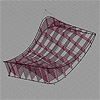
A previous work showed a method to create interlocking structures to be created without boolean operations. This time, a small addition is made to create waffle objects using two surfaces, one is the top surface, and the other is the bottom. It was a small modification at the beginning; to replace the “extrude” component with an “edge surface” component. But the interlocking details are now different at each intersection, so another modification is made to the drawing of the rectangles….

Graph Waves with Attractor Geodesic

January 25, 2012

The regular component design technique can be further improved by adding several manipulations. The purpose of this study was to create a surface component that reacts to an inherent parameter (actually a geodesic curve on the surface). However, within the process of parametric modeling, diverse formal potentials emerged. Most interesting results are achieved by adding a graph parameter to control the waves of reaction while splitting the surface as stripes. It is created in the recently updated version (0.8.00066) of…

The Moebius Strip

January 18, 2012

A Moebius strip, also known as a Moebius band, is a fascinating mathematical object and a type of non-orientable surface. It was discovered independently by the German mathematicians August Ferdinand Möbius and Johann Benedict Listing in the 19th century. To visualize a Moebius strip, imagine taking a long, narrow strip of paper and giving it a half twist before connecting its ends to form a loop. The result is a surface with only one side and one edge. This Grasshopper…

Surface Components Basics

January 17, 2012

This is a basic formation of component-based design in a dataflow environment. A double-curved surface is subdivided and re-constructed using straight sections. Parametric model of a surface construction by variable components. The main data list of subsurfaces are distributed into four distinct lists, that will be used to construct lines out of double-curved quadrilateral faces. Such definitions could be further advanced by adding a precise fabrication detail.

Moebius Basics

January 15, 2012

One of the most popular shapes in topology studies is the one-edge, one-face Moebius strip. Here is a basic definition that generates Moebius-like lofted surfaces. I say Moebius-like because, in Grasshopper, Rhino, or any NURBS surface method, I couldn’t manage to model this shape in its real topological singularity. The tricky part of this Grasshopper definition lies at the end, as I take the first segment of the surface, flip it, and attach it to the end of the segment…

The Flow Earring

January 9, 2012

I developed this code 13 years ago while learning the fundamentals of Visual Programming in Grasshopper. I was studying the ways of NURBS curve geometry. The animation shows the construction process of several Bezier Curves. In 2024, I optimized the code and added the thickness. The Flow Earring project showcases the beauty of parametric curves. The Grasshopper definition displays the animated construction process and the variations. The flow of the curve and its variations still look fascinating, reminding me of…

Cellular Canopy

January 8, 2012

Here, we plan and develop a 3d model that uses regular flow on surface command. However, while we are doing this, we also start to create a pseudo-parametric definition (or diagram) of the modeling process. In the end, this gives us the complete dataflow diagram of the 3d model. Students are expected to start understanding both the differences between geometric modeling and parametric modeling and also between procedural computing and dataflow computing. Below is an example of such diagrams students…

Tumbler Brick Wall

January 8, 2012

There are a couple of experiments in different schools about organizing free-form surfaces (walls here) with a composition of modular elements (bricks). Even though they created robots to make such brick walls, I still couldn’t understand why. Although creating a parametric model that calculates the exact locations of bricks, seems very easy at first sight, there came severe problems to solve in order to achieve a correct layout without using helpers such as physics engines. Of course, it’s possible to…

Grid Tearing

January 6, 2012

Here, I used a curve to accomplish grid tearing. It’s straightforward, and from an educational perspective, this exercise includes several potentials on vector arithmetics and graph manipulation techniques. As a design domain, this definition stresses the use of associative entities in a parametric model. Any primitive or complex entity may evoke different parameters in others. The beauty in the simplicity of these algorithms still amaze me.

« 1 2 3 … 15 16 17 18 19 20 21 22 23 24 25 26 27 »
  • Chapters

    • Algorithms
    • Discourses
    • Fabrications
    • Studios
  • Explore

    • All Keywords
    • Table of Contents
    • Monthly Archive
    • #descartes
    • #music
    • #geodesic
    • #firefly
    • #ice-ray
    • #kangaroo
    • #lissajous
    • #eps-foam
    • #semi-regular
    • #vector
    • #macro
    • #gosper-curve
    • #sphere
    • #optimization
    • #graph-mapper
    • #timer
    • #interlocking
    • #wittgenstein
    • #grid
    • #concrete
  • Search

  • Support designcoding!

  • Enjoying designcoding? Support me on Patreon to keep it growing. Thank you!

  • copyright 2026 designcoding.net | about | privacy policy | end user license agreement