
Puzzling
Nowadays, I found myself back into traditional hand sketching. Several failed attempts on Grasshopper led me back there. NURBS (and Grasshopper) somehow limits our conception of surfaces to four-cornered (or two-directional) manifolds. Although it sounds like limiting our designs, having four-cornered component spaces has still lots of experimental fields for designers. Escher is a cult person, who transforms the euclidean coordinate system to meet his design intentions. There are lots of interesting research about him, and he shows us how it’s possible to manipulate some fundamental geometric systems, although we believe that they are eternal. While I was planning to simulate Escher’s famous tessellations for real-time sketching, this exercise led me to the puzzle surfaces.
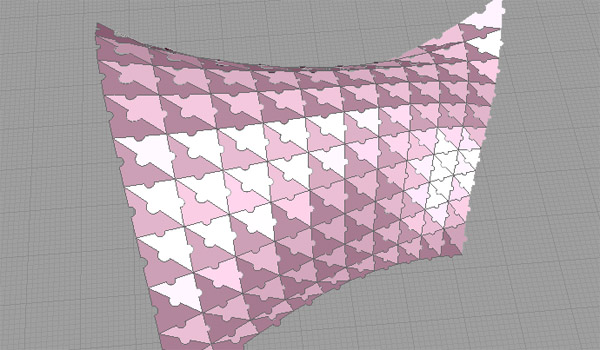
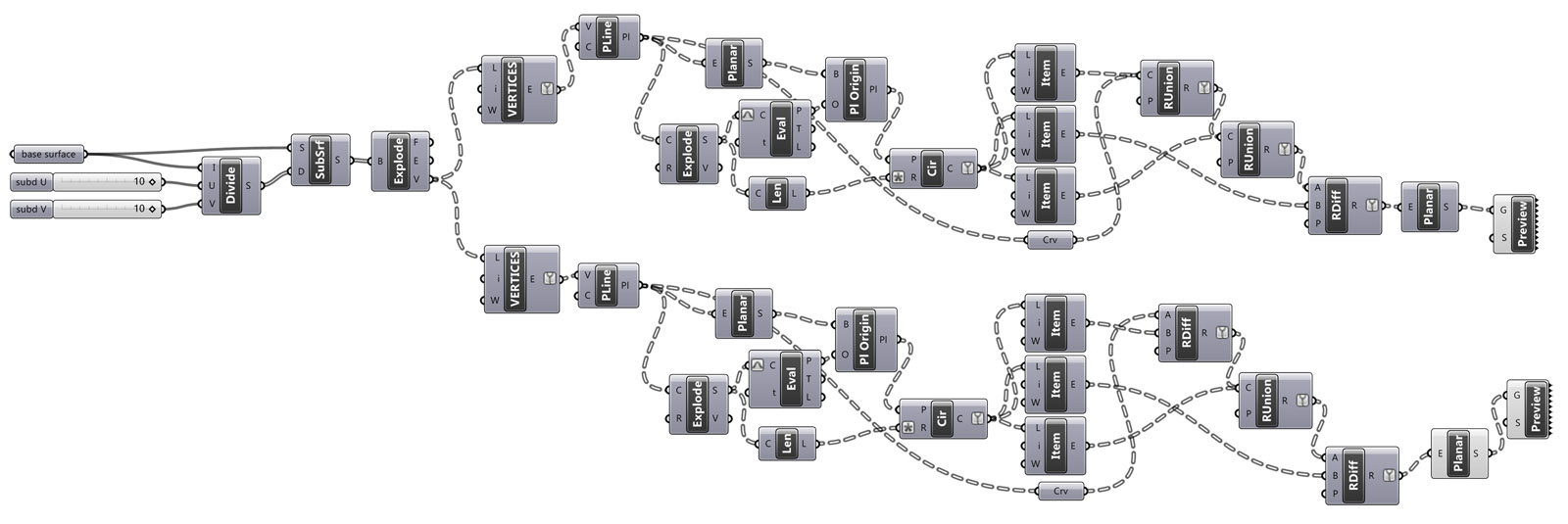
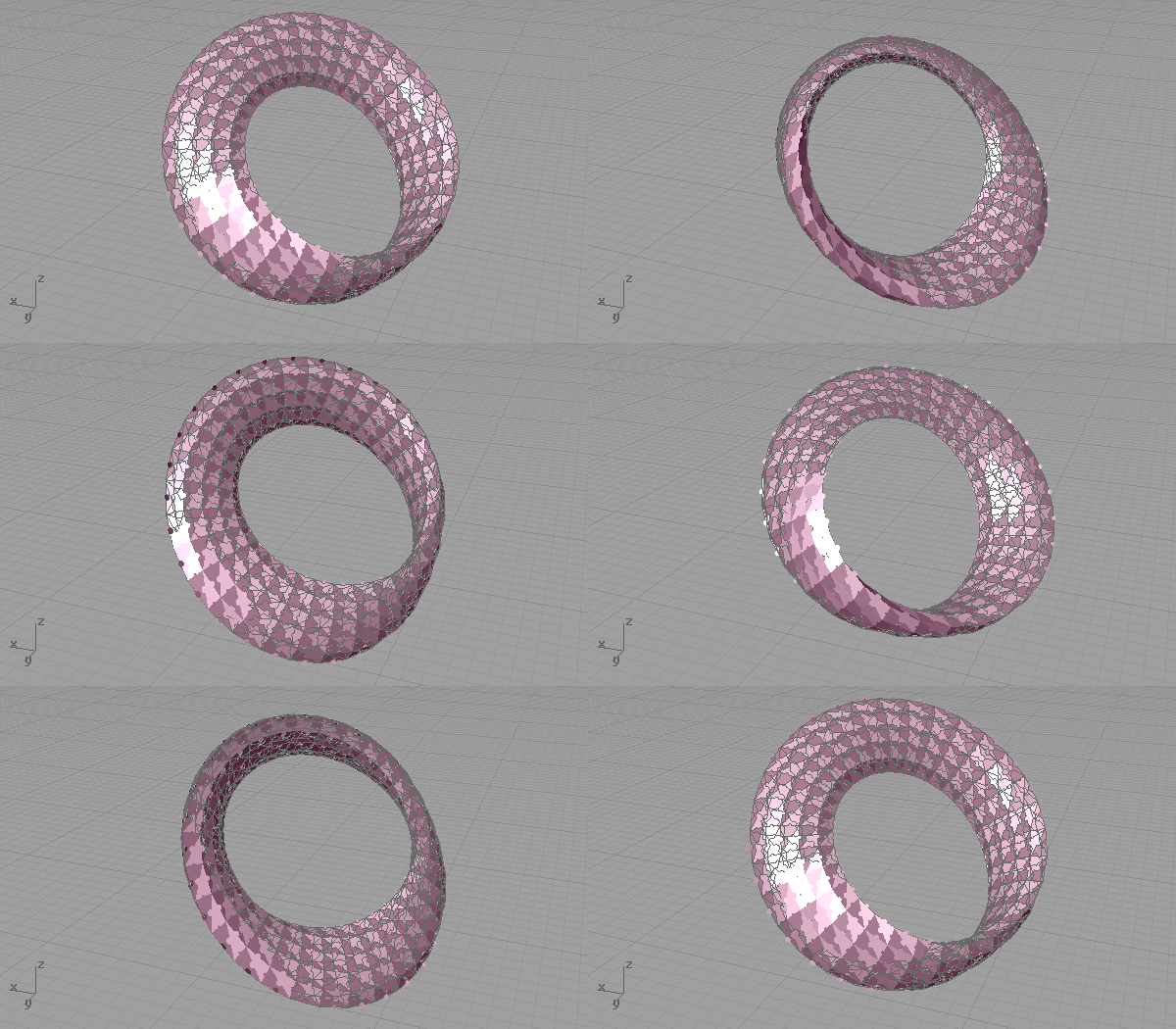
Grasshopper definition needs serious optimization, but it immediately shows how it becomes easy for Grasshopper if the target surfaces are four-cornered (or triangulated). This definition creates regions by adding and subtracting circular planes from the surface’s triangular subsets. It clearly opens the way to more complex tessellations and some other fabrication issues like deciding the size and side of each puzzle connection, and preparing the output for laser cutting (for example, cutting along each triangular face, and scoring the connections so that we may fold them to match the neighboring face). That was a nice evening study, puzzling me a lot, yet much more could be done.
Cite this post
Related Posts
Voronoi Puzzle
April 5, 2023
In this Voronoi puzzle exercise, we derive two-dimensional puzzles by using Voronoi diagrams. This is similar to my previous studies here, and here. Part 1: The Random Voronoi Diagram In section 1 of the below image, I use a rectangular region to generate random points. Then, I create a standard Voronoi diagram by using those points. Finally, I explode the Voronoi cells. Part 2: The Voronoi Puzzle Details In the second part, we draw an arc on the edges of…
Voronoi Kündekâri
June 28, 2013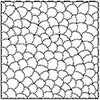
Kündekâri is an old woodworking technique, composed of interlocking parts without any glue or nail. It is primarily used in wooden doors and minbers inside Mosques. The interlocking system makes the whole structure very durable. I tried to model this technique using the Voronoi pattern, naming it Voronoi Kündekâri. Below you see a typical example of Kündekâri pieces and the resulting pattern. The interesting part of the Grasshopper model is to define the tongue-and-groove detail. It is similar to a…
3D Voronoi Puzzle
May 3, 2023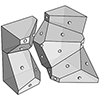
Here, our aim is to generate a 3D Voronoi puzzle ready for 3D printing. Below is the step-by-step explanation of this Grasshopper algorithm: The 3D Voronoi Puzzle Step number one is the application we saw earlier in the Voronoi diagrams. We obtain random polyhedra within a given volume quickly. The basic features we need for the puzzle are: (1) When we solve the puzzle the final volume should be a cube. (2) We should control the dimensions of the total…
Interlocking Structure with Boolean
August 23, 2026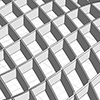
You are seeing the last of the interlocking system trials that I have previously tested in two exercises. If you remember, in our first trial, we were drawing interlocking joinery details on cross-sections using closed curves, without any solid modeling. And here is the most advanced one, I guess. In this exercise, however, we are creating a solid model that incorporates these interlocking details. This time, we will look at how to construct the same system using Boolean operations. Boolean…
Interlocking Pavilion
December 31, 2023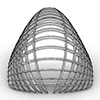
The interlocking frame structures represent a quintessential example of parametric design since very old times. More recently, they gained widespread attention through the Metropol Parasol in Seville, captivating architects and designers. I’ve extensively explored these structures on this blog, attempting various methods like manual slit drawing and solid/region boolean operations. My latest iteration aimed for greater simplicity and adaptability on complex surfaces. I call this new version Interlocking Pavilion. The ribs now align perpendicularly to the surface, which is a…