designcoding
About Table of Contents Keywords Monthly Archive
Support designcoding!

Algorithms

259 posts

Spherical Attraction

November 28, 2012

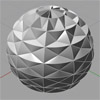
Today’s Architectural Geometry course was about platonic solids and different attractor objects in introducing component-based design systems. Benay’s idea was both pedagogical and interesting to test in Grasshopper. I searched for the most fundamental type of attractor solid in creating a composition such as this; There is a subdivided sphere and an attractor sphere. The pull component works great here. You may use multiple attractor solids or different shapes such as platonic solids as attractors. It is quite an easy…

Möbius Strip Fabrication

October 31, 2012

The Möbius strip is a famous mathematical object. Although being in three-dimensional space, it is a closed-loop of only one surface and only one edge. This quality alone makes the object an interesting study for computational design. I aimed to create an object to test our new CNC machine. I wanted to test the egg-crate interlocking fabrication method. This is why the study became a Möbius strip fabrication. Apart from its uses in science and technology, here is an interesting…

Cairo Pentagonal Tiling

October 22, 2012

This is a late update for my 2012 study on Cairo Pentagonal Tiling (or Cairo Tessellation). Originally, it was an exercise of dual tessellations. Because this tiling is the dual of the famous semi-regular tessellation of Snub Square. After coding the Snub Square tiling, I attempted to generate the dual of it. However, that created an inefficient result. This latest version generates the original Snub Square and Cario Pentagonal Tilings. Moreover, it is possible to play with the inputs to…

Snub Square Tiling

October 22, 2012

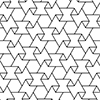
Here is the step-by-step generation of the old Snub Square Tiling. Frankly, this is the first step in the generation of Cairo Pentagonal Tiling I generated with Grasshopper earlier. Because Cairo pentagonal is the dual of a snub square. The first step was easy. Just dispatch cells of a square grid, then evaluate them according to the ratio of 0.366 approx. which is derived from the bisector of an equilateral triangle. Now, we have a snub square tiling, composed of…

Islamic Patterns of Semi-Regular Tessellations

October 22, 2012

The intricate harmony of the Islamic Patterns is amazing. The geometry of this and other Islamic pattern designs are explained in the 3rd chapter of Craig S. Kaplan’s Ph.D. dissertation. I constructed a semi-regular tessellation, particularly the 4.8 because it seems to open interesting explorations that mostly emerge from truncated squares. We know equilateral triangles and hexagons are also fundamental shapes for this task. However, the dual nature of the semi-regular tessellations makes a difference in most compositions. First, I…

Subdivide by Image Contrast

October 17, 2012

This was my old plan to work with images in Grasshopper. Certainly, that was not the result I expected, but this could be counted as a starting point. After seeing beautiful circle packing compositions here, I decided to program Grasshopper, so that it’ll create a subdivision, based on image data. This was the initial version, just subdividing a plane with Voronoi points and visualizing it according to the image’s color values of proper UV coordinates. There is no interpretation on…

Mandelbrot Set

October 10, 2012

Today’s fractal is the famous Mandelbrot Set. The Mandelbrot set is a well-known and complex mathematical set often associated with fractals and chaos theory. Named after the mathematician Benoît B. Mandelbrot, it’s a set of complex numbers defined by a simple iterative process. The Mandelbrot set is an intricate and self-similar boundary, which reveals increasingly complex patterns at different magnifications. On the other hand, I heard the term “The fingerprint of God” in some sources resembling its aesthetic and philosophical…

Julia Set

October 10, 2012

Today’s fractal is the Julia Set, the amazing simplicity of chaos. There are lots of applets and articles on the internet about this fractal. You can generate this with the iteration of a basic function many times and placing points on the complex plane. I developed a Grasshopper implementation in 2012. Also, this was my first study on complex numbers. At each iteration, the detail level increases. I utilized a common brute-force approach, distributing a grid of points, converting them…

Complex Numbers

October 6, 2012

Studying circle packing led me back to my high school days. First, I’ve tried to write a vb.net component so that I would say Grasshopper to place circles and check lots of things iterating again and again. Then I felt that this was not my real interest in circle packing. After finding an old post by Daniel Piker,  I’m truly enlightened about an old topic of our high school education: The complex numbers! Then I found this link, explaining the…

Conformal Circle Packing

September 19, 2012

After a couple of days of studying the mysterious Doyle spiral, I’ve decided to test an approach of circle packing from conformal mapping. First, I tried to understand the Poincare disk (earlier at here, here, and here and here). I used it as the hyperbolic representation of space on a two-dimensional plane. Then, I linked a regular hexagonal grid and rebuilt it after the hyperbolic distortion. This led me to find the below hexagonal grid. Therefore, it looks like a suitable…

« 1 2 3 … 9 10 11 12 13 14 15 16 17 18 19 20 21 22 23 24 25 26 »
  • Chapters

    • Algorithms
    • Discourses
    • Fabrications
    • Studios
  • Explore

    • All Keywords
    • Table of Contents
    • Monthly Archive
    • #gyroid
    • #le-corbusier
    • #rhombus
    • #mosque
    • #phenomenology
    • #semi-regular
    • #parametric-curve
    • #deformation
    • #robot
    • #euclidean-construction
    • #b-spline
    • #frege
    • #aperiodic
    • #circle
    • #dome
    • #robot-tool
    • #voronoi
    • #sandblasting
    • #workshop
    • #photoshop
  • Search

  • Support designcoding!

  • Enjoying designcoding? Support me on Patreon to keep it growing. Thank you!

  • copyright 2026 designcoding.net | about | privacy policy | end user license agreement