designcoding
About Table of Contents Keywords Monthly Archive
Support designcoding!

Algorithms

259 posts

Force Fields in Grasshopper

March 17, 2015

Finally, I had a chance to test and understand the force fields tab in Grasshopper. It creates a continuous vector field inside of a given boundary. Therefore, it is very useful if you want to create an effect of the continuous presence of a force, such as gravity. The Wikipedia definition of a vector field is very basic and understandable: In vector calculus and physics, a vector field is an assignment of a vector to each point in a subset of space. For instance, a vector field in the…

Contouring Update

March 17, 2015

After this tutorial, we are still working on the basic ways of making contouring easier in Grasshopper. This is the updated version of the 2-year-old contouring definition in Grasshopper, with some additional functionality. It produces a flat and properly numbered output for each section. However, it does not include optimized nesting to reduce material use.

Gaudi Column Macro

March 7, 2015

Gaudi-like columns are generated as part of the “boolean” classes of Design Computing. The most inspiring, beautiful, and ugly variations are often done by boolean intersection, as this operation is the surprising one of the three brothers. While the class deals with the concept of emergence once again via solid and void relationships, constructive solid modeling techniques are introduced. Although it is widely used as a spatial analysis approach in architecture, there are some examples of using boolean algebra in…

Herringbone Tiling

February 23, 2015

This quick project was about a special tiling pattern inside a multi-story residential building’s hallways in Grasshopper. While drawing the construction documents of the project, it was necessary to apply some coding here, as each floor had a different shape to be tiled. Although it is not a real Herringbone tiling, I named it because I couldn’t find a better name yet. First, I’ve imported the geometric boundaries and the “middle curves” of the designed tiling pattern. Then, I extended the division…

Contour-fold Structure

February 1, 2015

Euclidean constructions, when represented computationally, rely on algorithms and mathematical principles to generate geometric shapes and forms. Through precise calculations and logical operations, a computer program can emulate the actions of a compass and straightedge, constructing lines, circles, and polygons with accuracy and efficiency. These digital incarnations of Euclid’s timeless techniques enable the exploration of geometric concepts and the creation of visually captivating representations. This project is interesting because of the Euclidean construction underneath. Initially, I studied this type of…

Landscape Extensions Final: Digital Sketch

February 1, 2015

This is the final Grasshopper sketch of our graduate studio conducted together with Fulya Akipek at Yıldız Technical University Computational Design Unit. The project was about designing parametric “Landscape Extensions” at Kabataş Park in İstanbul. I hope I’ll be able to post the actual student works and the material system, but now; only the final result of the digital sketch we’ve developed together with students is presented here. This was a kind of “sketchy” definition that came up as an…

A Text Effect

January 2, 2015

This is a macro exercise in Rhino, showing that Rhino is pretty much capable of automating some cool text effects. Just copy and paste the below code into the command bar of the Rhino, or open the macro editor by typing macro edit, then paste it there and press play. You’ll enter any string when prompted, then the macro handles the rest of the process. You can play with the parameters by changing the numeric values you see in the…

Tetrahedral Helix and Snake Game

January 2, 2015

This is the Grasshopper definition that generates a tetrahedral helix (also called as Boerdijk-Coxeter helix) but in a funny way. This geometry is also a solution for tangent spheres. I generated the helix using Anemone components for recursion and gave it a little bit of responsiveness. I don’t know if it depends on the speed of your CPU but if it is slow enough, you’ll see the snake game of tetrahedral helix as it is driven by your input from a…

Cycloid Experiment

May 9, 2014

This is a Cycloid-like family of curves, generated by its classical description: a rolling circle. I had several other studies on similar topics before. In this cycloid experiment, I used Grasshopper in which, we don’t need to roll the circle. Instead, we can divide a parametric curve, utilizing data lists to simply rotate a circle around it. Finally, evaluating the circle repeatedly creates a Cycloid-like result. I found this as the most simplistic way of showing and studying these special…

Branches by Looping

May 9, 2014

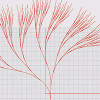
While testing Anemone components for Grasshopper, I accidentally generated these branches by looping. In fact, I was trying to develop the definition that mimics the well-known “Arch SED” component method. This method uses the tangent vectors for the endpoints of the arcs. Then, it iterates the process in a random fashion so that the branches (arcs) join nicely. Anyway, this definition develops new branches from a previous one. It does this by using three graph mappers for the position, rotation,…

« 1 2 3 4 5 6 7 8 9 10 11 12 13 14 15 16 17 18 19 20 21 22 23 24 25 26 »
  • Chapters

    • Algorithms
    • Discourses
    • Fabrications
    • Studios
  • Explore

    • All Keywords
    • Table of Contents
    • Monthly Archive
    • #gosper-curve
    • #rhombicosidodecahedron
    • #galapagos
    • #koch
    • #fourier
    • #rhombus
    • #brick
    • #graph-mapper
    • #facade
    • #virtual-studio
    • #cuboctahedron
    • #tree
    • #spiral
    • #landscape
    • #polygon
    • #workshop
    • #concrete
    • #metaball
    • #space-syntax
    • #fibonacci
  • Search

  • Support designcoding!

  • Enjoying designcoding? Support me on Patreon to keep it growing. Thank you!

  • copyright 2026 designcoding.net | about | privacy policy | end user license agreement