
Edge Bundling
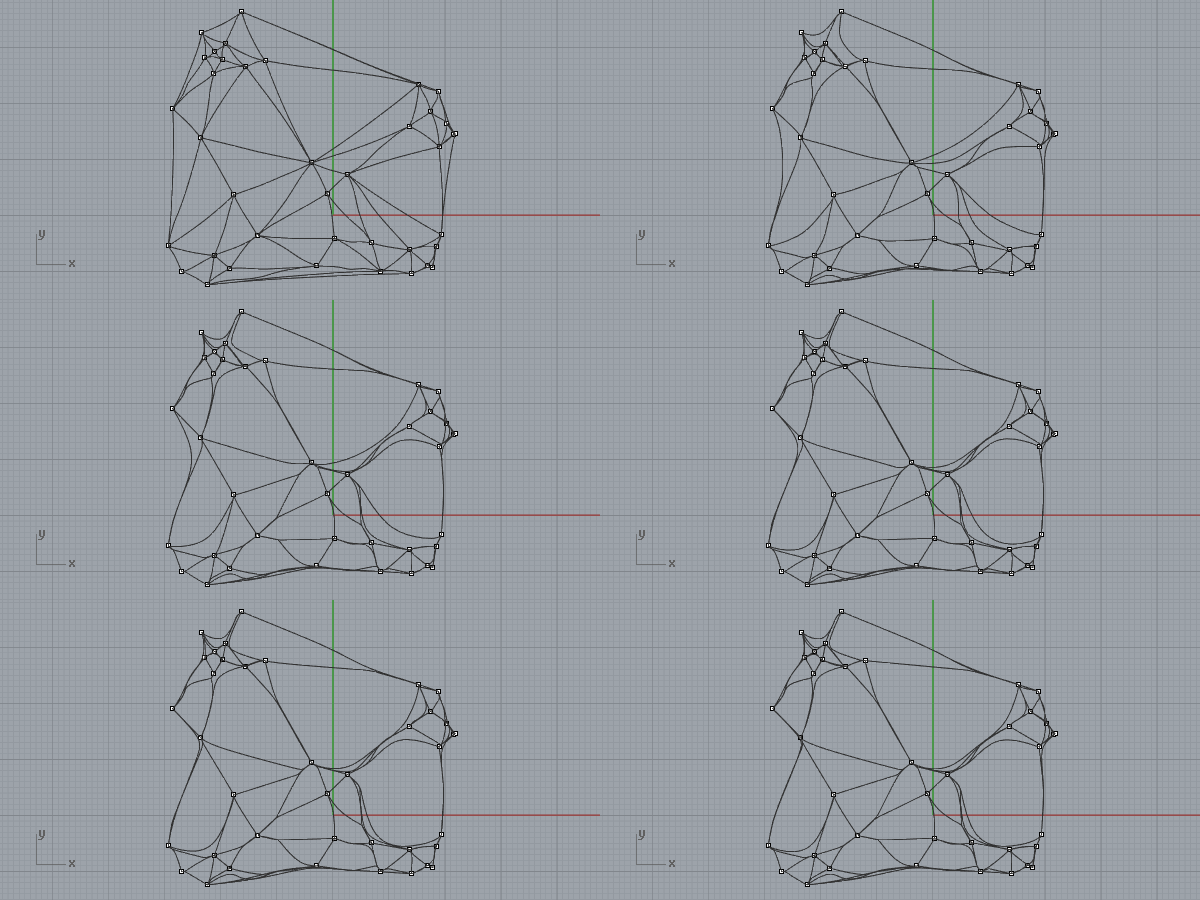
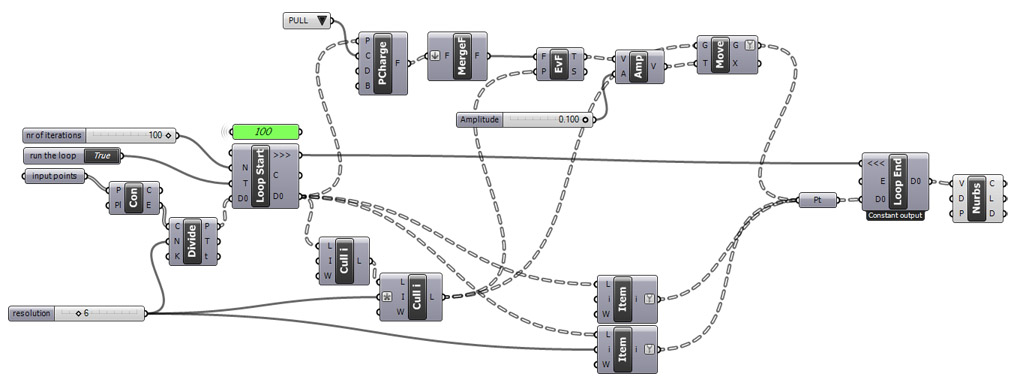
I’ve been searching for a way to implement edge bundling on Grasshopper. It is an effective visualization technique that you can use in connectivity diagrams. There are a couple of different approaches to this problem. It is a nice way to analyze common paths within crowded graphs. I’ve found several entries in the Grasshopper blog about this subject, but only implementing Kangaroo seemed to be a complete solution. My approach is of course not a scientific one, but after the application of Anemone, it is now possible to model such iterative processes without Kangaroo. Below is my first try. Just input some points (or just the edges if you like) then start the Anemone loop by clicking on the boolean trigger. For the first time, it is so simple to implement force fields within for loops in Grasshopper. Note that this definition requires Anemone components to run.
We can shorten the definition a bit. It is possible to define if the graph pushes or pulls itself. Be careful about the bounding box of the calculation process (the B parameter of pCharge component). Otherwise, your edges may not be calculated. This definition could be advanced to include various charge values for each point if you like. However, it was a nice introduction to the “loops” in Grasshopper, which seems to be very important for the future of dataflow design computing.
Cite this post
Related Posts
Dragon Curve Fractal
December 25, 2023
This week’s fractal is the famous Dragon Curve. Dragon Curve exhibits self-similarity, meaning parts of the curve resemble the overall shape, regardless of scale. It’s fascinating because a relatively simple construction process generates a complex and visually captivating fractal pattern. The Dragon Curve is often used to demonstrate fractal properties in mathematics and is popular in recreational mathematics due to its intricate and beautiful patterns. It has applications in computer graphics and is interesting in studying chaos theory, self-similarity, and…
Cesaro Fractal
December 19, 2023
In this study, I explore Cesaro Fractal, generated by Grasshopper. Usually, it is not possible to code recursive algorithms in Grasshopper. With the help of the Anemone add-on, these fractal curves are easy to model. I studied similar fractal algorithms here before. This one is very similar to the Koch’s snowflake. The only difference (as far as I understood) is the side of the spikes. Koch’s Snowflake generates triangular spikes pointing to the outside of the polygon. Cesaro Fractal does…
Koch Snowflake Fractal
April 12, 2023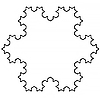
This is an implementation of the famous Koch Snowflake Fractal in Grasshopper. We will be using the Anemone add-on to handle the iterations. In this fractal, we start from an equilateral triangle. Then, we form new equilateral triangles, one-third of the side. So that each repetition protrudes in the middle of all the sides. In summary; The Preparation for Koch Snowflake Fractal Now let’s follow the Grasshopper application step by step. We start Koch Snowflake Fractal by creating a triangle…
Gosper-Peano Curve in Grasshopper
August 19, 2017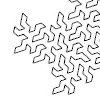
Anemone components are still working great, extending the abilities of Grasshopper. Here, I studied a space-filling (or plane-filling) fractal called the Gosper-Peano Curve. You should be very careful about the number of iterations (the N input). Because it can crash your Rhino if you change it to more significant numbers. Also, you should have Anemone components installed in order to run this definition. The generator curve is a special one. This website explains the generation of the curve from the…
Arc Tree Revisited: Anemone Update
April 26, 2015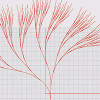
This is a classical method of generating tree-like forms utilizing a simple command “Arc SED”. The idea is simple, as the command draws arcs using an input direction vector, so this could easily be implemented creating a “smooth” composition of curves just by iteration. Actually, this has been a previous study, discussed before here, using Hoopsnake. Now, this time I’m implementing the same algorithm using Anemone and a couple of other changes. Here is the Grasshopper definition (Anemone Components should be…