
Lokma
Lokma is the name of a pastry made of fried dough soaked in sugar syrup or honey and cinnamon, typically shaped into a ring or ball.
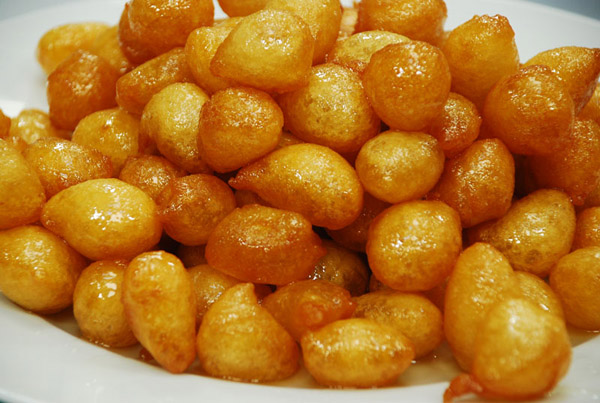
Unfortunately, it is not the “Lokma” we’ll study here. In Turkish, there is another meaning of the same word related to the history of Eastern architecture. It is the name of metal connectors in railings, mostly inside of the openings of garden walls and old Mosque complexes. We often call this system “Lokma Railing” or “Lokma Iron”, while the connector of the railing is a “Lokma”. I don’t know if there is any etymological relationship between the pastry and the connector but I love both of them.
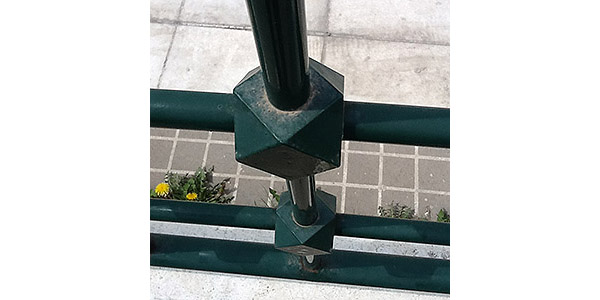
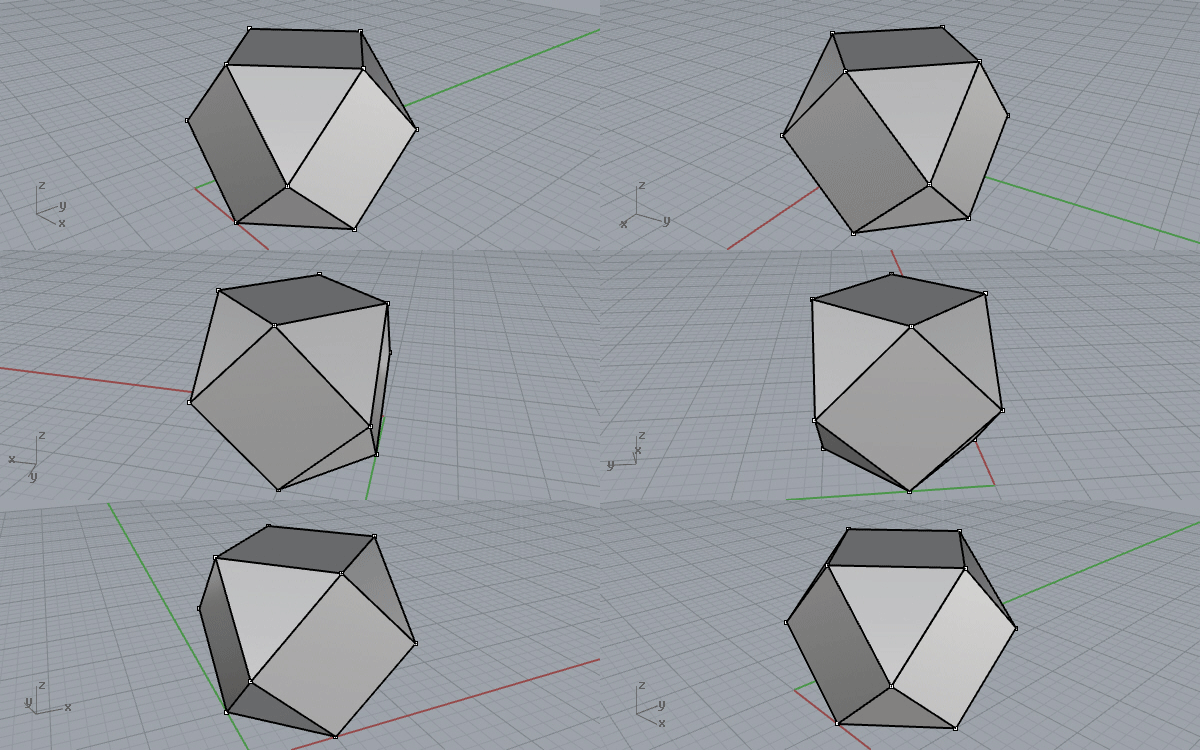
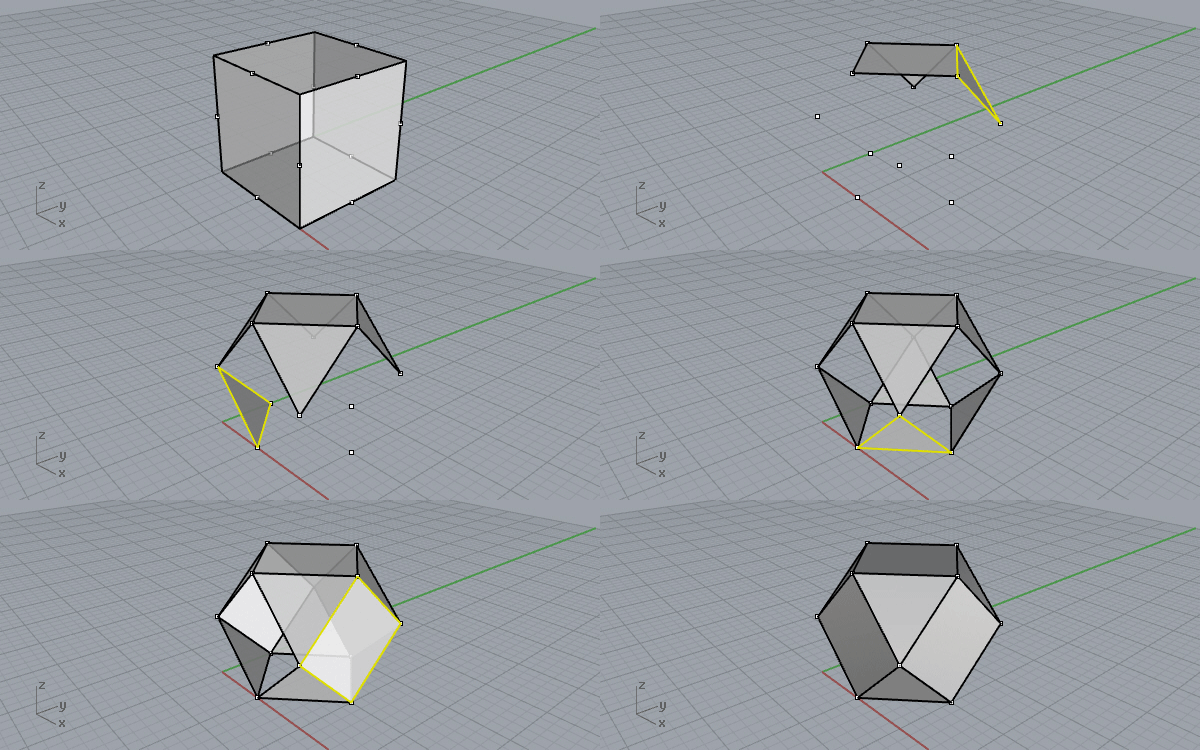
The geometric name of this solid is rectified cube. It is mostly produced by joining two pieces of cast iron around the pipes of the railing. However, there is very little information on the internet about this detail. It was related to this week’s architectural geometry class. We study platonic and archimedean solids there. You can also call rectified cube a Cuboctahedron. As explained in Wikipedia: A Cuboctahedron is a polyhedron with 8 triangular faces and 6 square faces. Thus, a Cuboctahedron has 12 identical vertices, with 2 triangles and 2 squares meeting at each, and 24 identical edges, each separating a triangle from a square. We just put points at the midpoints of every segment of a cube, then connected them to complete the solid;
In addition, it also means “bite” in Turkish, and also is the name of a toolset “torque wrench”.
Cite this post
Related Posts
Folding Truncated Cuboctahedron
December 14, 2024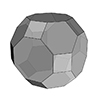
A truncated cuboctahedron is an Archimedean solid, meaning it is a highly symmetrical, convex polyhedron with identical vertices and faces of regular polygons. As its name suggests, you can create the truncated cuboctahedron by truncating (cutting off) the vertices of a cuboctahedron. A cuboctahedron is a rectified cube. After you model it, you can divide all its edges into 1/3s. Then, connect those division points to draw the squares, hexagons, and octagons. In this short tutorial video, I am folding…
Modeling and Unrolling Dymaxion
December 14, 2024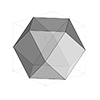
Buckminster Fuller used the term “dymaxion” for a variety of his designs, and one of these was the dymaxion map. It was based on the geometry of a polyhedron. While the dymaxion map is more directly related to the icosahedron, Fuller’s work often involved using other polyhedral shapes. One of them is the cuboctahedron. He used this term for various conceptual and practical designs, particularly in the context of his ideas on efficiency and structure. The cuboctahedron itself is notable…
Archimedean Pendants
July 11, 2024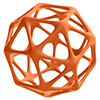
Today’s polyhedra are the famous Archimedean Solids! I created a simple Grasshopper script to generate pendants from these beautiful solids. I call this Archimedean Pendants. However, you can implement other polyhedra to the same code. I hardcoded the vertex coordinates so you won’t need an extra add-on to generate the polyhedra. Thanks to the new SubD component Multipipe, it makes life much easier to produce 3dprint-ready results. To make this definition more useful, you can add scale operations in all…
Coding the Snub Dodecahedron
March 25, 2024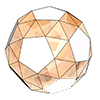
An Archimedean solid is a convex isogonal (vertex-transitive) and nonprismatic solid that is composed of two or more regular polygonal faces. There are thirteen such solids in geometry. Coding the snub dodecahedron study aims to generate one of these solids, composed of 12 regular pentagons, and 80 regular triangles. You can generate the snub dodecahedron by expanding and twisting the faces of a dodecahedron outward. This also creates rhombicosidodecahedron, which is another Archimedean solid. If you expand and twist the…
Star Polyhedra
January 26, 2024
Stellated polyhedra are three-dimensional geometric shapes formed by extending the faces of a regular polyhedron (a solid with flat faces) beyond their original boundaries until they intersect with each other. The term “stellate” comes from the Latin word “stella,” meaning star and these polyhedra often have a star-like appearance due to their extended faces. They are popular because of their aesthetic qualities. I studied these forms many times before. This time, I implemented the stellations and negative stellations (the excavated…