
Low Poly Trees in Grasshopper
Let’s make some nostalgia. I thought of a very simple and useful algorithm that I can generate with Grasshopper. At the concept stage in architectural projects, I tried to derive figures that could symbolize the trees on the land. To make random low poly trees in Grasshopper we need several lists of random numbers first. The Facet Dome component will meet all our needs. In the code I shared on this page, I arranged the data tree structure to handle one or more points. Thus, one can derive a large number of tree figures which are different from each other. What will this do? Will it solve our problems? Of course not. Because I’m just killing some time, that’s all.

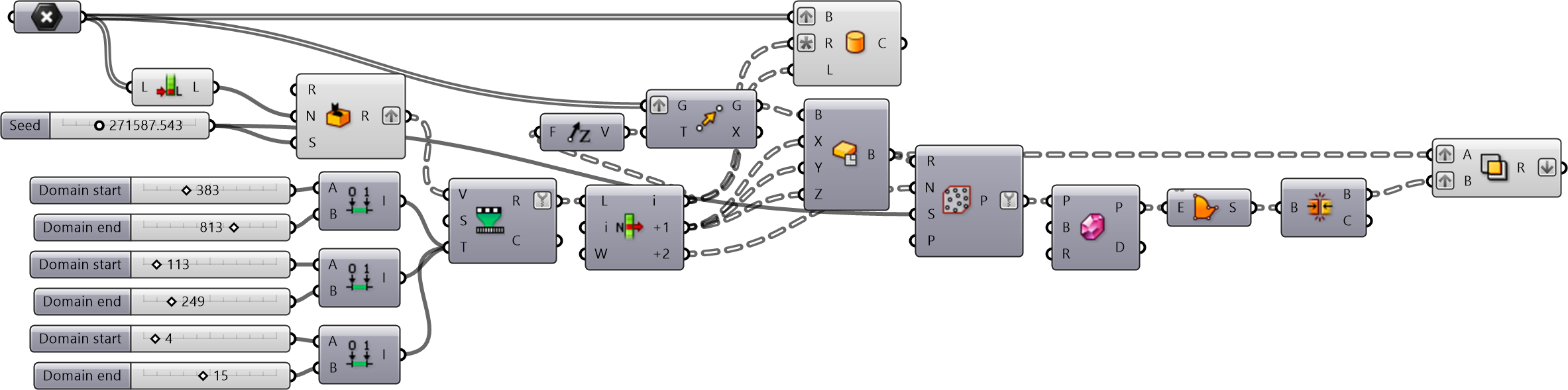
I actually developed this code for a friend of mine a long time ago. It was reading the height, species, and diameter data of the trees from the excel table. But unfortunately, I lost that code. So I recreated it. So this code can be refactored in such a way that information about trees is processed by reading it from a table. You can download and try the Grasshopper code above and see the results. If you are new to Grasshopper, this code will be a good example to show you how to use data trees and the ReMap Numbers component. Finally, I think the basics of parametric modeling can be understood through very simple and plain examples like this; “Low poly Trees”.
Cite this post
Related Posts
Parametric IQlight
August 23, 2024
Holger Strøm designed the famous IQlight system in 1973. After more than 50 years, it is still a popular, innovative, and smart design. The IQlight is a self-assembly lamp composed of interlocking quadrilaterals. By utilizing polyhedral geometry, you can generate various shapes and sizes. I created a model of one of the most common IQlight designs, fitting it onto the Catalan solid known as the rhombic triacontahedron. This solid is a convex polyhedron with 30 rhombic faces, making it an…
Archimedean Pendants
July 11, 2024
Today’s polyhedra are the famous Archimedean Solids! I created a simple Grasshopper script to generate pendants from these beautiful solids. I call this Archimedean Pendants. However, you can implement other polyhedra to the same code. I hardcoded the vertex coordinates so you won’t need an extra add-on to generate the polyhedra. Thanks to the new SubD component Multipipe, it makes life much easier to produce 3dprint-ready results. To make this definition more useful, you can add scale operations in all…
Star Polyhedra
January 26, 2024
Stellated polyhedra are three-dimensional geometric shapes formed by extending the faces of a regular polyhedron (a solid with flat faces) beyond their original boundaries until they intersect with each other. The term “stellate” comes from the Latin word “stella,” meaning star and these polyhedra often have a star-like appearance due to their extended faces. They are popular because of their aesthetic qualities. I studied these forms many times before. This time, I implemented the stellations and negative stellations (the excavated…
Catalan Lamps
January 11, 2024
Catalan Solids are the duals of Archimedean Solids. They were first described by mathematician Eugène Charles Catalan in the 19th century. There are 13 Catalan solids, and they exhibit interesting symmetries and unique characteristics. While coding the vertex coordinates of these solids in Grasshopper, I made a simple lamp design to exercise the programming language. The code generates the 13 Catalan Lamps with flaps. Since the polyhedra have planar faces, they can be cut out by hand or a laser…
Archimedean Planters
December 30, 2023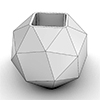
Archimedean Solids are convex polyhedra with faces of regular polygons and vertex-transitive. There are 13 such objects (excluding prisms and antiprisms which are probably less exciting). In this study, I experimented with these solids and designed a family of planters. Since they are convex and look cool, I decided to give it a try. I call this algorithm Archimedean Planters. The first part of the definition deals with the generation of the chosen solid. A list will help the user…