
Archimedean Planters
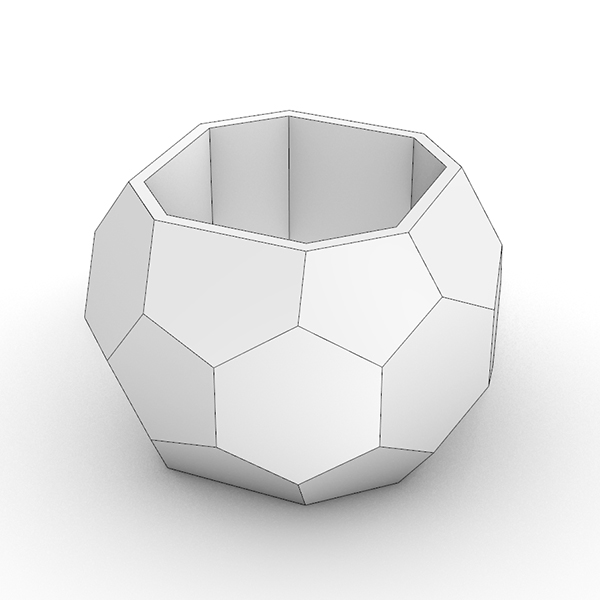
Archimedean Solids are convex polyhedra with faces of regular polygons and vertex-transitive. There are 13 such objects (excluding prisms and antiprisms which are probably less exciting). In this study, I experimented with these solids and designed a family of planters. Since they are convex and look cool, I decided to give it a try. I call this algorithm Archimedean Planters. The first part of the definition deals with the generation of the chosen solid. A list will help the user to choose the solid. Then, the top and bottom planes are cut by a user-defined amount to make it stand still. So, you can design your Archimdean planter pot quickly. When you are happy with the result, just bake the object into Rhino and it is generated as a single closed polysurface, suitable for 3d printing.
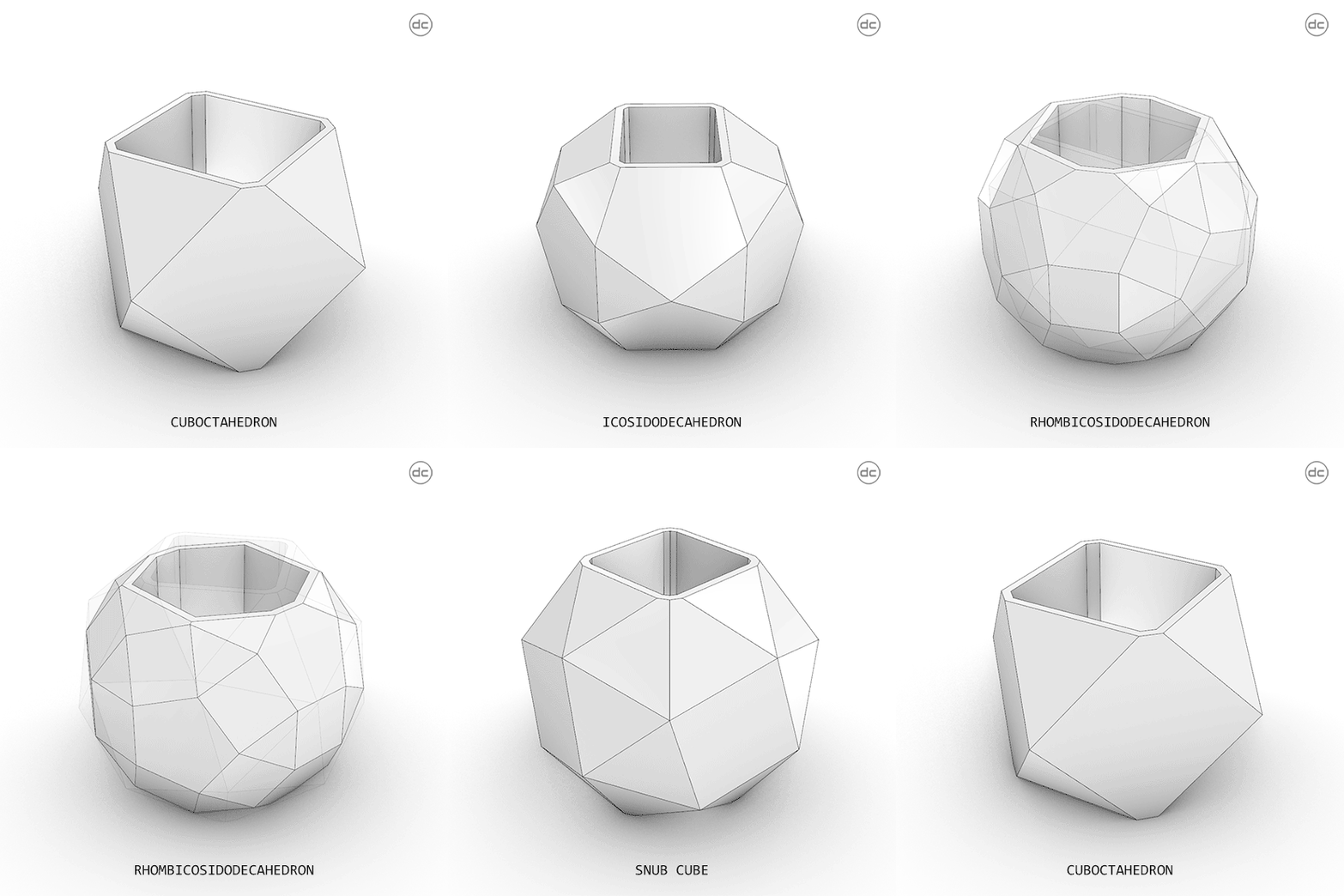
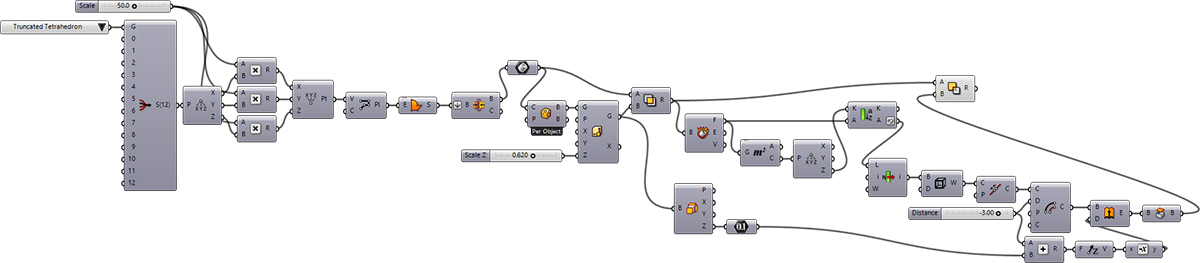
This Grasshopper definition generates plant pots out of Archimedean solids. The input parameters are the size of the pot, the planter hole, the amount of cutting from top and bottom, and the input solid. Thus, it is possible to re-generate the classical designs found everywhere and explore new designs. The result is a closed polysurface (solid object). Therefore, it is ready for 3d printing and molding for plaster, concrete, etc. I made the definition with the help of the native Grasshopper components in Rhinoceros 7. So, no external add-on is necessary.
Cite this post
Related Posts
Archimedean Pendants
July 11, 2024
Today’s polyhedra are the famous Archimedean Solids! I created a simple Grasshopper script to generate pendants from these beautiful solids. I call this Archimedean Pendants. However, you can implement other polyhedra to the same code. I hardcoded the vertex coordinates so you won’t need an extra add-on to generate the polyhedra. Thanks to the new SubD component Multipipe, it makes life much easier to produce 3dprint-ready results. To make this definition more useful, you can add scale operations in all…
Star Polyhedra
January 26, 2024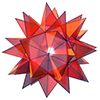
Stellated polyhedra are three-dimensional geometric shapes formed by extending the faces of a regular polyhedron (a solid with flat faces) beyond their original boundaries until they intersect with each other. The term “stellate” comes from the Latin word “stella,” meaning star and these polyhedra often have a star-like appearance due to their extended faces. They are popular because of their aesthetic qualities. I studied these forms many times before. This time, I implemented the stellations and negative stellations (the excavated…
Coding the Snub Dodecahedron
March 25, 2024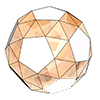
An Archimedean solid is a convex isogonal (vertex-transitive) and nonprismatic solid that is composed of two or more regular polygonal faces. There are thirteen such solids in geometry. Coding the snub dodecahedron study aims to generate one of these solids, composed of 12 regular pentagons, and 80 regular triangles. You can generate the snub dodecahedron by expanding and twisting the faces of a dodecahedron outward. This also creates rhombicosidodecahedron, which is another Archimedean solid. If you expand and twist the…
Parametric IQlight
August 23, 2024
Holger Strøm designed the famous IQlight system in 1973. After more than 50 years, it is still a popular, innovative, and smart design. The IQlight is a self-assembly lamp composed of interlocking quadrilaterals. By utilizing polyhedral geometry, you can generate various shapes and sizes. I created a model of one of the most common IQlight designs, fitting it onto the Catalan solid known as the rhombic triacontahedron. This solid is a convex polyhedron with 30 rhombic faces, making it an…
Catalan Lamps
January 11, 2024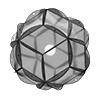
Catalan Solids are the duals of Archimedean Solids. They were first described by mathematician Eugène Charles Catalan in the 19th century. There are 13 Catalan solids, and they exhibit interesting symmetries and unique characteristics. While coding the vertex coordinates of these solids in Grasshopper, I made a simple lamp design to exercise the programming language. The code generates the 13 Catalan Lamps with flaps. Since the polyhedra have planar faces, they can be cut out by hand or a laser…