
Star Polyhedra
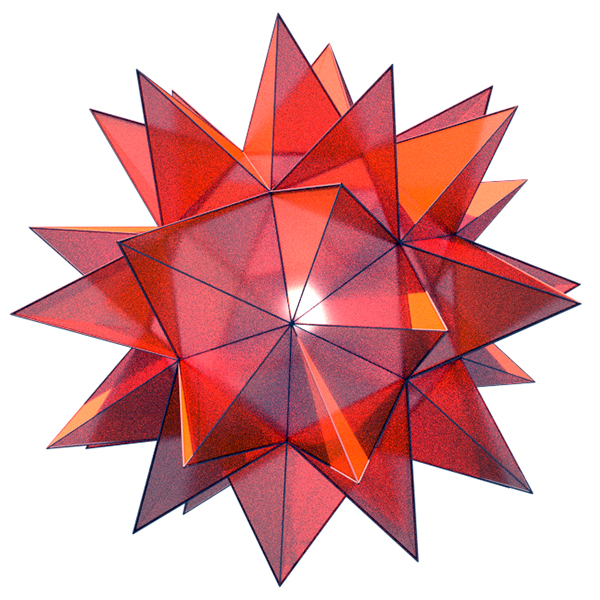
Stellated polyhedra are three-dimensional geometric shapes formed by extending the faces of a regular polyhedron (a solid with flat faces) beyond their original boundaries until they intersect with each other. The term “stellate” comes from the Latin word “stella,” meaning star and these polyhedra often have a star-like appearance due to their extended faces. They are popular because of their aesthetic qualities. I studied these forms many times before. This time, I implemented the stellations and negative stellations (the excavated polyhedra) of the famous Archimedean Solids in Grasshopper. I used the normal vectors of each face to extrude them. It is a nice and quick exercise of normal vectors and transformations in Grasshopper. You can attach any polyhedra to make their stellated versions, and use the Polyhedra Unroller with Flaps tool to try producing the laser-cutting documents.
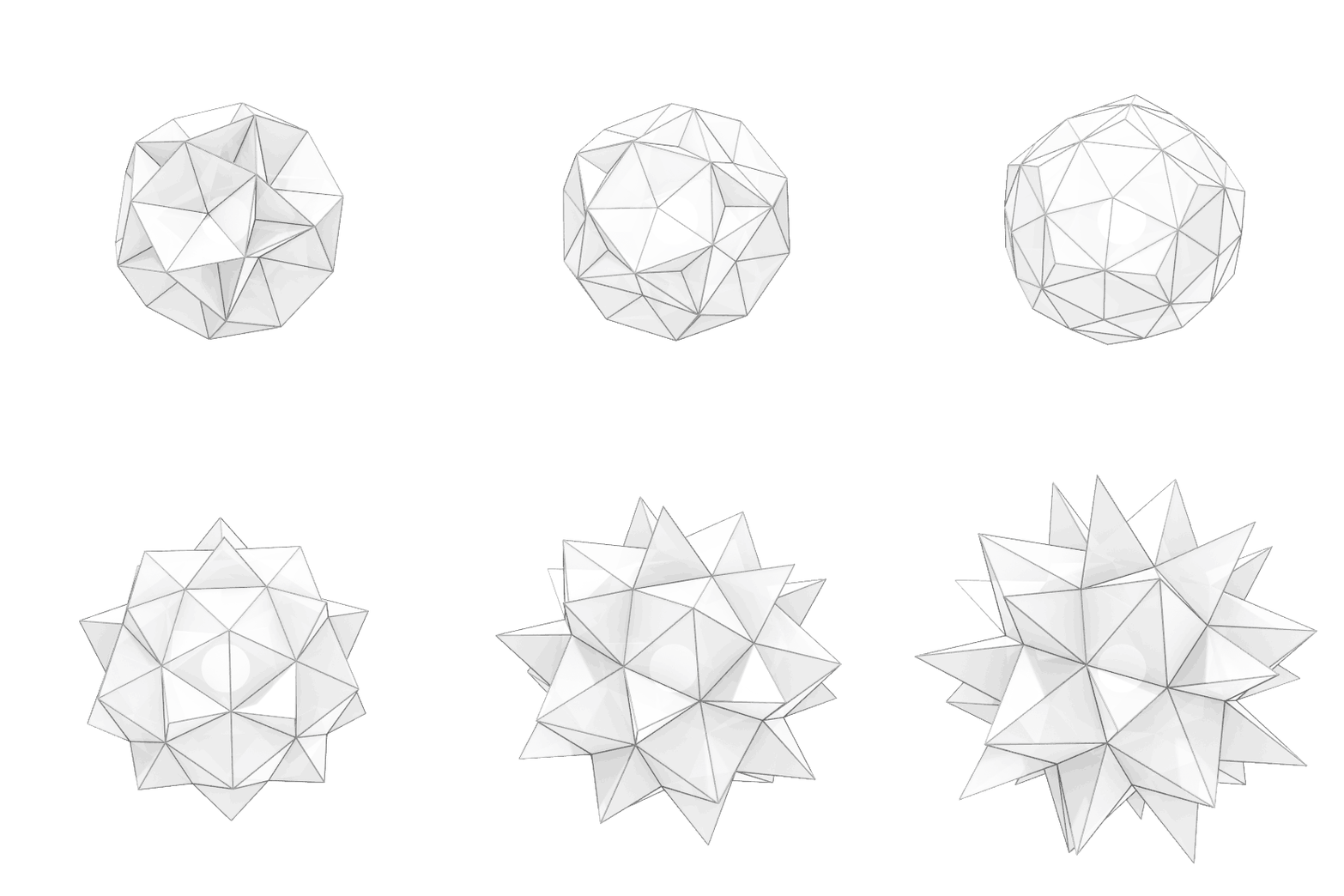
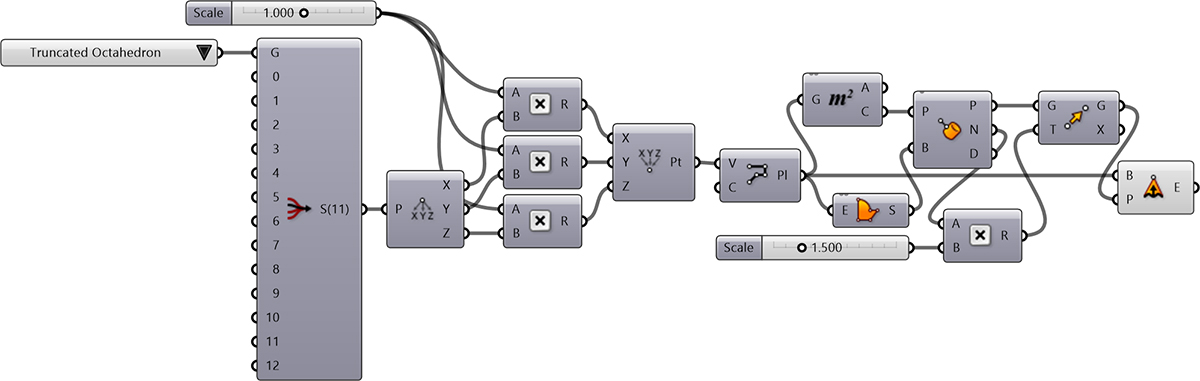
This Grasshopper definition generates stellated designs based on the input polyhedra. The input parameters are the type and radius of the base solid and the size of the spikes. It is possible to connect any polyhedra to explore different designs. The output of the definition is the solid 3d model of the design, and it is easy to unroll the faces as polylines. Therefore, it is partially ready for manual cutting or laser cutting. The code is using native Grasshopper components. Thus, no add-ons are necessary for it to work.
Cite this post
Related Posts
Archimedean Pendants
July 11, 2024
Today’s polyhedra are the famous Archimedean Solids! I created a simple Grasshopper script to generate pendants from these beautiful solids. I call this Archimedean Pendants. However, you can implement other polyhedra to the same code. I hardcoded the vertex coordinates so you won’t need an extra add-on to generate the polyhedra. Thanks to the new SubD component Multipipe, it makes life much easier to produce 3dprint-ready results. To make this definition more useful, you can add scale operations in all…
Archimedean Planters
December 30, 2023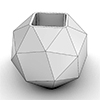
Archimedean Solids are convex polyhedra with faces of regular polygons and vertex-transitive. There are 13 such objects (excluding prisms and antiprisms which are probably less exciting). In this study, I experimented with these solids and designed a family of planters. Since they are convex and look cool, I decided to give it a try. I call this algorithm Archimedean Planters. The first part of the definition deals with the generation of the chosen solid. A list will help the user…
New Years Lanterns 2012-2013
December 20, 2012
This is the second year we are experimenting with a beautiful exercise with the Computation-based Basic Design 1 students at İstanbul Bilgi University Faculty of Architecture. The exercise is based on the ideas of Benay Gürsoy and Şebnem Yalınay, who are among the pioneers of this studio. The exercise is about the design and production of new year’s lanterns to be lit in the campus garden. Here are a few photos of the projects from the 2012 and 2013 semesters,…
Coding the Snub Dodecahedron
March 25, 2024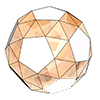
An Archimedean solid is a convex isogonal (vertex-transitive) and nonprismatic solid that is composed of two or more regular polygonal faces. There are thirteen such solids in geometry. Coding the snub dodecahedron study aims to generate one of these solids, composed of 12 regular pentagons, and 80 regular triangles. You can generate the snub dodecahedron by expanding and twisting the faces of a dodecahedron outward. This also creates rhombicosidodecahedron, which is another Archimedean solid. If you expand and twist the…
Parametric IQlight
August 23, 2024
Holger Strøm designed the famous IQlight system in 1973. After more than 50 years, it is still a popular, innovative, and smart design. The IQlight is a self-assembly lamp composed of interlocking quadrilaterals. By utilizing polyhedral geometry, you can generate various shapes and sizes. I created a model of one of the most common IQlight designs, fitting it onto the Catalan solid known as the rhombic triacontahedron. This solid is a convex polyhedron with 30 rhombic faces, making it an…