
Wiry Wonder
The Parquet Deformation named “Wiry Wonder” was designed by Michael Cuttita in William Huff’s studio at the State University of New York in 1989. The below figure shows the original drawing made by the student. Similar to the previous one, this composition is based on a hexagonal lattice. In this composition there are three significant prototiles, marking the three key moments in the shape-shifting process. There is also one invisible prototile. It accommodates the transition between the last two prototiles. The first prototile is similar to the second prototile of “Strange Start, Startling Stop”, composed of four small hexagons.
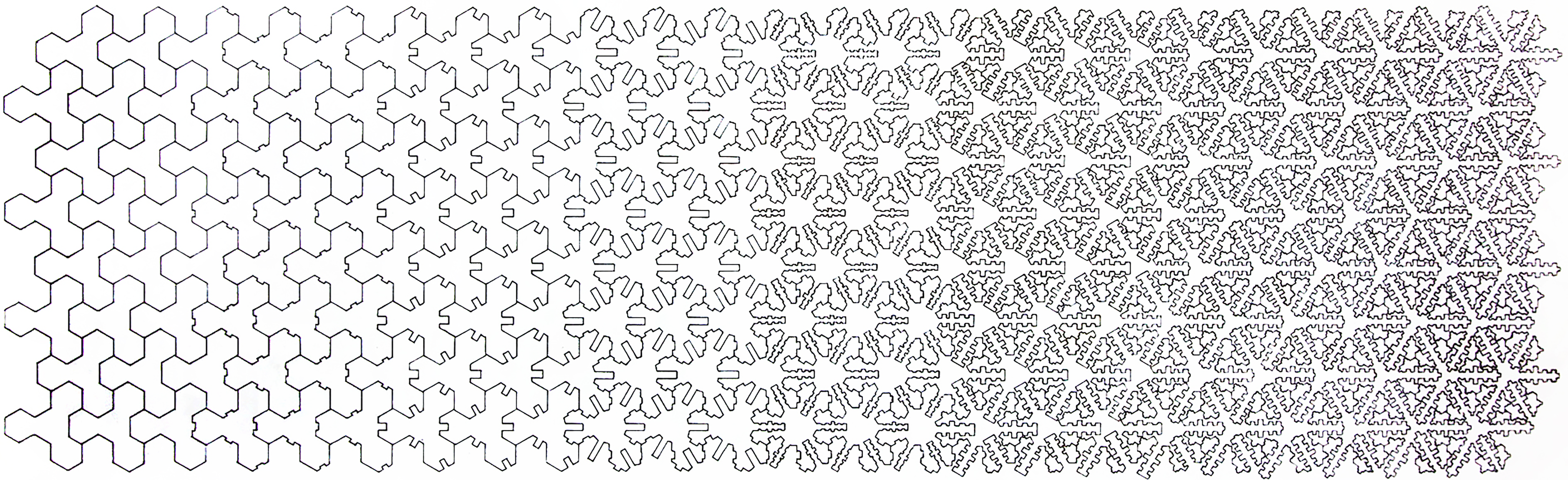
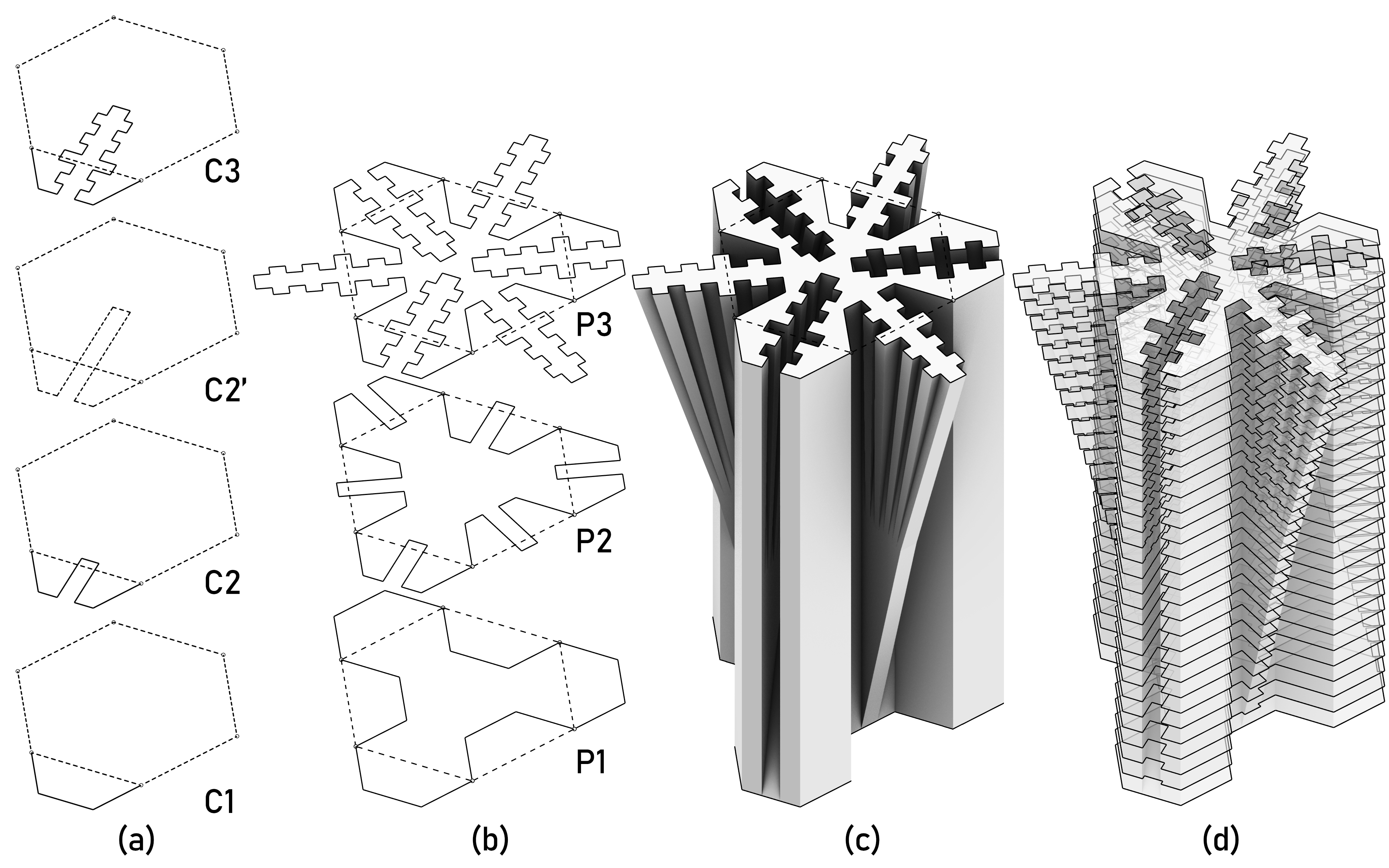
This prototile morphs into a shape with extensions inside and outside, creating the second prototile of Wiry Wonder. This morphing process finishes at the 8th tile from the left. The third and the last prototile make saw-like details on the newly created edges in the second prototile. Finally, this morphing process finishes on the right end. You can see these prototiles in below figure (a). It is the same symmetry operation with “Strange Start, Startling Stop”, that creates the prototiles shown in below figure (b).
The modeling approach presented above increases the speed of formal exploration. Using this method, you can design and draw a parquet deformation easily and quickly. Hopefully, I will present a Grasshopper toolset that helps in this task later. Thus, you can read the rest of the book chapter about this methodology here. I hope I will study more on this topic in the future and develop the Grasshopper addon better.
Cite this post
Related Posts
I at the Center
September 30, 2013
I at the Center is a multiple-axes vertex deformation based on a quadrangular hyperframe, designed by David Oleson at the studio of William Huff in 1964. Below, you see the original drawing and my Grasshopper animation based on a single-point attractor, creating the “I” wherever it is. It was a pleasure to read and repeat this deformation, which is a nice exercise in data tree operations and also one of the first examples I see about point attractor algorithms in design…
Trifoliolate
April 30, 2013
The Parquet Deformation exercise is generally originated with William Huff. Huff conducted it at several schools of architecture since the 1960s. Huff defines the exercise as rooted in two analytical disciplines; monohedral tilings in geometry, and the continuous deformations in biological morphology. This is generally exemplified by D’Arcy Thompson’s and Albrecht Dürer’s studies. One of the student’s works of Huff, Trifoliolate is a single-axis, single-prototile hexagonal parquet deformation. It was designed by Glen Paris at the studio of William Huff…
Metamorphosis
November 28, 2014
Here are some of the student works from this year’s Computation-based Basic Design Studio, centered around the captivating theme of Metamorphosis. Throughout the course, we tasked the students with pushing the boundaries of their creativity and innovation and encouraged them to construct designs that transcend conventional limitations and embody the essence of shapeshifting systematic wholes. The metamorphosis concept catalyzed their artistic exploration. Then, urged them to delve deep into the realm of design possibilities. A pivotal aspect of this studio…
Field Deformation
October 8, 2026
Ever since I restructured designcoding, I’m still sorting through the trash folder. All 580 posts published on the blog have been reviewed, and their files have been uploaded as open source. The mysterious trash folder, where I couldn’t even tell where things belonged, is shrinking fast. While checking this folder yesterday, I found a video. This is probably a simple tutorial I prepared about 10 years ago for the parametric modeling elective course (probably related to this 2012 post). The…
Deformation of Islamic Patterns
March 2, 2024
This is the new version of my previous study on the deformation of Islamic Patterns. I love the purity and simplicity of the geometric construction processes of these patterns. It is possible to observe them in many places in many different forms. By continuing this work, I aimed to highlight the pattern deformations that map out all the variation possibilities of these patterns. Unlike previous versions, this time I aimed to achieve results ready for laser-cutting production. As you will…