designcoding
About Table of Contents Keywords Monthly Archive
Support designcoding!

Paramod 2011 Fabrication

March 21, 2012

After a reviewing a short story of digital architecture from Branko Kolarevic, we looked at the roots of the theory and the concepts derived from it such as digital fabrication, building information modeling and parametric modeling. After a short brief, we’ve discussed about the final projects. Next week, we’ll start studying final projects and start to look at individual problems developed from them. Final submissions will highly be related with their design problem; it might be only digital animations, or…

Puzzling

March 21, 2012

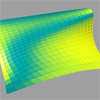
Nowadays, I found myself back into traditional hand sketching. Several failed attempts on Grasshopper led me back there. NURBS (and Grasshopper) somehow limits our conception of surfaces to four-cornered (or two-directional) manifolds. Although it sounds like limiting our designs, having four-cornered component spaces has still lots of experimental fields for designers. Escher is a cult person, who transforms the euclidean coordinate system to meet his design intentions. There are lots of interesting research about him, and he shows us how…

Trees and Recursive Computing

March 15, 2012

This topic of trees and recursive computing is inspired by the method shown here at the Rhino Python 101 Primer. This is a beautiful method of recursion that creates tree-like shapes, composed of arcs. I constructed these arcs by using the Arc SED (start, end, direction) method. This requires start and end points and a vector that is tangent to the arc (at the start point). Therefore, the overall look of a chain of these constructions creates curves with continuous…

Parametric Modeling Class: Subdivided Entities

March 14, 2012

Today, we’ve studied fundamentals of component-based design methods. Using curves and surfaces as starting points, we’ve experienced ways of translating those entities via design criteria based on our purposes. First, a curve is used to construct a leaf structure. We’ve experienced dispatching data lists and combining them back together. Subdividing curves into points created further entities such as vectors and planes. We used those entities as inputs of regular drawing and modeling commands such as rectangles, or planar surfaces. This…

Taenia Solium

March 14, 2012

Today, we’ve discussed ways of subdividing entities to create parametric definitions. Curves can be divided into segments, creating snake-like object definitions. This exercise is important regarding the management of data. Vectors and planes are used as reference entities here. Nowadays, it became clear to me that, reference planes are very important because they both include reference points and related vectors as well. The definition studied in this post includes a curve subdivision and a combination of vector / plane management to…

Parametric Muqarnas

March 13, 2012

This was an interesting topic in design computing class. Geometric constructions based on strict relationships are becoming exciting in parametric modeling environments. I think muqarnas includes such a relationship. There is a primary method of modeling this shape, introduced by Mete Tüneri. His solution to a simple parametric muqarnas object includes a surface with six reference points, with two boolean differences (one cylinder and one box) creating the component. In Grasshopper, I tried to simulate his process by adding real-time…

Attractors

March 7, 2012

Today’s subject was closely related to the one last week; the data list and data tree management. Creating suitable data structures for our purposes is one of the tricky parts of whole Grasshopper experiments. We’ve developed a grid of objects, somehow associated with another one (a curve). Strong emphasis was on the way of thinking, getting back and forth on the process, and the re-definition of data lists. Especially, this in-class exercise would help you understand basic design techniques in…

SPEC Student Examples

March 7, 2012

SPEC disappeared from our garden suspiciously. Hopefully, we’ve already finalized its parametric survey. Can create the original model by measuring exact corner coordinates. Then, it manipulated shape by creating diverse vectors for each shape. Emre has also tried a similar approach. Can be definition was too long, and did not use data trees, therefore it is slow. But it’s very effective at offering a solution for animation. I re-captured his frames for animation: Another innovative solution came from Yağız along…

Smooth Sketch Data Recorder

February 29, 2012

Here is a funny sketching system for the “SPEC” homework. Four (or more) points are created using 2d sliders (MD slider) and decomposed these points into x,y and z numbers. Then, they are re-populated in 3d points by changing their plane. X coordinates are connected into Y, and Y coordinates are connected to Z’s. Tricky part comes then, the X number is defined by a serie of numbers started from 0 to 30 by 1. After that, polylines are constructed using…

SPEC, Data Lists and Trees

February 29, 2012

Today, we’ve studied ways of representing multiple data structures in Grasshopper at ARCH 362. As of our last week’s experience, sometimes (most of the time actually) we’ll need to work with vast amount of data. We’ll have to control them in order to open door for further explorations. Today’s exercise was a good example of this “sustainable” process of data management. All functionality of Grasshopper is based on data matching. From short-list, long-list matching, to the structures of data trees….

« 1 2 3 … 41 42 43 44 45 46 47 48 49 50 51 52 53 54 55 56 57 »
  • Chapters

    • Algorithms
    • Discourses
    • Fabrications
    • Studios
  • Explore

    • All Keywords
    • Table of Contents
    • Monthly Archive
    • #platonic-solid
    • #stellated-solid
    • #gyroid
    • #sandblasting
    • #icosahedron
    • #responsive
    • #kangaroo
    • #parametric-curve
    • #designcoding
    • #interlocking
    • #vbnet
    • #tree
    • #rhombus
    • #space-filling
    • #koch
    • #computational-geometry
    • #tetrakaidecahedron
    • #3d-printing
    • #dual
    • #rhombicosidodecahedron
  • Search

  • Support designcoding!

  • Enjoying designcoding? Support me on Patreon to keep it growing. Thank you!

  • copyright 2026 designcoding.net | about | privacy policy | end user license agreement