designcoding
About Table of Contents Keywords Monthly Archive
Support designcoding!

Testing the Nesting

May 28, 2012

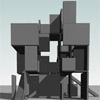
Here I am testing the nesting. RhinoNest is a plug-in for Rhino and a set of components for Grasshopper. I tested it using my old interlocking fabrication definition (here) and (here). I downloaded RhinoNest from this website and installed it. However, I sounded a little complicated at first sight. Then I found a sample definition (here) and modified it a little bit to meet my purposes. First of all, I added orientation components (grey group below) to align all sections to the WorldXY…

Icosahedron Study

May 27, 2012

I have come across several high school topics I was afraid of. While I was searching for a geodesic dome definition in Grasshopper, it was quite surprising that I found an easier way of modeling an approximation of icosahedron, the famous platonic solid. Icosahedron was a research topic of this website at various posts before (here, here, and here). In order to generate geodesic spheres, first I had to solve icosahedron. My first experiment was partially successful. I knew icosahedron’s…

Isovist Component

May 26, 2012

Yesterday, Kağan asked me about the isovist component in Grasshopper and how it works. In fact, it is a long story, I said because once upon a time, I was curious about Space Syntax theory as my old friend Ela Çil introduced it. So, here is an original definition of Michael Benedikt: “The environment is defined as a collection of visible actual surfaces in space. An isovist is the set of all points visible from a given vantage point in…

Semi-regular Tessellations

May 24, 2012

Creating and handling new types of grid configurations might be an important topic, as Grasshopper is not supporting them natively (yet). I tried to create some semi-regular tessellations based on regular grids. It is actually truncated versions of regular grids, but it slowly becomes interesting as I realized that I may further truncate emerging grids to create Level 2 and Level 3 grids with more complex tessellations. Here are two examples of Level 1, truncating regular tessellations of squares and…

Modeling a Geodesic Sphere

May 23, 2012

Not all of them, but when you get the idea, you’ll see there are lots of different alternatives for creating Fuller’s famous Geodesic Domes (Although in fact, he is not the inventor of it). I was playing with Platonic Solids in Rhino and realized that the “Pull” command is very useful in subdividing objects. I modeled this in Rhino 4. First, take a regular Icosahedron and divide it. Because, this is the simplest way for modeling a Geodesic sphere, by…

MetaBalls in 3D

May 23, 2012

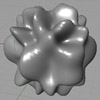
Playing with the 2D Metaball component in Grasshopper. I was curious about why there are no Metaballs in 3D in Grasshopper. Then, I realized that in fact, the 2D Metaball component is creating a section of a 3D Metaball computation. I think it is a topic worth studying even 10 years after this original post to develop an easy way to create the metaball surfaces. In 2012, thanks to the Grasshopper’s easy interface, I was able to create a series…

Excel Outputs in Grasshopper

May 22, 2012

Basic Design Studio at Bilgi University is coming to semester’s big final. Nowadays, students are trying to build their final projects. Oğuz and Gupse’s group has a truss structure with nearly 800 segments. They attempt to build it by taking length values from their own Rhino model by hand. And this itself had brought a difficulty, because one person of the group should be assigned only to do this measurement, reducing their workforce. They asked me if there is an…

Packing Objects with Galapagos

May 22, 2012

After the starting point of the Galapagos, there came another attempt to utilize this beautiful addition of David Rutten. This time, I worked over the night to tell it what I want. The aim was (or seemed to be) simple at first sight. I wanted several shapes (not one) to fit into an area, as smallest as possible, without overlaps. This is packing objects. A bounding box and area components quickly gave me the first fitness value. The area of the…

Evolutionary Solver Introduction

May 22, 2012

Galapagos was a great improvement when it became available natively within Grasshopper as an Evolutionary Solver. However, I couldn’t find time to examine it until recently. This examination gave me an idea of algorithmic thinking, tool making, and tool using. The first experiment shown below tries to solve equilateral triangulation, based on the Delaunay method. Galapagos has two different solvers, named “simulated annealing solver” and “evolutionary solver” shown respectively below. Both of them are trying to reach a fitness value…

Tetrahedron Quick Way

May 20, 2012

The tetrahedron is a popular platonic solid for designers. We’ve explained how to draw them using equilateral triangles here before. Recently I’ve found (sorry, lost the web address) a much quicker way of modeling a Tetrahedron using a cube. It’s very simple, just connecting the three opposite corners of the cube automatically makes them equal, resulting in the four equal faces. Of course this time you’ll have to calculate the actual edge length, but if you use the “box diagonal”…

« 1 2 3 … 38 39 40 41 42 43 44 45 46 47 48 49 50 51 52 53 54 55 56 57 »
  • Chapters

    • Algorithms
    • Discourses
    • Fabrications
    • Studios
  • Explore

    • All Keywords
    • Table of Contents
    • Monthly Archive
    • #logic
    • #dodecahedron
    • #revit
    • #islamic-pattern
    • #paneling
    • #wood
    • #hilbert
    • #rhombus
    • #geodesic
    • #linear-algebra
    • #animation
    • #wave
    • #tetrakaidecahedron
    • #facade
    • #macro
    • #ice-ray
    • #virtual-studio
    • #aperiodic
    • #design-competition
    • #dome
  • Search

  • Support designcoding!

  • Enjoying designcoding? Support me on Patreon to keep it growing. Thank you!

  • copyright 2026 designcoding.net | about | privacy policy | end user license agreement