designcoding
About Table of Contents Keywords Monthly Archive
Support designcoding!

Wind Tunnel in Vasari

April 13, 2012

When I was a student, 3D modeling and rendering on the computer was an advanced skill. I only managed to create my first rendering in the 4th-year project.  Then, it became a special talent for designers, even opening a freelance business. However, that came to an end when that technology expanded, reaching everybody. Ten years ago, different ecological analysis methods on geometric designs were also another specialized field that everybody doesn’t have access to. Now it seems those technical skills…

Paramod 2011 Mid-term

April 12, 2012

Today, we’ve finished first phase, the introduction to dataflow management in visual programming environments; and conducted “well defined” part of the mid-term examination. First two questions were designed to test technical skills of data matching, geometric evaluation. First one was a simple algorithm that calculates the area of ANY triangle in real-time. Tricky part of this problem was to research and find ways of calculating area and implementing it in Grasshopper. Most obvious formula, “a x h / 2” is…

Quadrilateral Surface Tessellation

April 9, 2012

As far as I understood, it is impossible to physically construct double-curved surfaces from quadrilateral and planar faces. This definition tries to find an optimized alternative to this problem. Any surface, single or double curved, is divided into standard sub surfaces. But this time, those surfaces are treated as planar surfaces, therefore one corner is moved to meet this requirement. The output consists of only planar surfaces ready for fabrication. There are potential improvements to this definition such as finding…

Monkey Saddle Surface

April 8, 2012

This is another popular “math surface” being rediscovered by designers nowadays, in 2012. Saddle surfaces, seen above as mentioned earlier (here) have a special type named “Monkey Saddle Surface”. This surface was a dramatic example of how Grasshopper can control equations and instantly show graphical results. The mathematical equations start with Z=… this makes it very easy for us to transform any x-y grid centers (a 2d data tree of 3d points) and add z values to them according to…

QuickShaper

April 5, 2012

QuickShaper (QS) an experimental computer utility for Shape Grammars. It aims to assist designers and students in creating and exploring rule-based designs. QS is first presented and published with Birgül Çolakoğlu at the 25th eCAADe Conference held at Frankfurt / Germany in September 29th, 2007. QS is a scripted utility, written in MaxScript, developed within Autodesk’s 3D Studio MAX version 9. It is not tested on earlier versions. QS works well with Max Design 2011 after modified 1.80 version. This…

Icosahedron by Code

April 5, 2012

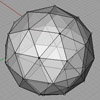
I tried different approaches to drawing platonic solids using Grasshopper’s native components. However, it seems impossible now. In geometric definition, a platonic solid is a set of points, distributed on a sphere with equal distances. If the set contains 12 points, then it’s an icosahedron. I found lots of information about these objects and mathematicians seem to love analyzing them. They created different approaches to building an icosahedron. One of them is very suitable to implement on Grasshopper’s VB component….

Window Component in Revit

April 5, 2012

[It seems simple at first sight, but creating a window definition in Revit requires a lot more time than I expected. A freelance job led me to create this parametric object, when I saw the architect’s sketch of all window types of the building side by side. There was a clear connection between all of them, leading me to define a single window object. Of course I’m not happy with the overall look of the window, those sills; but, what…

Paramod 2011 Student Examples

April 4, 2012

Here are some results of fourth homework. An animate design sketch of a roof structure. Yağız, Deniz and Sacha created animated results; Derya and Sacha proposed conventional approaches to create “openings” by animating geometries. However, that does not meet the requirement of structural (and logical) intentions of the design problem. Unless some very high-tech materials were introduced to design. On the other hand, Yağız tried to create a structure that looks more like real. This exercise showed us that in…

Grande Armchair

April 3, 2012

This is another old-school approach to parametric modeling, today known better as part of Building Information Modeling. I tried to create parametric objects in order to understand and learn the capabilities of Revit.  That was very useful for me in learning this interface. I specially chose Le Corbusier’s chair set as my first experiment on family creation in Revit. On his 100th anniversary of Eastern Voyage, Le Corbusier’s soul returned here, walking around the conference halls of Istanbul. This set…

Eschers Tessellations

March 29, 2012

After Puzzling, I tried to establish more of Escher’s basic grid transformations using Grasshopper’s native components. This definition simulates Escher’s transformation of four-cornered grids. The postulate is based on the fact that every quadrilateral (or triangular) planar shape can create regular tessellations without gaps or overlaps. In the traditional method, this tessellation is achieved by rotating the shape 180 degrees and copying afterward. However, in Grasshopper we simply define the fifth point for each shape and divide subsurfaces into four…

« 1 2 3 … 40 41 42 43 44 45 46 47 48 49 50 51 52 53 54 55 56 57 »
  • Chapters

    • Algorithms
    • Discourses
    • Fabrications
    • Studios
  • Explore

    • All Keywords
    • Table of Contents
    • Monthly Archive
    • #art
    • #nesting
    • #complex-number
    • #semi-regular
    • #virtual-studio
    • #3d-printing
    • #curvature
    • #design-competition
    • #robot
    • #image-sampler
    • #unrolling
    • #wave
    • #b-spline
    • #geodesic
    • #linear-algebra
    • #octahedron
    • #ice-ray
    • #space-syntax
    • #timer
    • #minimal-surface
  • Search

  • Support designcoding!

  • Enjoying designcoding? Support me on Patreon to keep it growing. Thank you!

  • copyright 2026 designcoding.net | about | privacy policy | end user license agreement