designcoding
Search
About Table of Contents Keywords Support designcoding!

Research

320 posts

Hexagonal grid with Rhino Python

July 25, 2017
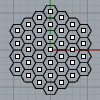
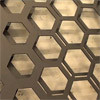
This python code proves how much effort it takes to create a simple hexagonal tessellation. There are, of course, much easier and faster methods than this. But here you see a code that introduces students to Rhino Python. Using this code, a new Rhino command…
Arc Tree Revisited: Anemone Update

April 26, 2015

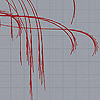
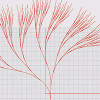
This is a classical method of generating tree-like forms utilizing a simple command “Arc SED”. The idea is simple, as the command draws arcs using an input direction vector, so this could easily be implemented creating a “smooth” composition of curves just by iteration. Actually,…

Canopy of Vector Fields

April 26, 2015

Utilizing “Force Field” components of Grasshopper to show my students how it is easy to develop flexible surfaces in design. The classical parametric canopy design is introduced in this video: According to Wikipedia; In vector calculus, a vector field is an assignment of a vector…

A-Chord Folding Structure

April 12, 2015

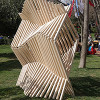
The A-Chord folding structure was developed and constructed for the World Wood Day 2015 event in İstanbul. The structure had fifty wooden struts of 4 cm X 4cm with changing heights from 200 cm to 230 cm. Two struts joined with a hinge enabled the folding motion…

Fractal Trees

April 11, 2015

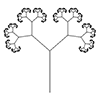
Based on this post, the problem of modeling tree-like fractal shapes is still a good question for the early years of computational design education. Last time, I used Rhino’s macro to study these fractal trees in an “impossibly” limited interface. But this time I used a…

Ice-Ray Lattices Revisited

April 9, 2015

Further studying iteration in Grasshopper, this time, inspired by George Stiny’s “Chinese Ice-Ray Lattice” subdivisions with Aneome, instead of the Hoopsnake add-on I tried in the previous work. As you know, loops add various ways of usage to Grasshopper. In future versions, loops may cease…

Delaunay Triangulation on Surface

March 26, 2015

This is a useful tip both to solve some of the problems with custom surface subdivisions, and to explain the uses of parametric surface evaluations (the U, V, W thing) and the practical use of data lists. Step 1: Put your points inside 0,0,0 and 1,1,0…

Force Fields in Grasshopper

March 17, 2015

Finally, I had a chance to test and understand the force fields tab in Grasshopper. It creates a continuous vector field inside of a given boundary. Therefore, it is very useful if you want to create an effect of the continuous presence of a force, such…

Herringbone Tiling

February 23, 2015

This quick project was about a special tiling pattern inside a multi-story residential building’s hallways in Grasshopper. While drawing the construction documents of the project, it was necessary to apply some coding here, as each floor had a different shape to be tiled. Although it is not…

Contour-fold Structure

February 1, 2015

Euclidean constructions, when represented computationally, rely on algorithms and mathematical principles to generate geometric shapes and forms. Through precise calculations and logical operations, a computer program can emulate the actions of a compass and straightedge, constructing lines, circles, and polygons with accuracy and efficiency. These…

Landscape Extensions Final: Digital Sketch

February 1, 2015

This is the final Grasshopper sketch of our graduate studio conducted together with Fulya Akipek at Yıldız Technical University Computational Design Unit. The project was about designing parametric “Landscape Extensions” at Kabataş Park. I hope I’ll be able to post the actual student works and…

Mesh

January 20, 2015

This year’s first semester at Basic Design Studio was full of surprises. Together with Can Sucuoğlu and Birgül Çolakoğlu, we coordinated 9 student groups in their 4-week final project called “Arboriforms“.  “Arbori-” is derived from the Latin word “arbor,” meaning “tree,” and “-form” indicates a…

Seamless Patterns Revisited

January 2, 2015

Again, we revisited the seamless patterns exercise this semester. This is one of the main exercises of architectural geometry class. We expected to improve students reasoning on generative patterning while they explain their processes step by step. The key element of this exercise is the usage of…

Tetrahedral Helix and Snake Game

January 2, 2015

This is the Grasshopper definition that generates a tetrahedral helix (also called as Boerdijk-Coxeter helix) but in a funny way. This geometry is also a solution for tangent spheres. I generated the helix using Anemone components for recursion and gave it a little bit of responsiveness….

The Miura Fold

May 23, 2014

This is one of the works of the three-day workshop at Eskişehir Anadolu University, called “Animate Patterning“. This project is based on our previous folding experiment posted here, while students advanced it, testing a folding style called “Miura”. They built a 2.5m x 1m folding pattern, explained…

Prototype Cut-Fold

May 12, 2014

Inspired by this cut-fold pattern, we developed a prototype with Fulya Akipek. The first experiments were made from 3mm thick foamboards and they worked very well with 50×70 plates. However, when the project gets bigger and bigger, we needed to add a joint detail and use…

Kinetic Tessellation

May 12, 2014

This is one of the ideas we’ve tested for the workshop “Animate Patterning“. Inspired by this work, Apart from the pattern that turns around, the torque, rotation radius and speed of the servo, weight, connection detail, and a number of foamboards become important inputs for…

Cycloid Experiment

May 9, 2014

This is a Cycloid-like family of curves, generated by its classical description: a rolling circle. I had several other studies on similar topics before. In this cycloid experiment, I used Grasshopper in which, we don’t need to roll the circle. Instead, we can divide a…

Branches by Looping

May 9, 2014

While testing Anemone components for Grasshopper, I accidentally generated these branches by looping. In fact, I was trying to develop the definition that mimics the well-known “Arch SED” component method. This method uses the tangent vectors for the endpoints of the arcs. Then, it iterates…

Life Sciences

April 30, 2014

Here is the video of the project Life Sciences, designed together with Fulya Akipek, and engineered by Filika Interactive. To be presented in the 2014 Vitra Contemporary Architecture Series Exhibition, Life Sciences is an interactive project produced by Filika Interactive using Openframeworks following the conceptual and visual…

« 1 2 3 4 5 6 7 8 9 10 11 12 13 14 15 16 »
  • Search

  • Categories

    • Education
      • Basic Design
      • Design Geometry
      • Design Mathematics
      • Digital Fabrication
      • Parametric Modeling
      • Tutorials
    • Philosophy
      • Analytical Tradition
      • Phenomenology
    • Practice
      • 3D Models
      • Projects
      • Publications
      • Workshops
    • Research
      • 3D Printing
      • Building Facade
      • Calculus
      • Climate Analysis
      • Compass Constructions
      • Computational Geometry
      • Curves
      • Decorative Arts
      • Digital Fabrication
      • Evolutionary Solvers
      • Folding Structures
      • Fractals
      • Graph Theory
      • Interlocking Structures
      • Islamic Patterns
      • Linear Algebra
      • Minimal Surfaces
      • Muqarnas
      • Non-Euclidean Geometry
      • Paneling
      • Parametric Curves
      • Parametric Objects
      • Parametric Surfaces
      • Pattern Deformations
      • Patterns
      • Pavilions
      • Polyhedra
      • Rammed Earth Structures
      • Robotic Fabrication
      • Shape Grammars
      • Simulation
      • Space Syntax
      • Surface Constructions
      • Tessellations
      • Tools
      • Vector Fields
      • Virtual Reality
    • Tools and Languages
      • 3DS Max
      • 3DS Max Script
      • Grasshopper
      • Photoshop
      • Physical Prototyping
      • Revit
      • Rhino
      • Rhino Macro
      • Rhino Python
      • Rhino Script
      • Unity
  • Monthly Archive

    • August 2026 (1)
    • October 2025 (1)
    • June 2025 (2)
    • May 2025 (2)
    • April 2025 (5)
    • December 2024 (40)
    • August 2024 (5)
    • July 2024 (6)
    • April 2024 (4)
    • March 2024 (10)
    • February 2024 (10)
    • January 2024 (8)
    • December 2023 (10)
    • August 2023 (3)
    • July 2023 (3)
    • June 2023 (7)
    • May 2023 (8)
    • April 2023 (7)
    • March 2023 (2)
    • February 2023 (2)
    • January 2023 (3)
    • December 2022 (6)
    • November 2022 (7)
    • January 2022 (1)
    • December 2021 (1)
    • October 2021 (3)
    • September 2021 (4)
    • August 2021 (4)
    • May 2019 (2)
    • April 2019 (1)
    • March 2019 (5)
    • January 2019 (2)
    • December 2018 (1)
    • November 2018 (4)
    • October 2018 (9)
    • July 2018 (1)
    • June 2018 (3)
    • May 2018 (1)
    • April 2018 (4)
    • February 2018 (2)
    • January 2018 (7)
    • August 2017 (9)
    • July 2017 (6)
    • October 2016 (1)
    • May 2015 (5)
    • April 2015 (8)
    • March 2015 (12)
    • February 2015 (4)
    • January 2015 (11)
    • November 2014 (1)
    • August 2014 (1)
    • June 2014 (2)
    • May 2014 (12)
    • April 2014 (5)
    • March 2014 (3)
    • February 2014 (6)
    • January 2014 (4)
    • December 2013 (5)
    • November 2013 (11)
    • October 2013 (2)
    • September 2013 (9)
    • August 2013 (4)
    • July 2013 (2)
    • June 2013 (14)
    • May 2013 (4)
    • April 2013 (10)
    • March 2013 (11)
    • February 2013 (11)
    • January 2013 (10)
    • December 2012 (10)
    • November 2012 (6)
    • October 2012 (13)
    • September 2012 (2)
    • August 2012 (5)
    • July 2012 (14)
    • June 2012 (6)
    • May 2012 (17)
    • April 2012 (15)
    • March 2012 (9)
    • February 2012 (16)
    • January 2012 (18)
    • December 2011 (20)
    • November 2011 (2)
  • Support designcoding!

    Enjoying designcoding? Support its future with a small donation on Patreon. Thank you!

    Patreon


    copyright 2026 designcoding.net | about | table of contents | keywords | privacy policy | end user license agreement