designcoding
Search
About Table of Contents Keywords Support designcoding!

surface

33 posts

Quadrilateral Surface Tessellation

April 9, 2012
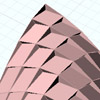
As far as I understood, it is impossible to physically construct double-curved surfaces from quadrilateral and planar faces. This definition tries to find an optimized alternative to this problem. Any surface, single or double curved, is divided into standard sub surfaces. But this time, those…
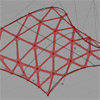
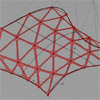
Paramod 2011 Subdivided Entities

March 14, 2012

Today, we’ve studied fundamentals of component-based design methods. Using curves and surfaces as starting points, we’ve experienced ways of translating those entities via design criteria based on our purposes. First, a curve is used to construct a leaf structure. We’ve experienced dispatching data lists and…

Parametric Truss

February 10, 2012

This is the old-method Parametric Truss definition. Interestingly this quickly became a solid solution, used and taught for years. I couldn’t find a better answer yet. As Grasshopper updates, some of the components in this definition change but the overall structure remains. Subdivision of a…

Data Recorder and Surfaces

February 7, 2012

In this experiment, I’m trying to use data recorder to change components on a surface. The component part is a standart triangular construction, but the attractor points are defined by a 2D slider that is connected to a data recorder. Data recorder remembers last 15…

Basic Curve Attractor

January 31, 2012

This study includes three main topics related to the basics of Grasshopper. The first one is the surface subdivision, the parametric definition of a surface component, that is, in this case, a simple pyramidal object. The second thing is the associative behavior of surface components…

Interlocking Structure Between Two Surfaces

January 29, 2012

A previous work showed a method to create interlocking structures to be created without boolean operations. This time, a small addition is made to create waffle objects using two surfaces, one is the top surface, and the other is the bottom. It was a small…

Surface Components Basics

January 17, 2012

This is a basic formation of component-based design in a dataflow environment. A double-curved surface is subdivided and re-constructed using straight sections. Parametric model of a surface construction by variable components. The main data list of subsurfaces are distributed into four distinct lists, that will…

Moebius Basics

January 15, 2012

One of the most popular shapes in topology studies is the one-edge, one-face Moebius strip. Here is a basic definition that generates Moebius-like lofted surfaces. I say Moebius-like because, in Grasshopper, Rhino, or any NURBS surface method, I couldn’t manage to model this shape in…

Tumbler Brick Wall

January 8, 2012

There are a couple of experiments in different schools about organizing free-form surfaces (walls here) with a composition of modular elements (bricks). Even though they created robots to make such brick walls, I still couldn’t understand why. Although creating a parametric model that calculates the…

Interlocking Structure (No Boolean)

January 2, 2012

It has been a tough problem for me, for the last two days. A parametric model of an interlocking structure (sometimes also called egg-crate, waffle, or contouring structure) can be created easily in Grasshopper using a Contour component. In addition, you need a couple of…

Surface Subdivision

December 25, 2011

[2011_12_25_divide] here is the fundamental of surface subdivision in Grasshopper. In order to design a parametric truss exercise, this is the generally accepted starting point. Get a surface from the file, subdivide it into U and V directions to create point lists, and then manipulate…

Graph Surface

December 24, 2011

This time, in order to develop a potential “dummy” surface for Grasshopper experiences, I built a better definition. The Graph Surface definition uses a polygon as a basis, divides the edges and moves them according to various parameters. It’s fun to play with mapping different…

Graph Mapping Edge Surface

December 19, 2011

The smooth and continuous nature of the “Sine Surface” has garnered significant popularity among designers and architects alike. This captivating curved surface offers a visually pleasing aesthetic that adds an elegant touch to various design projects. Its flowing contours and gentle undulations create a sense…

« 1 2
  • Search

  • Categories

    • Education
      • Basic Design
      • Design Geometry
      • Design Mathematics
      • Digital Fabrication
      • Parametric Modeling
      • Tutorials
    • Philosophy
      • Analytical Tradition
      • Phenomenology
    • Practice
      • 3D Models
      • Projects
      • Publications
      • Workshops
    • Research
      • 3D Printing
      • Building Facade
      • Calculus
      • Climate Analysis
      • Compass Constructions
      • Computational Geometry
      • Curves
      • Decorative Arts
      • Digital Fabrication
      • Evolutionary Solvers
      • Folding Structures
      • Fractals
      • Graph Theory
      • Interlocking Structures
      • Islamic Patterns
      • Linear Algebra
      • Minimal Surfaces
      • Muqarnas
      • Non-Euclidean Geometry
      • Paneling
      • Parametric Curves
      • Parametric Objects
      • Parametric Surfaces
      • Pattern Deformations
      • Patterns
      • Pavilions
      • Polyhedra
      • Rammed Earth Structures
      • Robotic Fabrication
      • Shape Grammars
      • Simulation
      • Space Syntax
      • Surface Constructions
      • Tessellations
      • Tools
      • Vector Fields
      • Virtual Reality
    • Tools and Languages
      • 3DS Max
      • 3DS Max Script
      • Grasshopper
      • Photoshop
      • Physical Prototyping
      • Revit
      • Rhino
      • Rhino Macro
      • Rhino Python
      • Rhino Script
      • Unity
  • Monthly Archive

    • August 2026 (1)
    • October 2025 (1)
    • June 2025 (2)
    • May 2025 (2)
    • April 2025 (5)
    • December 2024 (40)
    • August 2024 (5)
    • July 2024 (6)
    • April 2024 (4)
    • March 2024 (10)
    • February 2024 (10)
    • January 2024 (8)
    • December 2023 (10)
    • August 2023 (3)
    • July 2023 (3)
    • June 2023 (7)
    • May 2023 (8)
    • April 2023 (7)
    • March 2023 (2)
    • February 2023 (2)
    • January 2023 (3)
    • December 2022 (6)
    • November 2022 (7)
    • January 2022 (1)
    • December 2021 (1)
    • October 2021 (3)
    • September 2021 (4)
    • August 2021 (4)
    • May 2019 (2)
    • April 2019 (1)
    • March 2019 (5)
    • January 2019 (2)
    • December 2018 (1)
    • November 2018 (4)
    • October 2018 (9)
    • July 2018 (1)
    • June 2018 (3)
    • May 2018 (1)
    • April 2018 (4)
    • February 2018 (2)
    • January 2018 (7)
    • August 2017 (9)
    • July 2017 (6)
    • October 2016 (1)
    • May 2015 (5)
    • April 2015 (8)
    • March 2015 (12)
    • February 2015 (4)
    • January 2015 (11)
    • November 2014 (1)
    • August 2014 (1)
    • June 2014 (2)
    • May 2014 (12)
    • April 2014 (5)
    • March 2014 (3)
    • February 2014 (6)
    • January 2014 (4)
    • December 2013 (5)
    • November 2013 (11)
    • October 2013 (2)
    • September 2013 (9)
    • August 2013 (4)
    • July 2013 (2)
    • June 2013 (14)
    • May 2013 (4)
    • April 2013 (10)
    • March 2013 (11)
    • February 2013 (11)
    • January 2013 (10)
    • December 2012 (10)
    • November 2012 (6)
    • October 2012 (13)
    • September 2012 (2)
    • August 2012 (5)
    • July 2012 (14)
    • June 2012 (6)
    • May 2012 (17)
    • April 2012 (15)
    • March 2012 (9)
    • February 2012 (16)
    • January 2012 (18)
    • December 2011 (20)
    • November 2011 (2)
  • Support designcoding!

    Enjoying designcoding? Support its future with a small donation on Patreon. Thank you!

    Patreon


    copyright 2026 designcoding.net | about | table of contents | keywords | privacy policy | end user license agreement