
Surface Subdivision
Here is the fundamental of surface subdivision in Grasshopper. In order to design a parametric truss exercise, this is the generally accepted starting point. Get a surface from the file, subdivide it into U and V directions to create point lists, and then manipulate these points to create something interesting. Having a list of points would also present good potential regarding attraction with other entities, such as point or curve attractors. As you probably notice, this is the new version of Grasshopper, which also includes NURBS objects.
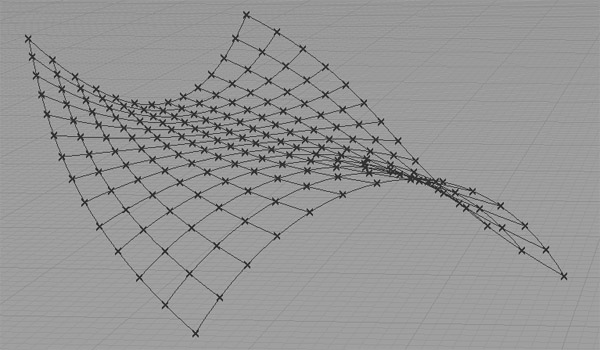
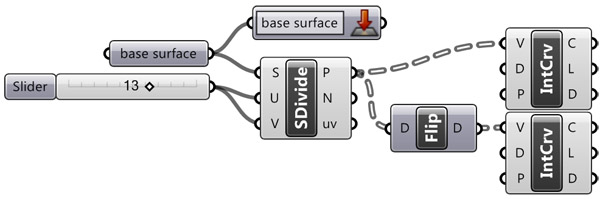
As a parametric truss exercise, this method has some other variations, using subsurfaces or Delaunay connectivity diagrams. It’s up to the designer to make this choice, however, no one still manages to represent all possible choices. From an educational perspective, such explorations might give students a fundamental understanding of parametric modeling and associative geometry but also has pitfalls such as software dependency (especially in pretty VPLs such as Grasshopper).
Cite this post
Related Posts
Rhombille Tiling on Surface
June 13, 2023
This is an update on my 2012 exercise on rhombille tiling. This reminded me of the old-school subdivisions of surfaces again after 11 years. It was while reading about rhombic dodecahedron (the stackable solid), that I came across this cute tiling. It’s quite simple, just a hexagonal grid with a special reconstruction. I decided to recreate it by using well-known native Grasshopper components. I animated the result with a variation of the Breaststroke surface function (described here). Then I reconstructed…
Defective Use of Algorithms: TPI Disability
June 24, 2013
This is based on my failure of creating an optimum solution for planar polygonal subdivisions. There is a method called Tangent Plane Intersection (TPI), explained briefly here (sometimes similar algorithms are called “planar remeshing” and “variational shape approximation”) which is effectively used in the Trada pavilion (here). I tried to implement a similar method using only native Grasshopper components and no recursion, but it quickly became much more complicated than I thought. It was based on the simple idea that…
Quadrilateral Surface Tessellation
April 9, 2012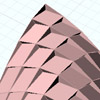
As far as I understood, it is impossible to physically construct double-curved surfaces from quadrilateral and planar faces. This definition tries to find an optimized alternative to this problem. Any surface, single or double curved, is divided into standard sub surfaces. But this time, those surfaces are treated as planar surfaces, therefore one corner is moved to meet this requirement. The output consists of only planar surfaces ready for fabrication. There are potential improvements to this definition such as finding…
Surface Components Basics
January 17, 2012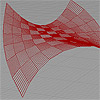
This is a basic formation of component-based design in a dataflow environment. A double-curved surface is subdivided and re-constructed using straight sections. Parametric model of a surface construction by variable components. The main data list of subsurfaces are distributed into four distinct lists, that will be used to construct lines out of double-curved quadrilateral faces. Such definitions could be further advanced by adding a precise fabrication detail.
Snub Square Surface
February 20, 2013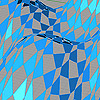
For the last 10 days, I’ve been searching for a proper algorithm for representing surfaces using planar shapes. It is obvious that triangulation is an answer but there is an interesting research topic of planar remeshing using shapes other than quads, hexagons, or any other regular polygons. Especially in computer graphics, such things refer to the optimization of models to decrease the load of GPUs. In the Grasshopper community, this has also been discussed and there is a great implementation…