
Tumbler Brick Wall
There are a couple of experiments in different schools about organizing free-form surfaces (walls here) with a composition of modular elements (bricks). Even though they created robots to make such brick walls, I still couldn’t understand why. Although creating a parametric model that calculates the exact locations of bricks, seems very easy at first sight, there came severe problems to solve in order to achieve a correct layout without using helpers such as physics engines. Of course, it’s possible to achieve this simply with a projection from a single direction, however, I wanted to develop a parametric model that also works when the “wall” tumbles. That led us to the problem of equal subdivision of surfaces in Grasshopper.
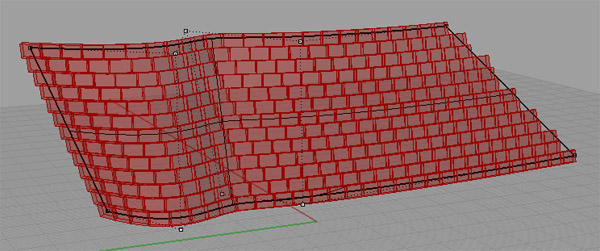
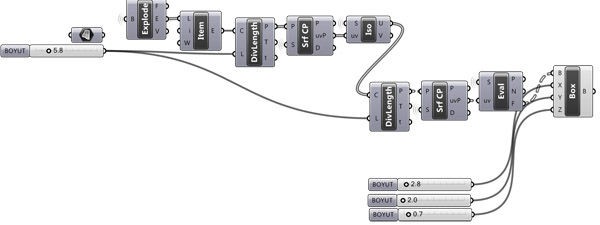
Here is an old definition. You can download the Grasshopper and the Rhino documents. The “tumbler brick wall” should be studied deeper into calculating the angle, direction, and brick layouts of original masonry techniques.
Cite this post
Related Posts
Parametric Brickwork
January 7, 2013
You might recall this type of parametric brickwork from architectural classics, such as the Programmed Wall by ETH Zurich and Gramazio Kohler Research, or the facade of the Mulberry House by SHoP Architects. Initially, I explored the simplest method for placing boxes on a surface, but this approach didn’t yield the correct layout. To improve it, I introduced gaps, which not only liberated the wall’s design but also opened up exciting possibilities for manipulating the “gap” parameter and brick sizes….
Parametric Bricks
January 17, 2024
In 2016, archi-union architects and fab-union intelligent engineering completed the renovation of the art gallery in Shanghai, China. The distinctive feature of the building was the robotic masonry fabrication of the brick facades. The undulating and waving parametric bricks were increasingly becoming popular after the introduction of parametric design tools such as Grasshopper and the works of Gramazio & Kohler at ETH Zurich since 2008, I guess. I made two Grasshopper experiments in 2012 and 2013 to generate such structures….
Parametric Muqarnas Blocks
January 9, 2024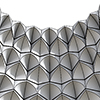
While reviewing past Grasshopper studies, I stumbled upon a Parametric Muqarnas study dating back 11 years. Although it shares numerous characteristics with a muqarnas design, it is not a perfect match. The Grasshopper definition used in that study was not particularly efficient, prompting me to revisit and improve it. This particular design presents various challenges, making it an excellent exercise for mastering Grasshopper. My goal with this study was to create Parametric Muqarnas Blocks suitable for 3D printing. To achieve…
Parametric Muqarnas
March 13, 2012
This was an interesting topic in design computing class. Geometric constructions based on strict relationships are becoming exciting in parametric modeling environments. I think muqarnas includes such a relationship. There is a primary method of modeling this shape, introduced by Mete Tüneri. His solution to a simple parametric muqarnas object includes a surface with six reference points, with two boolean differences (one cylinder and one box) creating the component. In Grasshopper, I tried to simulate his process by adding real-time…
Robotic Fabrication Student Project: Micro-Wave
March 21, 2019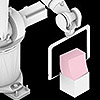
This is a robotic fabrication student project developed in the Digital Fabrication elective course in 2018. This group of students experimented with the hot wire cutting of EPS foam. Their aim was to create curved surfaces by using a straight wire. Design research started with a literature study of precedents. Then, after several cutting experiments with the available hotwire cutter tool, they gained better control over the technology. However, they found the available tool too large and inefficient. They decided…