designcoding
About Table of Contents Keywords Monthly Archive
Support designcoding!

Kangaroo 2 Test

April 27, 2015

After several readings, I’ve understood the way of working the new and very interesting feature of Kangaroo 2: “Grab”. Now, we can actually grab the Grasshopper objects from Rhino viewport! Also, on one hand, the new Kangaroo has a very special way of working (not common to us, native Grasshopper users) and on the other hand, it is very very easy to use and understand now. I loved that. Here is the classical truss exercise I’ve made with my students…

Tower Crane Exercise

April 26, 2015

It is a nice exercise to study various components of point-to-curve transformations and vice versa. Tower Crane was our second-week exercise at İstanbul Bilgi University Faculty of Architecture Parametric Modeling class, asking students to design and draw a parametric object that has joints and parts that are moving alongside straight lines. Below is the most “safe-side” solution for me, although there are also very complicated solutions such as Mertcan’s.

Arc Tree Revisited: Anemone Update

April 26, 2015

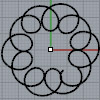
This is a classical method of generating tree-like forms utilizing a simple command “Arc SED”. The idea is simple, as the command draws arcs using an input direction vector, so this could easily be implemented creating a “smooth” composition of curves just by iteration. Actually, this has been a previous study, discussed before here, using Hoopsnake. Now, this time I’m implementing the same algorithm using Anemone and a couple of other changes. Here is the Grasshopper definition (Anemone Components should be…

Canopy of Vector Fields

April 26, 2015

Utilizing “Force Field” components of Grasshopper to show my students how it is easy to develop flexible surfaces in design. The classical parametric canopy design is introduced in this video: In vector calculus, a vector field is an assignment of a vector to each point in a subset of space. A vector field in the plane, for instance, can be visualized as a collection of arrows with a given magnitude and direction each attached to a point in the plane….

A-Chord Folding Structure

April 12, 2015

The A-Chord folding structure was developed and constructed for the World Wood Day 2015 event in İstanbul. The structure had fifty wooden struts of 4 cm X 4cm with changing heights from 200 cm to 230 cm. Two struts joined with a hinge enabled the folding motion of the structure. Thus, the nearby unit is folding in the opposite direction. The Grasshopper model generated all construction details and drawings automatically. As a result, these data enabled the revisions needed for structural experiments. In…

Fractal Trees

April 11, 2015

Based on this post, the problem of modeling tree-like fractal shapes is still a good question for the early years of computational design education. Last time, I used Rhino’s macro to study these fractal trees in an “impossibly” limited interface. But this time I used a VB.NET script. Here is the code inside of the VB.net component: Here are the inputs. x is the number of iterations. The Crv input is a line needed for the first iteration. t represents how…

Facade Studies

April 11, 2015

Some facade studies as early sketches of an architectural project; all of them are utilizing a similar Grasshopper approach. My favorite “Graph Mapper” generates the overall gridal deformation, then some of them are drawing geometry for membranes, while others are generated to be realized from sheet metal. Hopefully, one or two of these could be further studied: “Below, I am sharing my favorite among these codes. I had to pull off some geometric acrobatics to affect all four facades of…

Ice-Ray Lattices Revisited

April 9, 2015

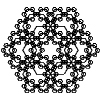
Further studying iteration in Grasshopper, this time, inspired by George Stiny’s “Chinese Ice-Ray Lattice” subdivisions with Aneome, instead of the Hoopsnake add-on I tried in the previous work. As you know, loops add various ways of usage to Grasshopper. In future versions, loops may cease to be just an add-on and become native components of Grasshopper. Until then, loop plugins like Anemone take on this task. In the example here, we create an application by throwing random lines to divide…

ARCH362 Midterm

March 27, 2015

About to finish the well-defined section of this year’s Parametric Modeling course, here are the mid-term questions I’ve asked; First question checks if the curve < > point conversions are well understood in Grasshopper. Evaluating a parametric curve and generating the closest point from another curve. This also requires a basic understanding of the use of the Grasshopper interface. The second question was testing a basic and classical use of attractors on grids of objects. Students generated their own grids…

Leveling in Dataflow

March 26, 2015

This is a great book, explaining very familiar concepts of dataflow diagrams for designers firsthand. Leveling is an interesting chapter there, I’m not sure if it completely fits with the use of “Clusters” in Grasshopper but it is obvious that the complex systems should be well organized not only to be perceptually “better” ones but also to develop a way to use parts of definitions again and again in different situations. …How do you actually DO the leveling of DFDs? The…

« 1 2 3 … 16 17 18 19 20 21 22 23 24 25 26 27 28 29 30 31 32 33 34 35 36 … 55 56 57 »
  • Chapters

    • Algorithms
    • Discourses
    • Fabrications
    • Studios
  • Explore

    • All Keywords
    • Table of Contents
    • Monthly Archive
    • #3d-printing
    • #anemone
    • #enneahedron
    • #paneling
    • #euclidean-construction
    • #wood
    • #designcoding
    • #sphere
    • #octahedron
    • #buckyball
    • #hilbert
    • #metaball
    • #dome
    • #tetrahedron
    • #fourier
    • #rammed-earth
    • #puzzle
    • #space-filling
    • #complex-number
    • #icosidodecahedron
  • Search

  • Support designcoding!

  • Enjoying designcoding? Support me on Patreon to keep it growing. Thank you!

  • copyright 2026 designcoding.net | about | privacy policy | end user license agreement