…While it is true that every curve which can be described by a continuous motion should ve recognized in geometry, this does not mean that we should use at random the first one that we meet in the construction of a given problem. We should always choose with care the simplest curve that can be used in the solution of a problem, but it should be noted that the simplest […]
Digging out with Grasshopper, Rhinoscript, and Paneling Tools, everything seems to be more and more automated and fast. However my colleagues Mete, Benay and Elif reminded me that, we can always do much with those high-end architectural geometry tools, but we still have to understand and follow the roots, probably best described by the “manual ways”. Sometimes using these methods would be much more intuitive as they are SLOW enough […]
Experimenting with various plug-ins for solar calculations, I found Daniel Da Rocha’s robust implementation of the solar position algorithm in vb.net. It calculates the solar angle of any place and time. Although it’s written in the old vb.net component, it still works great. I’m trying to create a fast and easy workflow to optimize Grasshopper models based on solar directions. This is done by projecting faces to the solar planes […]
Today, there are pedagogical and practical challenges on the use of algorithms in architectural design, as computer puts not only a physical but also a cognitive layer between designer and the subject. Formulation of this cognitive layer is becoming important, regarding which model of computing is used to connect designer with the subject. Is it a “designerly” search, or design exploration in a visual programming environment? As most of the researchers admit […]
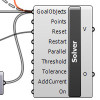
This is the continuation of my scripting experiment within Grasshopper. Like the minimum spanning tree algorithm, this is also a famous problem of computational geometry; the shortest path problem. I’m now coding faster and understanding the namespace more easily in Grasshopper. This time, the challenge was implementing Dijkstra’s algorithm for the Shortest Path Generator. Again, it’s a quite powerful algorithm, I even plan to use it in my current project. Although […]
This is the basic form of a surface division, based on curvature. As each point on the surface has a curvature value, this might be used to dispatch those values and see the points at flat and curved parts of the surface. Here is the Grasshopper definition [GHX: 0.8.0066] (Please use right click + save target as to download ghx definitions in this site. Otherwise your browser may try to execute them […]
This is the updated version of my MST code from 2012. After over a hundred hours of Rhinocommon and Grasshopper SDK studies, and lots of dead ends, I was finally able to calculate the minimum spanning tree of any given curve network in Grasshopper. Problems like these are interesting to me because of their clear logic and diverse areas of applications in design. I tried to simulate Dijkstra’s, Kruskal’s, and […]
Trying to further improve my experience in parametric modeling, I’m mixing and joining old definitions to reveal different potentials. I’m experiencing spatial mapping or morphing in Grasshopper. This is an equivalent form of the “flow along surface” command in Rhinoceros. It re-builds a geometric composition over another space (from world XY coordinates onto a surface with UV coordinates here) This is especially useful in creating surface compositions from famous tessellations […]
Searching for a meaning to today’s popular design methods and concepts we are all going after. Most of the abstract problems, today described within architectural domains, are very parallel to another field defined by M. Ian Shamos in 1978. Here is the introduction paragraph of his PhD thesis; Geometry is a subject that has captured the imagination of Man for at least 2500 years. It is at the very foundation […]
Another famous shape of architectural geometry is a set of definitions creating minimal surfaces. I’ve found the trigonometric equation of the Gyroid and created a simple logic for approximating it as points in Grasshopper. However, when I searched the net for similar solutions, I found lots of them including the same approach as mine (Wynstan Wu’s definition). I was planning to develop a script in Grasshopper to take these estimated […]
When I was a student, 3D modeling and rendering on the computer was an advanced skill. I only managed to create my first rendering in the 4th-year project. Then, it became a special talent for designers, even opening a freelance business. However, that came to an end when that technology expanded, reaching everybody. Ten years ago, different ecological analysis methods on geometric designs were also another specialized field that everybody […]
Today, we’ve finished first phase, the introduction to dataflow management in visual programming environments; and conducted “well defined” part of the mid-term examination. First two questions were designed to test technical skills of data matching, geometric evaluation. First one was a simple algorithm that calculates the area of ANY triangle in real-time. Tricky part of this problem was to research and find ways of calculating area and implementing it in […]
As far as I understood, it is impossible to physically construct double-curved surfaces from quadrilateral and planar faces. This definition tries to find an optimized alternative to this problem. Any surface, single or double curved, is divided into standard sub surfaces. But this time, those surfaces are treated as planar surfaces, therefore one corner is moved to meet this requirement. The output consists of only planar surfaces ready for fabrication. […]
This is another popular “math surface” being rediscovered by designers nowadays, in 2012. Saddle surfaces, seen above as mentioned earlier (here) have a special type named “Monkey Saddle Surface”. This surface was a dramatic example of how Grasshopper can control equations and instantly show graphical results. The mathematical equations start with Z=… this makes it very easy for us to transform any x-y grid centers (a 2d data tree of […]
QuickShaper (QS) an experimental computer utility for Shape Grammars. It aims to assist designers and students in creating and exploring rule-based designs. QS is first presented and published with Birgül Çolakoğlu at the 25th eCAADe Conference held at Frankfurt / Germany in September 29th, 2007. QS is a scripted utility, written in MaxScript, developed within Autodesk’s 3D Studio MAX version 9. It is not tested on earlier versions. QS works […]
I tried different approaches to drawing platonic solids using Grasshopper’s native components. However, it seems impossible now. In geometric definition, a platonic solid is a set of points, distributed on a sphere with equal distances. If the set contains 12 points, then it’s an icosahedron. I found lots of information about these objects and mathematicians seem to love analyzing them. They created different approaches to building an icosahedron. One of […]
[RFA: Revit 2012] It seems simple at first sight, but creating a window definition in Revit requires a lot more time than I expected. A freelance job led me to create this parametric object, when I saw the architect’s sketch of all window types of the building side by side. There was a clear connection between all of them, leading me to define a single window object. Of course I’m […]