designcoding
About Table of Contents Keywords Monthly Archive
Support designcoding!

#grasshopper

268 posts

Karyokinesis

November 2, 2013

While searching for a way to work with random points and growing populations, this idea appeared accidentally. I wasn’t trying to mimic the behavior of Karyokinesis of biological cells (in fact I’m in serious doubt about biomimicry in general). The trick is to use a timer + data recorder + a knob for the arbitrary user input. It starts to breed when you start the timer, but to change the evolution speed, just roll the knob!  Of course, the knob…

Image Processing Basics

November 1, 2013

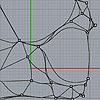
This was the initial example of image processing in our Parametric Modeling class. Hand-drawn and digital diagrams can also be digitized and used in order to describe certain parameters for design formation. Such algorithms would similarly use the Image Sampler Component of Grasshopper. In the algorithm below, image data is used to capture black pixels as attractors of a Voronoi subdivision. A regular point grid is dispatched according to Brightness values so that the points that lie on the lines of…

Spiral of Random

October 21, 2013

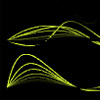
Grasshopper still surprises me. This definition draws a spiral by using a random component. It is obvious that the seed value of the random component has a relationship with an archimedean or a similar spiral. My intention was to create a definition to put a number of random points inside a circular area, not a rectangular one. While I grow the radius of a circle and get a t parameter evaluation from a random component using the same seed value…

I at the Center

September 30, 2013

I at the Center is a multiple-axes vertex deformation based on a quadrangular hyperframe, designed by David Oleson at the studio of William Huff in 1964. Below, you see the original drawing and my Grasshopper animation based on a single-point attractor, creating the “I” wherever it is. It was a pleasure to read and repeat this deformation, which is a nice exercise in data tree operations and also one of the first examples I see about point attractor algorithms in design…

Manage Rhino Viewport in Grasshopper

September 13, 2013

This simple vb.net component controls the Rhino viewport background without a need to enter its options panel. It is used to change the viewport background color and grid visibility quickly within Grasshopper. Here is the definition file: [GHX: 0.9.0056]. In order to be able to return to default settings, I put a “default” toggle. Just click on it to “false” state, then the Rhino background color can be changed by the B input. This component also handles the grid. However I…

Testing Spatial Deformation

September 13, 2013

Instead of searching for an iterated and rule-based variety, this method captures instances of spatial deformation by transforming the hyperframe. This liberates us from a classical understanding of pattern deformations that are enframed within regular polygons, mostly rectangles or hexagons. Grasshopper has a built-in component to study such variety. The spatial Deform component gets vectors as inputs and transforms any given geometric object according to it. This website has also another nice use of this component.

Facade Study with Grasshopper

September 12, 2013

This is a small project of a facade study in Grasshopper, designed by KAF Architecture, and built in 2013 at Altunizade, İstanbul. KAF Architecture designed the facade with varying holes with an image of a forest. The image was supposed to generate the holes. At first, the office tried to do this manually, placing circular holes on the image in AutoCAD. However, after several hours, they thought that they needed some kind of an algorithm to accomplish this task. Therefore,…

Parametric Modeling 2013 @ Istanbul Bilgi University

September 2, 2013

ARCH 362 COURSE BRIEF (2013) Design computing reflects a focal shift from the singular construction of objects into the relational nature of revealing diversity. Algorithms are mainstream interfaces for the explication of geometric relationships, extending techniques required for such revealing. This course introduces some ways of managing diversity while reasoning about sequential and concurrent; absolute and relational; ordered and chaotic. Students are expected to be familiar with fundamentals of Rhino3D, and willing to experience more of it. Coding exercises, readings,…

Fracture

September 2, 2013

Fracture is a simple effect experiment on Grasshopper. Although it is not the best tool for an interactive media installation regarding its performance, I tried to use it as a simple sketching tool for concept development. It is the sketch of a material system we are working on nowadays for an Exhibition. The initial diagram of Grasshopper includes a nested Voronoi subdivision broken by moving attractor points. It is not fast enough for a real-time interaction yet, because of the…

Detecting Closed Shapes

August 26, 2013

Again, I continue with some simple solutions for Grasshopper. The surface split component gives all possible surfaces sliced with given curves. And it creates “invalid” curves with at least one open edge. I used this to perceive the closed regions within a given complex curve set. Just put the “Clean” component to erase the outer invalid surfaces and there remain the closed ones. However this time the question was where to put the circle and what its radius of it…

« 1 2 3 … 5 6 7 8 9 10 11 12 13 14 15 16 17 18 19 20 21 22 23 24 25 26 27 »
  • Chapters

    • Algorithms
    • Discourses
    • Fabrications
    • Studios
  • Explore

    • All Keywords
    • Table of Contents
    • Monthly Archive
    • #moebius
    • #anemone
    • #tensegrity
    • #visualization
    • #golden-ratio
    • #brick
    • #solar-analysis
    • #paper
    • #hilbert
    • #firefly
    • #mosque
    • #facade
    • #truchet
    • #circle
    • #kangaroo
    • #dual
    • #packing
    • #regulations
    • #random
    • #optimization
  • Search

  • Support designcoding!

  • Enjoying designcoding? Support me on Patreon to keep it growing. Thank you!

  • copyright 2026 designcoding.net | about | privacy policy | end user license agreement