designcoding
About Table of Contents Keywords Monthly Archive
Support designcoding!

#grasshopper

268 posts

Tattoo Design

April 27, 2023

Here is a tattoo design I am currently developing by using Grasshopper. 11 years ago, I developed a Grasshopper definition that approximates Julia Sets here. One of the experimental outputs of that definition looks suitable for a tattoo design. It is a beautiful fractal shape. But I am not perfectly sure about its suitability for a tattoo. Here it is: This was generated by the function z2+c and the parameters were: 0.3+0.49i with 25 iterations. I experimented a bit more…

Spiral Staircase

April 17, 2023

This is a basic Grasshopper exercise, covering many fundamental topics. The aim is to create the parametric model of a spiral staircase. This is more educational than functional, I guess. Below is the explanation of the Grasshopper definition in three parts. Helix Points for the Spiral Staircase In the first part of the definition, I am defining the points ordered on a helix. First, I calculate the number of steps by dividing the total height value by the height of…

Fibonacci Sphere

April 12, 2023

This website explains the problem and several solutions. I managed to implement the formulas to convert a 2D square grid into spherical coordinates. The Fibonacci Sphere is one of the solutions to the equal distribution of points on a sphere. It is not the best solution to this problem. But it is regarded as a quick and efficient one. Suitable for me. I developed this Grasshopper code by studying the above website and some other sources. The code starts with…

Koch Snowflake Fractal

April 12, 2023

This is an implementation of the famous Koch Snowflake Fractal in Grasshopper. We will be using the Anemone add-on to handle the iterations. In this fractal, we start from an equilateral triangle. Then, we form new equilateral triangles, one-third of the side. So that each repetition protrudes in the middle of all the sides. In summary; The Preparation for Koch Snowflake Fractal Now let’s follow the Grasshopper application step by step. We start Koch Snowflake Fractal by creating a triangle…

Interlocking Structures Revisited

April 10, 2023

I studied the interlocking joint details in Grasshopper here and here. This time, the interlocking structures were revisited with a cleaner code and an in-depth explanation. I believe that this is a very good educational exercise for learning the potential of the native Grasshopper components. The Preparations The Region Difference (RDiff) component is used to create the interlocking detail of a surface that is contoured with bi-directional spacing. In the first part of the code, after contouring our surface in…

Voronoi Puzzle

April 5, 2023

In this Voronoi puzzle exercise, we derive two-dimensional puzzles by using Voronoi diagrams. This is similar to my previous studies here, and here. Part 1: The Random Voronoi Diagram In section 1 of the below image, I use a rectangular region to generate random points. Then, I create a standard Voronoi diagram by using those points. Finally, I explode the Voronoi cells. Part 2: The Voronoi Puzzle Details In the second part, we draw an arc on the edges of…

Vector Fields Exercise

April 4, 2023

Fields is a native group of components available since the very early version of Grasshopper. In today’s Design Computing class, we studied it again with the first-year design students. I studied these interesting and beautiful shapes earlier here, here, here, and here. The one you see below is a short in-class exercise about vector fields. The exercise aims to show the Grasshopper’s capabilities in form-finding studies via Field Lines. The definition starts with the generation of a set of random…

Rhino+Gh: Grasshopper for Beginners (7)

February 2, 2023

We continue with the Grasshopper for Beginners series by explaining Rhino+Gh workflow principles. What does GH add to Rhino‘s standard drawing and modeling functions? To put the question differently, what does GH do that conventional modeling programs, such as Rhino, can’t? What is the difference and relationship between Rhino+Gh? Let’s take an example to answer these questions. Our example is about parametrically describing a surface model and deriving its alternatives. First, we will try to create a surface using only…

Folding Pattern: Folding Experiments (3)

January 21, 2023

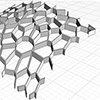
This is the continuation of the physical prototyping project of a folding pattern from 9 years ago. I simulate the folding pattern using the Rhino Grasshopper Kangaroo. As seen in the video, this is possible thanks to the pre-set hinge positions on the Rhino model. Thus, the folding motion can be animated on the screen. You can download and try the Grasshopper code. I often use this code in my ARCH 362 Parametric Modeling course. I think it is possible…

Hello World! Grasshopper for Beginners (6)

January 17, 2023

Let’s continue the Grasshopper for Beginners series. We start with the traditional “Hello World!” displayed on the Rhino screen: Placing the Components In most CAD programs, the text creation function, which is the equivalent of the Text command, is performed by a component called Text Tag (Tag) in GH. The Text Tag (Tag) component is in the Dimension panel under the Display tab. If you’re not comfortable with tabs and panels yet, you can revisit this section from the beginning….

« 1 2 3 4 5 6 7 8 9 10 11 12 13 14 15 16 17 18 … 25 26 27 »
  • Chapters

    • Algorithms
    • Discourses
    • Fabrications
    • Studios
  • Explore

    • All Keywords
    • Table of Contents
    • Monthly Archive
    • #data-flow
    • #unity
    • #dual
    • #paper
    • #kuka-prc
    • #descartes
    • #grid
    • #linear-algebra
    • #le-corbusier
    • #hotwire-cutting
    • #muqarnas
    • #euclidean-construction
    • #nesting
    • #noise
    • #tetrakaidecahedron
    • #escher
    • #vector-field
    • #fourier
    • #processing
    • #music
  • Search

  • Support designcoding!

  • Enjoying designcoding? Support me on Patreon to keep it growing. Thank you!

  • copyright 2026 designcoding.net | about | privacy policy | end user license agreement