
Parametric Mug
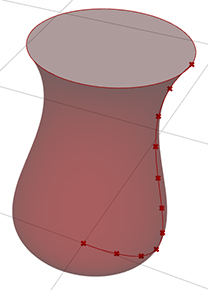
Let’s have some fun with the parametric stuff! You may remember that we created many vases and glass alternatives that we could bake with a single Revolution (RevSrf) component in previous exercises. Since we were referencing the profile curve drawn in Rhino, it was also possible to create a one-component glass algorithm with some Rhino knowledge. Now, we will try to develop a parametric mug. In the application you see here, we carried out the drawing of the profile curve by Grasshopper. For this, we used Graph Mapper (Graph) component.
Parametric Tea Glass
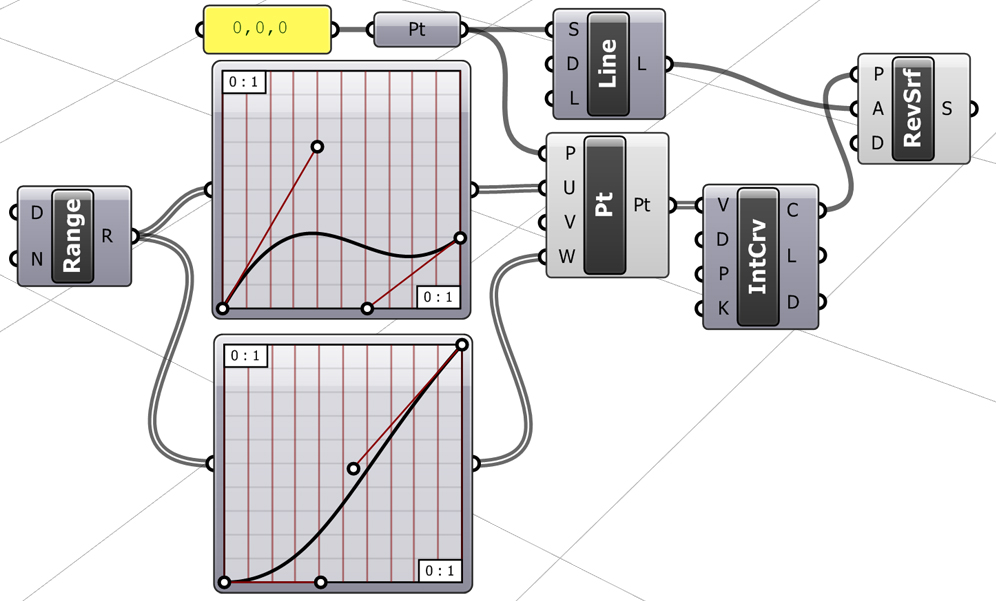
We draw the node points of the profile curve by the Interpolate (IntCrv) component. We extracted these from the Graph Mapper (Graph) components. So that the transitions between the coordinates of the points remain more consistent. We also added the axis of rotation by drawing a straight line. Thus, this application can work on its own without any Rhino curves.
Parametric Mug
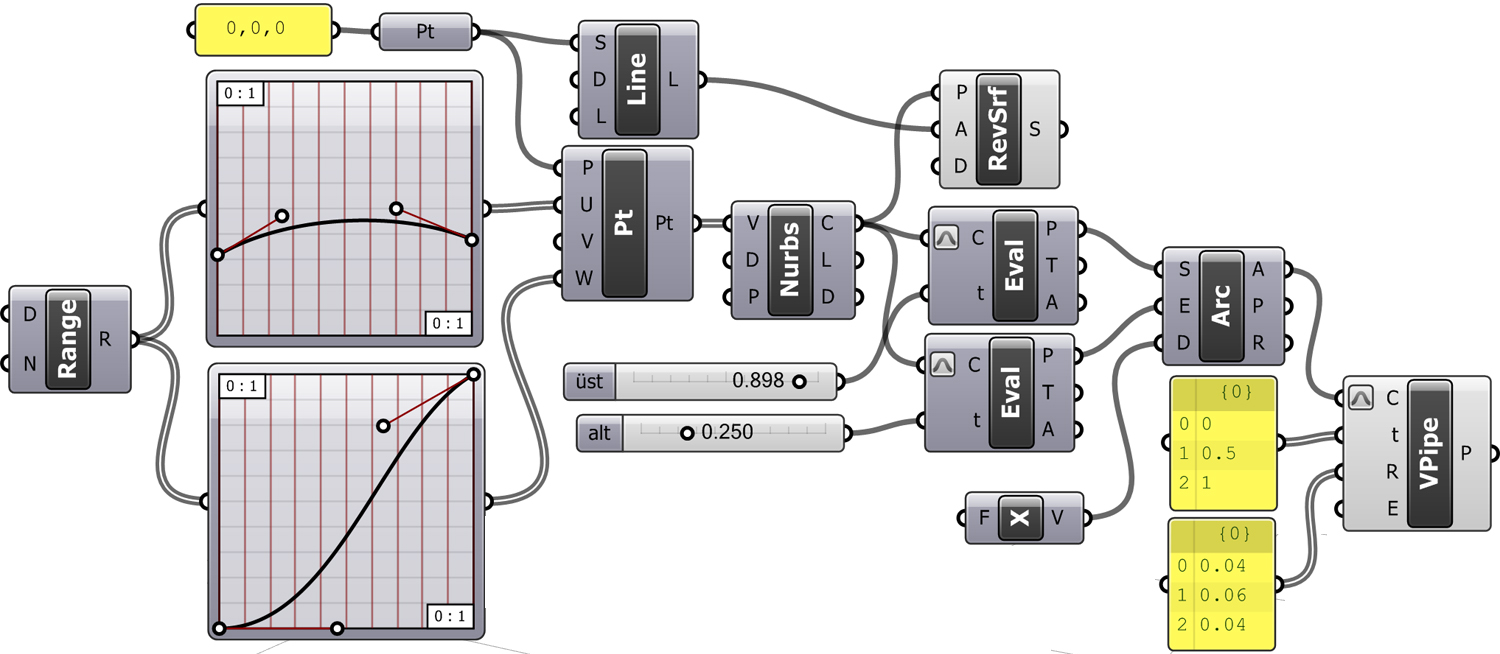
So, what should we do if we want to add a handle that adapts to the shape of the glass? The definition below is an experiment related to this. In order to attach the handle, we designated two points with Evaluate Curve (Eval) on the profile curve. We used the Revolution (RevSrf) and an arc passing through these points, and variable thicknesses with the Variable Pipe (VPipe) we have just learned.
We have two data lists with different thicknesses and curve parameters to apply. It is also possible for us to make them more interactive. For example, add another Graph Mapper (Graph) instead of editing them manually. In order to improve this code, we can try smooth transitions of the surfaces at the junction of the handle and the glass. In the current version, Grasshopper, unfortunately, does not have Rhino’s Blendsrf command. Thus we do not yet have components that take on functions such as smooth transitions between surfaces. If you are obsessed with this, the Sweep2 (Swp2) component means hours and a few parametric cups of parametric coffee in your parametric mug are waiting for you.
Here are the Grasshopper definitions for these basic exercises:
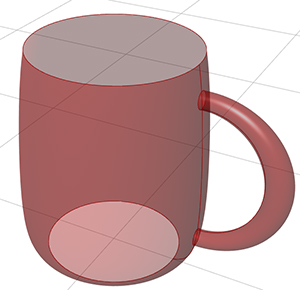
Cite this post
Related Posts
String Art in Rhino Python
June 19, 2025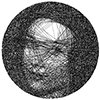
String art is a cool art technique that combines geometry and aesthetics to recreate images using lines between pins. Here is a good reference to start studying it. In this post, I explored a custom Rhino Python script designed for Rhinoceros 7 and 8. It transforms a grayscale image into a dense web of threads. The algorithm analyzes the darkest areas of the image and connects pins in a circular layout to form compositions. The script begins by converting a…
Parametric IQlight
August 23, 2024
Holger Strøm designed the famous IQlight system in 1973. After more than 50 years, it is still a popular, innovative, and smart design. The IQlight is a self-assembly lamp composed of interlocking quadrilaterals. By utilizing polyhedral geometry, you can generate various shapes and sizes. I created a model of one of the most common IQlight designs, fitting it onto the Catalan solid known as the rhombic triacontahedron. This solid is a convex polyhedron with 30 rhombic faces, making it an…
Archimedean Pendants
July 11, 2024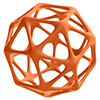
Today’s polyhedra are the famous Archimedean Solids! I created a simple Grasshopper script to generate pendants from these beautiful solids. I call this Archimedean Pendants. However, you can implement other polyhedra to the same code. I hardcoded the vertex coordinates so you won’t need an extra add-on to generate the polyhedra. Thanks to the new SubD component Multipipe, it makes life much easier to produce 3dprint-ready results. To make this definition more useful, you can add scale operations in all…
Lissajous Pendants
February 9, 2024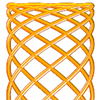
Lissajous curves, named after the French physicist Jules Antoine Lissajous are a family of curves that emerge from the interaction between two harmonic oscillations. They have applications in various fields including physics, engineering, and signal processing. They are commonly used in electronic devices such as oscilloscopes to visualize the phase relationship between two oscillating signals. Similarly, they are also useful in mechanical engineering for analyzing and designing mechanisms that involve harmonic motion. Lissajous curve functions can help in understanding the…
Star Polyhedra
January 26, 2024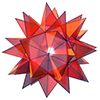
Stellated polyhedra are three-dimensional geometric shapes formed by extending the faces of a regular polyhedron (a solid with flat faces) beyond their original boundaries until they intersect with each other. The term “stellate” comes from the Latin word “stella,” meaning star and these polyhedra often have a star-like appearance due to their extended faces. They are popular because of their aesthetic qualities. I studied these forms many times before. This time, I implemented the stellations and negative stellations (the excavated…