designcoding
About Table of Contents Keywords Monthly Archive
Support designcoding!

#grasshopper

271 posts

MetaBalls in 3D

May 23, 2012

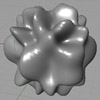
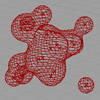
Playing with the 2D Metaball component in Grasshopper. I was curious about why there are no Metaballs in 3D in Grasshopper. Then, I realized that in fact, the 2D Metaball component is creating a section of a 3D Metaball computation. I think it is a topic worth studying even 10 years after this original post to develop an easy way to create the metaball surfaces. In 2012, thanks to the Grasshopper’s easy interface, I was able to create a series…

Excel Outputs in Grasshopper

May 22, 2012

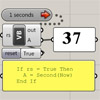
Basic Design Studio at Bilgi University is coming to semester’s big final. Nowadays, students are trying to build their final projects. Oğuz and Gupse’s group has a truss structure with nearly 800 segments. They attempt to build it by taking length values from their own Rhino model by hand. And this itself had brought a difficulty, because one person of the group should be assigned only to do this measurement, reducing their workforce. They asked me if there is an…

Packing Objects with Galapagos

May 22, 2012

After the starting point of the Galapagos, there came another attempt to utilize this beautiful addition of David Rutten. This time, I worked over the night to tell it what I want. The aim was (or seemed to be) simple at first sight. I wanted several shapes (not one) to fit into an area, as smallest as possible, without overlaps. This is packing objects. A bounding box and area components quickly gave me the first fitness value. The area of the…

Evolutionary Solver Introduction

May 22, 2012

Galapagos was a great improvement when it became available natively within Grasshopper as an Evolutionary Solver. However, I couldn’t find time to examine it until recently. This examination gave me an idea of algorithmic thinking, tool making, and tool using. The first experiment shown below tries to solve equilateral triangulation, based on the Delaunay method. Galapagos has two different solvers, named “simulated annealing solver” and “evolutionary solver” shown respectively below. Both of them are trying to reach a fitness value…

Solar Position

May 6, 2012

Experimenting with various plug-ins for solar calculations, I found Daniel Da Rocha’s robust implementation of the solar position algorithm in vb.net. It calculates the solar angle of any place and time. Although it’s written in the old vb.net component, it still works great. I’m trying to create a fast and easy workflow to optimize Grasshopper models based on solar directions. This is done by projecting faces to the solar planes and checking how much of their area is included in…

Designing with Grasshopper

May 2, 2012

Today, there are pedagogical and practical challenges on the use of algorithms in architectural design, as computer puts not only a physical but also a cognitive layer between designer and the subject. Formulation of this cognitive layer is becoming important, regarding which model of computing is used to connect designer with the subject. Is it a “designerly” search, or design exploration in a visual programming environment? As most of the researchers admit that visual programming environments are very effective in generating variations,…

Shortest Path Generator

April 30, 2012

This is the continuation of my scripting experiment within Grasshopper. Like the minimum spanning tree algorithm, this is also a famous problem of computational geometry; the shortest path problem. I’m now coding faster and understanding the namespace more easily in Grasshopper. This time, the challenge was implementing Dijkstra’s algorithm for the Shortest Path Generator. Again, it’s a quite powerful algorithm, I even plan to use it in my current project. Although there is a faster alternative, Shortest Walk-in Food4Rhino and it…

Points by Curvature

April 26, 2012

This is the basic form of a surface division, based on curvature. As each point on the surface has a curvature value, this might be used to dispatch those values and see the points at flat and curved parts of the surface. I used my favourite surface equation definition (here) as implemented equation of cos(x)+cos(y) in the animation below.

Minimum Spanning Tree

April 26, 2012

This is the updated version of my MST code from 2012. After over a hundred hours of Rhinocommon and Grasshopper SDK studies, and lots of dead ends, I was finally able to calculate the minimum spanning tree of any given curve network in Grasshopper. Problems like these are interesting to me because of their clear logic and diverse areas of applications in design. I tried to simulate Dijkstra’s, Kruskal’s, and Prim’s algorithms, but no chance. There are similar solutions such…

Spatial Mapping made Easy

April 19, 2012

Trying to further improve my experience in parametric modeling, I’m mixing and joining old definitions to reveal different potentials. I’m experiencing spatial mapping or morphing in Grasshopper. This is an equivalent form of the “flow along surface” command in Rhinoceros. It re-builds a geometric composition over another space (from world XY coordinates onto a surface with UV coordinates here) This is especially useful in creating surface compositions from famous tessellations such as Voronoi. There are lots of things I can…

« 1 2 3 … 12 13 14 15 16 17 18 19 20 21 22 23 24 25 26 27 28 »
  • Chapters

    • Algorithms
    • Discourses
    • Fabrications
    • Studios
  • Explore

    • All Keywords
    • Table of Contents
    • Monthly Archive
    • #logic
    • #geodesic
    • #contouring
    • #random
    • #music
    • #sphere
    • #escher
    • #landscape
    • #laser-cutting
    • #ice-ray
    • #rhombicosidodecahedron
    • #shape-grammars
    • #kangaroo
    • #buckyball
    • #fibonacci
    • #packing
    • #stone
    • #solar-analysis
    • #golden-ratio
    • #truchet
  • Search

  • Support designcoding!

  • Enjoying designcoding? Support me on Patreon to keep it growing. Thank you!

  • copyright 2026 designcoding.net | about | privacy policy | end user license agreement