designcoding
About Table of Contents Keywords Monthly Archive
Support designcoding!

#grasshopper

268 posts

Custom Graphics on VPL

January 10, 2012

This was an interesting challenge for me to find out if an architect can use Visual Programming Languages (VPL’s) also for graphical purposes? Now, I would say “not exactly” because this definition took much time than I expected. The aim was to create an algorithm for a business card design that has variable outputs. Each card should be different, but without using any randomization. This project is suitable for more development because now it is only producing one sequence of…

The Flow Earring

January 9, 2012

I developed this code 13 years ago while learning the fundamentals of Visual Programming in Grasshopper. I was studying the ways of NURBS curve geometry. The animation shows the construction process of several Bezier Curves. In 2024, I optimized the code and added the thickness. The Flow Earring project showcases the beauty of parametric curves. The Grasshopper definition displays the animated construction process and the variations. The flow of the curve and its variations still look fascinating, reminding me of…

Cellular Canopy

January 8, 2012

Here, we plan and develop a 3d model that uses regular flow on surface command. However, while we are doing this, we also start to create a pseudo-parametric definition (or diagram) of the modeling process. In the end, this gives us the complete dataflow diagram of the 3d model. Students are expected to start understanding both the differences between geometric modeling and parametric modeling and also between procedural computing and dataflow computing. Below is an example of such diagrams students…

Tumbler Brick Wall

January 8, 2012

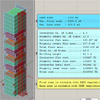
There are a couple of experiments in different schools about organizing free-form surfaces (walls here) with a composition of modular elements (bricks). Even though they created robots to make such brick walls, I still couldn’t understand why. Although creating a parametric model that calculates the exact locations of bricks, seems very easy at first sight, there came severe problems to solve in order to achieve a correct layout without using helpers such as physics engines. Of course, it’s possible to…

Grid Tearing

January 6, 2012

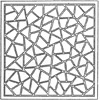
Here, I used a curve to accomplish grid tearing. It’s straightforward, and from an educational perspective, this exercise includes several potentials on vector arithmetics and graph manipulation techniques. As a design domain, this definition stresses the use of associative entities in a parametric model. Any primitive or complex entity may evoke different parameters in others. The beauty in the simplicity of these algorithms still amaze me.

Parametric Entrance

January 3, 2012

This was my first serious Grasshopper study. In 2009, I decided to attend a design contest for a campus entrance. Of course, the jury didn’t know that the design resulted from a parametric model. I have called this Parametric Entrance since then. The starting point of this project was the conception of the “entrance” as a design problem related to the project area as a whole, rather than just a gate. The visual impact on the topography was achieved by…

Interlocking Structure (No Boolean)

January 2, 2012

It has been a tough problem for me, for the last two days. A parametric model of an interlocking structure (sometimes also called egg-crate, waffle, or contouring structure) can be created easily in Grasshopper using a Contour component. In addition, you need a couple of list management operations and a boolean (or region) difference event. However, Rhino and Grasshopper are very slow at calculating boolean differences on both solids and surfaces. Fabrication models of such structures don’t have to be…

Hyperbolic Paraboloid Surface

December 30, 2011

Since the mid-20th century, the hyperbolic paraboloid surface has been one of the most popular mathematical forms for architects. Named Hypar in short, this is the Quadric Surface equation of the Hyperbolic Paraboloid. Erik Demaine summarizes several examples from architecture such as the roof of the Girls’ Grammar School in London (designed by Chamberlin, Powell, and Bonn), the Philips pavilion at the 1958 Brussels exhibition designed by Le Corbusier, and finally, Frei Otto illustrated and analyzed a grid of connecting…

Surface Subdivision

December 25, 2011

Here is the fundamental of surface subdivision in Grasshopper. In order to design a parametric truss exercise, this is the generally accepted starting point. Get a surface from the file, subdivide it into U and V directions to create point lists, and then manipulate these points to create something interesting. Having a list of points would also present good potential regarding attraction with other entities, such as point or curve attractors. As you probably notice, this is the new version…

Circle Crossing

December 25, 2011

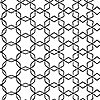
I am learning Grasshopper. In this Circle Crossing definition, I tried to create the above pattern (also described in Sunflower Spiral) as simply as possible, this definition creates not only spirals but is also capable of more tessellations I guess. Maybe a three-dimensional equivalent might be studied in the future. As you can see from the definition, I started with a large circle. Then, I divided it into segments and placed new circles centered on them. Finally, I divide the…

« 1 2 3 … 16 17 18 19 20 21 22 23 24 25 26 27 »
  • Chapters

    • Algorithms
    • Discourses
    • Fabrications
    • Studios
  • Explore

    • All Keywords
    • Table of Contents
    • Monthly Archive
    • #koch
    • #lissajous
    • #sphere
    • #robot
    • #brick
    • #non-euclidean
    • #grid
    • #platonic-solid
    • #workshop
    • #laser-cutting
    • #animation
    • #minimal-surface
    • #enneahedron
    • #moulding
    • #optimization
    • #timer
    • #vector-field
    • #attractor
    • #descartes
    • #designcoding
  • Search

  • Support designcoding!

  • Enjoying designcoding? Support me on Patreon to keep it growing. Thank you!

  • copyright 2026 designcoding.net | about | privacy policy | end user license agreement