designcoding
About Table of Contents Keywords Monthly Archive
Support designcoding!

#robot

23 posts

Inverse Kinematics in Rhino Python

May 22, 2019

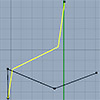
This is a simple inverse kinematics solution developed by Andreas Aristidou and Joan Lasenby in 2011. They call it Forwards and Backwards Reaching Inverse Kinematics (FABRIK in short). It was quite interesting the learn this technique because it is a fast and accurate approximation of a kinematic chain. There are very interesting potentials of this technique in terms of architectural simulations. I tried to develop a Rhino Python script in Rhino 6. It seems to be working properly. Here is…

Robotic Fabrication Student Project: Micro-Wave

March 21, 2019

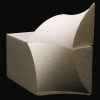
This is a robotic fabrication student project developed in the Digital Fabrication elective course in 2018. This group of students experimented with the hot wire cutting of EPS foam. Their aim was to create curved surfaces by using a straight wire. Design research started with a literature study of precedents. Then, after several cutting experiments with the available hotwire cutter tool, they gained better control over the technology. However, they found the available tool too large and inefficient. They decided…

Robotic Fabrication Project KUKABAE

March 6, 2019

I will try to explain the student project called KUKABAE that was developed in my Robotic Fabrication elective course in 2018. This was a very interesting project. Initially, the students were doing the design to attach an ordinary pen holder to the robot. but then the project changed by chance. they decided to replace a pen holder with a ceramic knife. As seen in the video and pictures, the relationship between the material and the instrument became more complicated and…

Robotic Hotwire Cutting Polyhedra

December 20, 2018

Today, we have studied creating complex robot programs manually again. Platonic solids were the subject of this study. Students tried to create a sequence of robot moves that produces a Platonic solid out of a 17cm EPS cube. We simply call this the robotic hotwire cutting polyhedra exercise. However, the size of our hotwire cutter became one of the problems because of its risk of crashing. We crashed several times but managed to cut some polyhedra at the end of…

Robotic Earthcrafts Student Project: ZOM

November 6, 2018

This project is developed in the summer workshop titled Robotic Earthcrafts conducted at İstanbul Bilgi University Architectural Design graduate program. Students call this project “ZOM”. Students are Murat Sökün, Zeynep Çakmak, and Özlem Güven. We organized the workshop together with Fulya Akipek and Hülya Oral. You can find more details about the workshop here. In this project, a simple robot code created the EPS molds of the rammed-earth module. Below are some of the photos of the design and construction…

Robotic Chopstick Digger Exercise

November 5, 2018

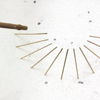
Today, we tried to understand one of the ways of generating multiple planes in Grasshopper. This is an important step in utilizing the robot program efficiently. Instead of manually jogging the robot, we designed the path that the robot will dig lots of chopsticks. In the “Robotic Chopstick Digger Exercise”, every student designed their own paths and decided the height, orientation, and number of sticks to be dug on an EPS block. I provided the Rhino and Grasshopper files with…

Spatial Recognition Test

November 3, 2018

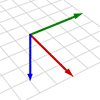
In the Digital Fabrication course, I needed to explain the plane orientation and rotation angles. This is why I prepared this Spatial Recognition Test. This is an important topic regarding the matching of the TCP (tool center point) plane of the robot and the plane(s) designers generate. In Rhino, we define a construction plane by red (X), green (Y), and blue (Z) colors. The relative positions among those axes are the well-known “right-hand rule”. In mathematics and physics, the right-hand…

Robotic Chopstick Digger

October 29, 2018

Today in the Digital Fabrication course, we examined digital-physical translations utilizing the robots add-on for Grasshopper. Students learn how to get coordinate data from a physical environment, use it in the digital model and apply it to a robot motion. We aimed to dig chopsticks into an EPS block by using a special wooden tool called “Chopstick Digger”. In the first hour of the class, we attached the “pointer” tool, which is already calibrated to the robot. Students used “Actual…

Digital Fabrication Day#4: Kissing the Cube

October 25, 2018

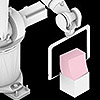
In the Digital Fabrication course, we are in the middle of a sea, full of technical details, and students need motivation. This is why I felt I should do something simple and educational but funny at the same time; a “kissing the cube” exercise. The planned exercise was about programming the robot to touch every facet of a cube without colliding with it. Of course, we couldn’t manage to kiss all the facets due to the limitation of the robot’s…

Basics of Robot Programming

October 24, 2018

Today, we started learning Robots add-on for Grasshopper. The first two codes we experimented with were similar to the first week’s jogging exercises. In the first one called “axial jogging”, we had 6 number sliders to control the angles of the axes. Every number slider generates values between -Pi and +Pi. These numbers are joined into a text by adding a comma in between. Then, Create program and Simulate Program components of the Robots plug-in are used to convert this…

« 1 2 3 »
  • Chapters

    • Algorithms
    • Discourses
    • Fabrications
    • Studios
  • Explore

    • All Keywords
    • Table of Contents
    • Monthly Archive
    • #music
    • #arduino
    • #aluminium
    • #grid
    • #koch
    • #bezier-curve
    • #space-syntax
    • #macro
    • #growth
    • #text
    • #boolean
    • #rhombus
    • #timer
    • #3d-max
    • #truchet
    • #hilbert
    • #dürer
    • #computational-geometry
    • #nesting
    • #virtual-studio
  • Search

  • Support designcoding!

  • Enjoying designcoding? Support me on Patreon to keep it growing. Thank you!

  • copyright 2026 designcoding.net | about | privacy policy | end user license agreement