
Spatial Recognition Test
In the Digital Fabrication course, I needed to explain the plane orientation and rotation angles. This is why I prepared this Spatial Recognition Test. This is an important topic regarding the matching of the TCP (tool center point) plane of the robot and the plane(s) designers generate. In Rhino, we define a construction plane by red (X), green (Y), and blue (Z) colors. The relative positions among those axes are the well-known “right-hand rule”. In mathematics and physics, the right-hand rule is a common mnemonic for understanding notation conventions for vectors in 3 dimensions. Therefore, we determine the correct direction of the axes using this rule. However, I prefer to teach this subject not by memorizing something with the right hand, but by thinking and reasoning about the visual orientations of those axes in the space. Here is the simple Spatial Recognition Test you can see below;
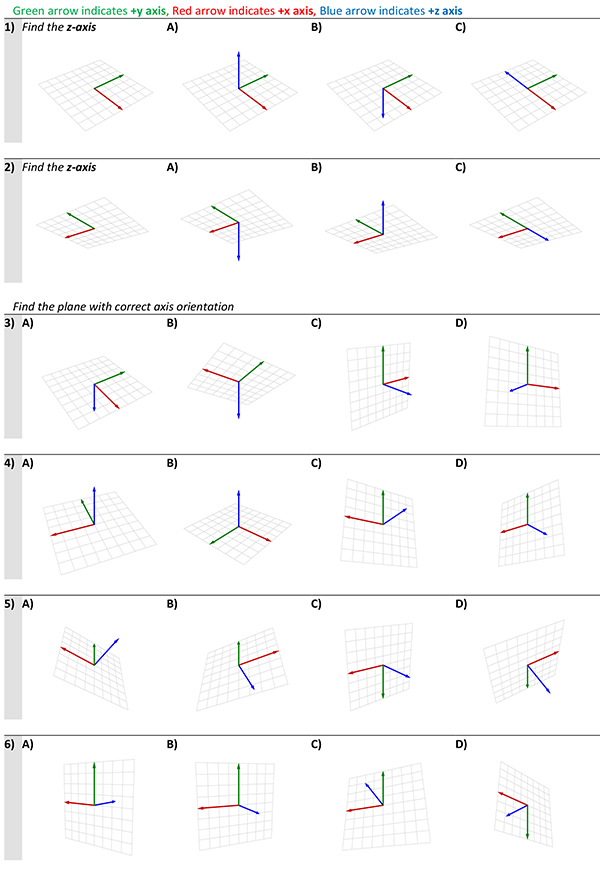
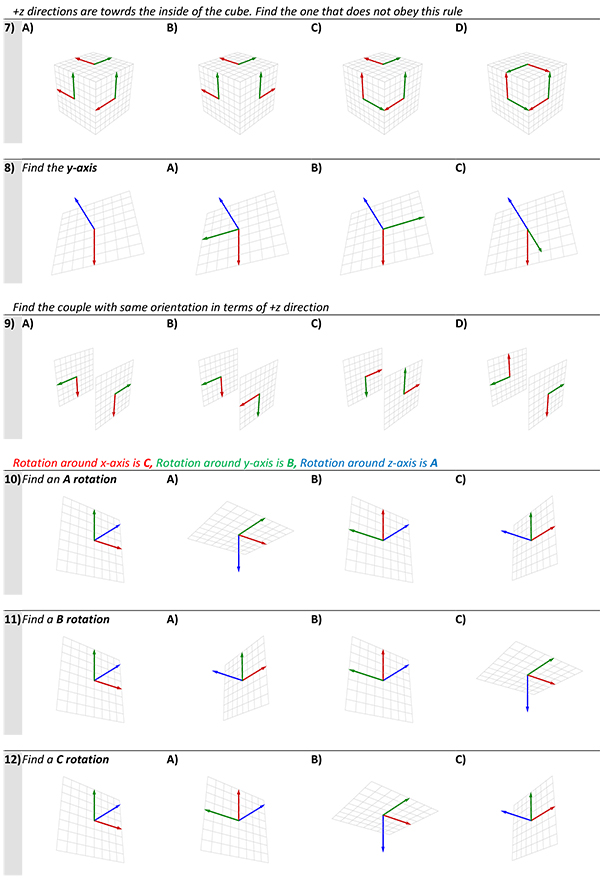
Here is the PDF version of the above questions. You can see that it includes X, Y, and Z directions and A, B, and C rotations. I teach this to be implemented on our Kuka robotic arm. KUKA robots use the so-called XYZ-ABC format. Thus, XYZ is the position in millimeters, ABC is the angles in degrees, with A rotating around the z-axis, B rotating around the y-axis, and C rotating around the x-axis. I believe that these a bit old-school tests and exams are still efficient for teaching sophisticated topics.
Cite this post
Related Posts
PLURA Pavilion
September 22, 2026
Last year, during the first stage of the Architectural Design Graduate project, our student team made a quick preparation and participated in the experimental works exhibition at the International Antalya Architecture Biennale (IABA 2025). This was a challenging yet educational process for our team. Using EPS foam and the robotic hotwire cutter (RHWC), a production run of 125 units, consisting of two modules (95 octahedra and 30 icosahedral units), was carried out. The icosahedral units also underwent an additional cutting…
Hydrophilic Structures
June 6, 2019
Hydrophilic Structures is the 2018-2019 Spring Semester Graduate Studio of the Architectural Design Program. The studio aims to increase the public interaction with water, while being sensitive to the ecological and historical context of the shores of İstanbul. Students will be encouraged to design sustainable, floating modules and structures, which can be integrated into semi-open architectural programmes. A full-scale prototype will be fabricated and tested at the Santral Campus coast to Haliç. The main conceptual framework of the studio consists…
Robotic Fabrication Project KUKABAE
March 6, 2019
I will try to explain the student project called KUKABAE that was developed in my Robotic Fabrication elective course in 2018. This was a very interesting project. Initially, the students were doing the design to attach an ordinary pen holder to the robot. but then the project changed by chance. they decided to replace a pen holder with a ceramic knife. As seen in the video and pictures, the relationship between the material and the instrument became more complicated and…
Robotic Chopstick Digger Exercise
November 5, 2018
Today, we tried to understand one of the ways of generating multiple planes in Grasshopper. This is an important step in utilizing the robot program efficiently. Instead of manually jogging the robot, we designed the path that the robot will dig lots of chopsticks. In the “Robotic Chopstick Digger Exercise”, every student designed their own paths and decided the height, orientation, and number of sticks to be dug on an EPS block. I provided the Rhino and Grasshopper files with…
Digital Fabrication Day#4: Kissing the Cube
October 25, 2018
In the Digital Fabrication course, we are in the middle of a sea, full of technical details, and students need motivation. This is why I felt I should do something simple and educational but funny at the same time; a “kissing the cube” exercise. The planned exercise was about programming the robot to touch every facet of a cube without colliding with it. Of course, we couldn’t manage to kiss all the facets due to the limitation of the robot’s…