designcoding
About Table of Contents Keywords
Support designcoding!

#rhino-python

43 posts

Cubic Bézier Curve with Rhino Python

April 30, 2018

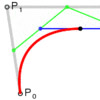
Below is the Python code you can run in Rhino, that draws a cubic Bézier curve (degree 3). As you can see, the Rhino Python code is very slow and inefficient because we calculate every point with lots of computations. Instead, we can use the spline formulae to make this quicker but I wanted to show that the mathematical construction is parallel to the geometric one. This is a nested set of linear interpolations. In fact, the linterp function in…

Derivative and Slope

April 6, 2018

Yes, interesting topics started to reveal themselves, when I dig into the function curves, especially in the parametric representation. The first interesting application is the “derivative”. Nobody in high school told me that the derivative of a function at a given point gives the slope of the graph at that point. Moreover, it is possible to convert the slope value into an angle in degrees, showing the angle of the tangent line to the x-axis at that point. They are…

Graph of Parametric Functions

April 6, 2018

This RhinoPython script handles the simple graphs of two-dimensional parametric functions. Therefore, it approximates these functions by drawing parametric curves. It generates many points by solving the functions. The graph of parametric functions is a major topic in most Design Mathematics courses. Because it looks like the building block of many concepts of CAD. However, there is much more to learn before saying that the third degree NURBS is a degree-3 polynomial function. I am curious about learning the underlying…

Design Mathematics: New Course

February 15, 2018

Jumping into the world of mathematics as a designer seemed to be frightening at the beginning but I opened a new elective course at Bilgi, Design Mathematics. Starting today, I’ll try to log my experiences with the students while we are trying to understand mathematics. The ultimate objective is to find paths that may lead to answering the following question; “what is the relationship between design and math”? Next week, we’ll start with some of the warm-ups and preparatory topics…

Cycloid Curves with Rhino Python

August 7, 2017

Studied earlier in Grasshopper here, creating a cycloid-like curve actually mimics the physical process of rotating disks on a path. Below is a test in Rhino Python.

Dual Polyhedra Generator

August 3, 2017

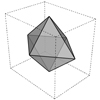
According to Wolfram, By the duality principle, for every polyhedron, another polyhedron exists in which faces and polyhedron vertices occupy complementary locations. This polyhedron is known as the dual, or reciprocal”. We can use this method to generate new polyhedra from known ones. I tried to develop a Dual Polyhedra Generator in this Rhino Python script. First, the script asks a user to select a closed polysurface object. Then, it attempts to identify the area centroids of the faces. By…

Polygon Fractals with Rhino Python

August 2, 2017

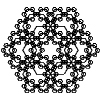
We will see a simple Rhino Python exercise here. I called these Polygon Fractals (or Pentaflakes sometimes). It is both educational and fun to play with them. In Rhino, it can be a good exercise for basic CAD commands and transformations such as move, copy, and scale, and precision drawing operations such as object snapping. Also, in Grasshopper, it can be a good challenge for looping. In Rhino Python, it is already a good exercise for understanding Python and the…

Fractal Curves with Rhino Python

July 31, 2017

A simple Rhino Python script that generates fractal curves. An example is a test with the Gosper-Peano curve. However the script is not supporting segment directions, which is why the result is not the intended curve. Curve directions could be implemented in the future.

Fibonacci Spiral with Rhino Python

July 30, 2017

As studied earlier in Grasshopper here, the sunflower spiral, or Phyllotaxis, or Fibonacci’s spiral, could be drawn as an exercise of looping in Rhino Python. Phyllotaxis is the arrangement or patterning of leaves, flowers, or other plant parts around a stem or axis. Thus, it refers to the specific geometric arrangement of these structures in plants. The term “phyllotaxis” comes from the Greek words “phyllon” (meaning “leaf”) and “taxis” (meaning “arrangement” or “order”). Phyllotaxis can vary widely among different plant…

Convex Hull with Rhino Python

July 28, 2017

This Rhino Python code calculates the cross-product determinant used to determine the orientation of three points (current, next_point, and point) to see if they form a left turn or a right turn. This is a well-known technique in computational geometry to check the relative orientation of points. In this script, the direction is the cross-product determinant that determines the relative orientation of the points. If the result is negative, the point is to the right of the line from current…

« 1 2 3 4 5 »
  • Chapters

    • Algorithms
    • Discourses
    • Fabrications
    • Studios
  • Explore

    • #stellated-solid
    • #icosidodecahedron
    • #timer
    • #firefly
    • #deleuze
    • #solar-analysis
    • #vector
    • #space-syntax
    • #circle
    • #tetrakaidecahedron
    • #snub-square
    • #golden-ratio
    • #3d-printing
    • #space-filling
    • #terrain
    • #le-corbusier
    • #responsive
    • #dome
    • #sphere
    • #wood
    • All Keywords
    • Table of Contents
    • Monthly Archive
  • Search

  • Patreon

    Support designcoding!

    Enjoying designcoding? Support its future with a small donation on Patreon. Thank you!


    copyright 2026 designcoding.net | about | privacy policy | end user license agreement