
Design Mathematics Student Works
Below are some of the student works from the 2018 course: Design Mathematics. The final project of the course was about experimenting the designerly creativity. This included utilizing the mathematical concepts and objects studied throughout the semester. This was a rather open-ended homework question. But in the following years, I am not planning to repeat it. Because it becomes difficult to assess the learning outcome from open-ended homework within such a strict course content.
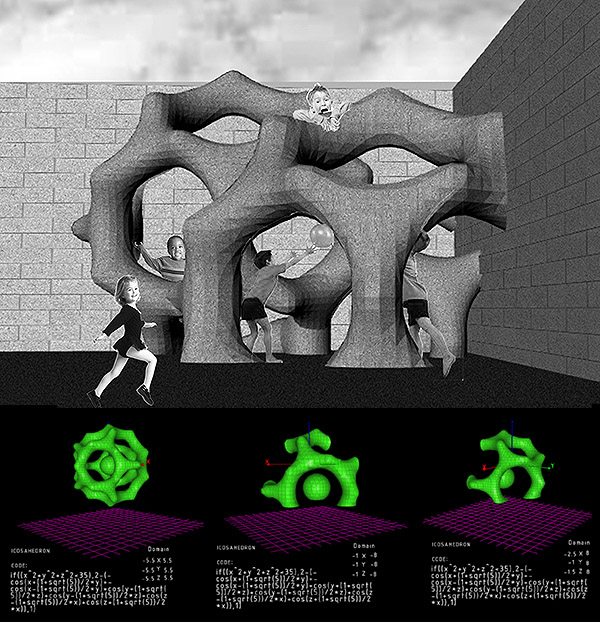
Ayşenur Gençsoy experimented with the tool MathMod. As you see, the criteria of this experiment were mostly about spatial variation. The complex parametric equations used in this design show a little out-of-control in that part. However, Ayşegül successfully imported the generated geometry and continued studying in Rhino.
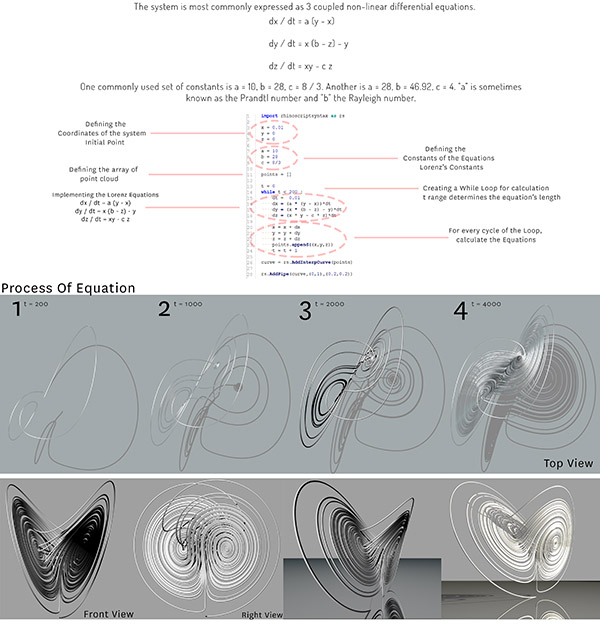
Said Koçak studied Rhino Python, which was the main platform we studied throughout the semester. He approximated the famous “Butterfly Curve“. This required extensive research and development practice. So, I find this educational, fun, challenging, and helpful.
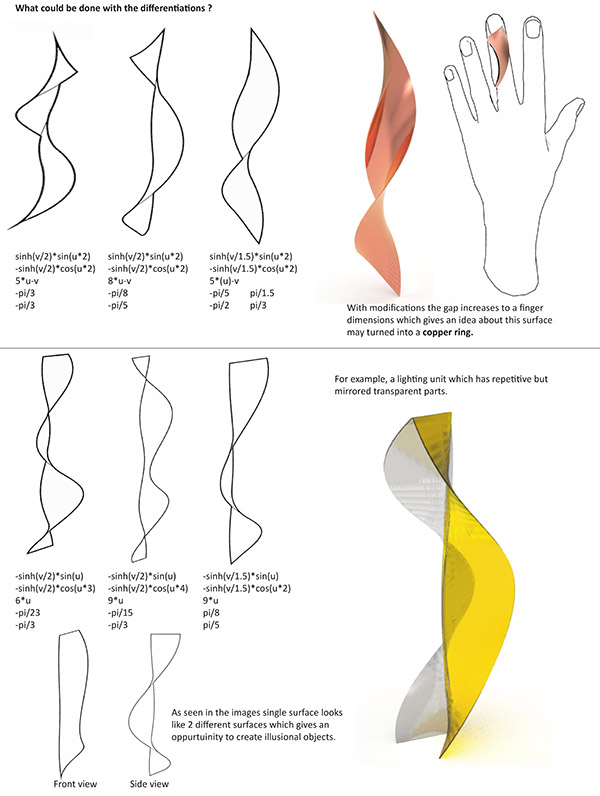
Sercan Okay approached the problem from a practical point of view. She designed a ring by using a parametric surface. That surface revolves via trigonometric functions. In fact, students did not have much time to experiment. But I think this one was a good start. She needed more time to advance this.
There were many other Design Mathematics student works. However, these three examples explain the major approaches. Throughout the semester, I thought about the assessment strategy of this course. Years after, I am still not sure about the evaluation of such courses. Because the integration between mathematics and design disciplines in an educational setting requires good planning. Also, this seems to be an open question in academia. The Design Mathematics course has three major interests. These are; design, mathematics, and coding (as a medium). Therefore, this becomes a pedagogical choice.
Cite this post
Related Posts
Design Mathematics Graduate Course
August 12, 2026
I’m looking forward to teaching Design Mathematics, a compulsory course in Istanbul Bilgi University’s graduate program in Architectural Design. The course was previously offered as an elective in the undergraduate program (here). Over time, I have also shared parts of the course content on the blog, particularly the sections on linear algebra and Rhino Python. Unfortunately, though, I have never quite managed to turn this material into the book project I had envisioned. Perhaps this semester I’ll finally make it…
Design Mathematics: New Course
February 15, 2018
Jumping into the world of mathematics as a designer seemed to be frightening at the beginning but I opened a new elective course at Bilgi, Design Mathematics. Starting today, I’ll try to log my experiences with the students while we are trying to understand mathematics. The ultimate objective is to find paths that may lead to answering the following question; “what is the relationship between design and math”? Next week, we’ll start with some of the warm-ups and preparatory topics…
Parametric Modeling Class: Subdivided Entities
March 14, 2012
Today, we’ve studied fundamentals of component-based design methods. Using curves and surfaces as starting points, we’ve experienced ways of translating those entities via design criteria based on our purposes. First, a curve is used to construct a leaf structure. We’ve experienced dispatching data lists and combining them back together. Subdividing curves into points created further entities such as vectors and planes. We used those entities as inputs of regular drawing and modeling commands such as rectangles, or planar surfaces. This…
Reptile Skin Student Examples
February 22, 2012
Here are some of the results of first assignment, “Reptile Skin”. Generally, we couldn’t manage to develop innovative solutions to the problem. But this became a good starting point for understanding the method of “skins of components” in contemporary digital design. Before going into any control over the flow of data, it’s hard to maintain associative geometries. We usually feel stuck within the capabilities of the single commands or procedures. That’s why, digital design deals with “processes” much more intensively…
Wave Generator
April 17, 2024
Here is a wave generator code I developed using Grasshopper and Python. While searching for a solution to the realistic water simulations, I came up with the Gerstner Waves. I tried to implement it. However, I came up with this final result, which is not a Gerstner Wave generator, but a much simpler one. It combines many user-fed wave components and calculates the resulting single wave. I played with this code for hours with different components. So, it is worth…