
Design Mathematics: New Course
Jumping into the world of mathematics as a designer seemed to be frightening at the beginning but I opened a new elective course at Bilgi, Design Mathematics. Starting today, I’ll try to log my experiences with the students while we are trying to understand mathematics. The ultimate objective is to find paths that may lead to answering the following question; “what is the relationship between design and math”? Next week, we’ll start with some of the warm-ups and preparatory topics such as number families and number systems, scientific notation… etc. Interestingly Rhino presents a very nice platform to study some of the math topics. We’ll also see its potential in teaching math to designers. I’ll probably use some Rhino Python scripts to introduce the basic operations such as graphing curves. I’ll post those scripts here.
I found these YouTube channels very inspiring:
Here is a more formal introduction to the Design Mathematics course:
Mathematics is the study of abstract generalizations, patterns, and relationships. Mathematical knowledge opens the path of new technologies and paradigms in many fields of science and engineering. As a consequence, it becomes a universal language among these professions. Designers need a minimum of mathematical knowledge. Being a computational designer requires competencies beyond being a good tool user. Because of the chosen multi-disciplinary attitude for the profession. It is becoming increasingly important to understand the underlying mathematical basis before any design tool or method is introduced into this perspective. This course re-introduces the essence of mathematical knowledge to designers. I chose course topics from some of the main topics which are concerned with shape and space. Python programming language will be used to experiment with the essence of the mathematical concepts in digital design workflows.
Cite this post
Related Posts
Design Mathematics Graduate Course
August 12, 2026
I’m looking forward to teaching Design Mathematics, a compulsory course in Istanbul Bilgi University’s graduate program in Architectural Design. The course was previously offered as an elective in the undergraduate program (here). Over time, I have also shared parts of the course content on the blog, particularly the sections on linear algebra and Rhino Python. Unfortunately, though, I have never quite managed to turn this material into the book project I had envisioned. Perhaps this semester I’ll finally make it…
Design Mathematics Student Works
May 22, 2019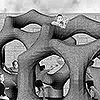
Below are some of the student works from the 2018 course: Design Mathematics. The final project of the course was about experimenting the designerly creativity. This included utilizing the mathematical concepts and objects studied throughout the semester. This was a rather open-ended homework question. But in the following years, I am not planning to repeat it. Because it becomes difficult to assess the learning outcome from open-ended homework within such a strict course content. Ayşenur Gençsoy experimented with the tool…
Flow Map on Terrains
September 11, 2026
We previously looked at the terrain generator script we used in midterm projects with first-year architecture students over here. Later on, we added a few analysis modules to this tool. You might remember the slope analysis tool from this link. Today’s topic is another type of analysis: flow. The idea for this code wasn’t actually mine; I developed it by looking at an existing script based on Serkan Uysal’s suggestion. Unfortunately, I don’t know who originally wrote it. Keeping track…
Modeling the Gyroid Solid
March 30, 2024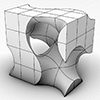
Gyroid is a popular triply-periodic minimal surface. Although it is a mathematical entity, designers and architects like its approximations very much. We used an interpretation of Gyroid in the rammed-earth structure: “Common-action Wall” in 2017. In that project, we utilized its spatial quality of dividing the space into two intertwining and symmetrical volumes. By making one of these volumes solid, I left the other void. So, in this tutorial, I am going to explain modeling the Gyroid Solid by utilizing…
Coding the Dodecahedron
March 7, 2024
Here is a method for coding the dodecahedron and all its irregular variants in Grasshopper as quickly as possible. I utilized the golden ratio rectangles, usually used to construct the sister polyhedron, the icosahedron. However, the magic component of the Grasshopper, the Faceted Dome rescued me again to generate the dual of it, the dodecahedron. This is a special platonic solid, which has 12 regular pentagonal faces. There are several techniques that I generally prefer to use in Grasshopper. You…