designcoding
About Table of Contents Keywords Monthly Archive
Support designcoding!

#parametric-surface

49 posts

Quadrilateral Surface Tessellation

April 9, 2012

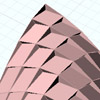
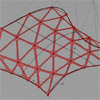
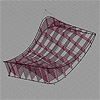
As far as I understood, it is impossible to physically construct double-curved surfaces from quadrilateral and planar faces. This definition tries to find an optimized alternative to this problem. Any surface, single or double curved, is divided into standard sub surfaces. But this time, those surfaces are treated as planar surfaces, therefore one corner is moved to meet this requirement. The output consists of only planar surfaces ready for fabrication. There are potential improvements to this definition such as finding…

Monkey Saddle Surface

April 8, 2012

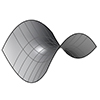
This is another popular “math surface” being rediscovered by designers nowadays, in 2012. Saddle surfaces, seen above as mentioned earlier (here) have a special type named “Monkey Saddle Surface”. This surface was a dramatic example of how Grasshopper can control equations and instantly show graphical results. The mathematical equations start with Z=… this makes it very easy for us to transform any x-y grid centers (a 2d data tree of 3d points) and add z values to them according to…

Parametric Modeling Class: Subdivided Entities

March 14, 2012

Today, we’ve studied fundamentals of component-based design methods. Using curves and surfaces as starting points, we’ve experienced ways of translating those entities via design criteria based on our purposes. First, a curve is used to construct a leaf structure. We’ve experienced dispatching data lists and combining them back together. Subdividing curves into points created further entities such as vectors and planes. We used those entities as inputs of regular drawing and modeling commands such as rectangles, or planar surfaces. This…

Reptile Skin Student Examples

February 22, 2012

Here are some of the results of first assignment, “Reptile Skin”. Generally, we couldn’t manage to develop innovative solutions to the problem. But this became a good starting point for understanding the method of “skins of components” in contemporary digital design. Before going into any control over the flow of data, it’s hard to maintain associative geometries. We usually feel stuck within the capabilities of the single commands or procedures. That’s why, digital design deals with “processes” much more intensively…

Parametric Truss

February 10, 2012

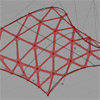
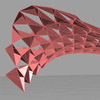
This is the old-method Parametric Truss definition. Interestingly this quickly became a solid solution, used and taught for years. I couldn’t find a better answer yet. As Grasshopper updates, some of the components in this definition change but the overall structure remains. Subdivision of a free-form surface and addition of geometric components has, of course, a wide range of alternatives. Maybe we should combine this with different problems and solutions we’ve talked about earlier on this website. The same solution…

Data Recorder and Surfaces

February 7, 2012

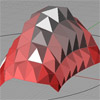
In this experiment, I’m trying to use data recorder to change components on a surface. The component part is a standart triangular construction, but the attractor points are defined by a 2D slider that is connected to a data recorder. Data recorder remembers last 15 points, while you move the 2d slider, last 15 points are projected on the base surface. This creates an illusion as if a “snake” game on a surface. Definition then uses the closes point distance…

Basic Curve Attractor

January 31, 2012

This study includes three main topics related to the basics of Grasshopper. The first one is the surface subdivision, the parametric definition of a surface component, that is, in this case, a simple pyramidal object. The second thing is the associative behavior of surface components with an external parameter, that is another entity in space; a curve. Traditionally, this is simply demonstrated by The important thing here is to find a method to compare each object (here it is the…

Interlocking Structure Between Two Surfaces

January 29, 2012

A previous work showed a method to create interlocking structures to be created without boolean operations. This time, a small addition is made to create waffle objects using two surfaces, one is the top surface, and the other is the bottom. It was a small modification at the beginning; to replace the “extrude” component with an “edge surface” component. But the interlocking details are now different at each intersection, so another modification is made to the drawing of the rectangles….

Graph Waves with Attractor Geodesic

January 25, 2012

The regular component design technique can be further improved by adding several manipulations. The purpose of this study was to create a surface component that reacts to an inherent parameter (actually a geodesic curve on the surface). However, within the process of parametric modeling, diverse formal potentials emerged. Most interesting results are achieved by adding a graph parameter to control the waves of reaction while splitting the surface as stripes. It is created in the recently updated version (0.8.00066) of…

The Moebius Strip

January 18, 2012

A Moebius strip, also known as a Moebius band, is a fascinating mathematical object and a type of non-orientable surface. It was discovered independently by the German mathematicians August Ferdinand Möbius and Johann Benedict Listing in the 19th century. To visualize a Moebius strip, imagine taking a long, narrow strip of paper and giving it a half twist before connecting its ends to form a loop. The result is a surface with only one side and one edge. This Grasshopper…

« 1 2 3 4 5 »
  • Chapters

    • Algorithms
    • Discourses
    • Fabrications
    • Studios
  • Explore

    • All Keywords
    • Table of Contents
    • Monthly Archive
    • #parametric-curve
    • #tiling
    • #polygon
    • #macro
    • #tangent
    • #hyperbolic
    • #sandblasting
    • #wood
    • #deformation
    • #fractal
    • #anemone
    • #aperiodic
    • #non-euclidean
    • #rhombus
    • #hexagon
    • #brick
    • #design-competition
    • #enneahedron
    • #relief
    • #curvature
  • Search

  • Support designcoding!

  • Enjoying designcoding? Support me on Patreon to keep it growing. Thank you!

  • copyright 2026 designcoding.net | about | privacy policy | end user license agreement