designcoding
About Table of Contents Keywords Monthly Archive
Support designcoding!

#parametric-surface

49 posts

Surface Components Basics

January 17, 2012

This is a basic formation of component-based design in a dataflow environment. A double-curved surface is subdivided and re-constructed using straight sections. Parametric model of a surface construction by variable components. The main data list of subsurfaces are distributed into four distinct lists, that will be used to construct lines out of double-curved quadrilateral faces. Such definitions could be further advanced by adding a precise fabrication detail.

Moebius Basics

January 15, 2012

One of the most popular shapes in topology studies is the one-edge, one-face Moebius strip. Here is a basic definition that generates Moebius-like lofted surfaces. I say Moebius-like because, in Grasshopper, Rhino, or any NURBS surface method, I couldn’t manage to model this shape in its real topological singularity. The tricky part of this Grasshopper definition lies at the end, as I take the first segment of the surface, flip it, and attach it to the end of the segment…

Tumbler Brick Wall

January 8, 2012

There are a couple of experiments in different schools about organizing free-form surfaces (walls here) with a composition of modular elements (bricks). Even though they created robots to make such brick walls, I still couldn’t understand why. Although creating a parametric model that calculates the exact locations of bricks, seems very easy at first sight, there came severe problems to solve in order to achieve a correct layout without using helpers such as physics engines. Of course, it’s possible to…

Interlocking Structure (No Boolean)

January 2, 2012

It has been a tough problem for me, for the last two days. A parametric model of an interlocking structure (sometimes also called egg-crate, waffle, or contouring structure) can be created easily in Grasshopper using a Contour component. In addition, you need a couple of list management operations and a boolean (or region) difference event. However, Rhino and Grasshopper are very slow at calculating boolean differences on both solids and surfaces. Fabrication models of such structures don’t have to be…

Surface Subdivision

December 25, 2011

Here is the fundamental of surface subdivision in Grasshopper. In order to design a parametric truss exercise, this is the generally accepted starting point. Get a surface from the file, subdivide it into U and V directions to create point lists, and then manipulate these points to create something interesting. Having a list of points would also present good potential regarding attraction with other entities, such as point or curve attractors. As you probably notice, this is the new version…

Graph Surface

December 24, 2011

This time, in order to develop a potential “dummy” surface for Grasshopper experiences, I built a better definition. The Graph Surface definition uses a polygon as a basis, divides the edges and moves them according to various parameters. It’s fun to play with mapping different graph types and various polygons and subdivision values. Surprisingly, this definition led me to a wide range of possibilities I haven’t planned. Especially, shifting the graph along the edge of polygon (as seen above) creates interesting…

Surface Component based on Gaussian Curvature

December 22, 2011

This experiment is based on a traditional surface-component definition. However, the variation of components is associated with Gaussian curvature. We just control the subdivision and a multiplier value. Results are interesting in as an educational tool to explain NURBS surface curvature and its utilization for Design Geometry. Different surface shapes generate exciting results. Of course, this could be much improved by recognizing positive and negative curvature values, (probably only accepting positive ones maybe).

Semi-regular Surface Tessellation

December 20, 2011

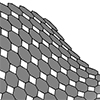
Back in 2011, one of the first posts on designcoding explored how to divide a surface in alternative ways. I called this Grasshopper definition a semi-regular surface tessellation. Although the term isn’t entirely accurate -since the pattern is neither planar nor made of equilateral shapes- it still reflects what I had in mind. Dividing surfaces into fabricable parts remains a key concept in learning parametric modeling, so I decided to revisit and update this old definition. There must be many…

Graph Mapping Edge Surface

December 19, 2011

The smooth and continuous nature of the “Sine Surface” has garnered significant popularity among designers and architects alike. This captivating curved surface offers a visually pleasing aesthetic that adds an elegant touch to various design projects. Its flowing contours and gentle undulations create a sense of harmony and organic beauty. Recently, I delved into this with the help of Grasshopper’s Graph Mapping functionality, I began my artistic journey. Although I encountered some initial challenges, I managed to generate a series…

« 1 2 3 4 5
  • Chapters

    • Algorithms
    • Discourses
    • Fabrications
    • Studios
  • Explore

    • All Keywords
    • Table of Contents
    • Monthly Archive
    • #cycloid
    • #stellated-solid
    • #complex-number
    • #pvc-hose
    • #hyperbolic
    • #cube
    • #escher
    • #deformation
    • #grid
    • #aluminium
    • #firefly
    • #optimization
    • #icosidodecahedron
    • #voronoi
    • #mosque
    • #moulding
    • #packing
    • #kuka-prc
    • #vector
    • #gyroid
  • Search

  • Support designcoding!

  • Enjoying designcoding? Support me on Patreon to keep it growing. Thank you!

  • copyright 2026 designcoding.net | about | privacy policy | end user license agreement