designcoding
About Table of Contents Keywords
Support designcoding!

#polyhedra

57 posts

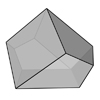
Drawing Herschels Enneahedron

July 26, 2017

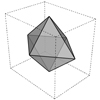
Exercising the “folding” process of a nine-faced solid. Start from its net, and analyze the matching edges. Then, use sphere intersections to calculate the rotation angles. Visit here for more information about this solid: http://aperiodical.com/2013/10/an-enneahedron-for-herschel/

Lokma

December 30, 2013

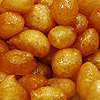
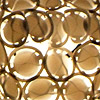
Lokma is the name of a pastry made of fried dough soaked in sugar syrup or honey and cinnamon, typically shaped into a ring or ball. Unfortunately, it is not the “Lokma” we’ll study here. In Turkish, there is another meaning of the same word related to the history of Eastern architecture. It is the name of metal connectors in railings, mostly inside of the openings of garden walls and old Mosque complexes. We often call this system “Lokma Railing”…

Lanterns

December 24, 2013

This year’s “Lanterns” assignment was nothing short of spectacular. It left both the students and faculty in awe of the creative brilliance displayed. Despite facing constraints in terms of time and experience, the Basic Design students surpassed all expectations. They crafted mesmerizing compositions of polyhedra and intricate unrolled surfaces. Their ability to conceptualize and execute such remarkable lantern designs can be attributed to the valuable skills they honed in their Architectural Geometry courses. Throughout the studio sessions, we introduced a…

Folded Plates: Basic Design Project

June 21, 2013

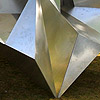
Below is one of the fourteen final projects of the freshman year Basic Design studio in İstanbul Bilgi University Faculty of Architecture. The component is made of folded aluminum sheets. Students insist that this is the most optimal solution to the problem of polyhedra in a component-based structure. They experimented with this shape a lot and tried their best to make one that has similar triangular faces on different sides, so the component would drive the macro form in diverse…

Modeling the Weaire-Phelan Structure

May 15, 2013

Becoming popular after the Beijing 2008 Olympics National Aquatics Centre‘s facade (which is believed to be a Voronoi subdivision, as an epic mistake), the Weaire Phelan structure is a solution of equal volumes with minimal surface area. This nice website briefly explains the phenomenon. There is also an implementation on Grasshopper by Jon Mirtschin. Here, I will be modeling the Tetrakaidecahedron of the Weaire-Phelan structure. First, we define the overall size by drawing a 20×10 rhombus. Copy the rhombus by…

Sixty Square Sphere

February 21, 2013

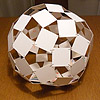
This was a couple of weeks ago, together with my six-year-old son Mete, we decided to make a “ball” out of old memory cards. I was curious about a subdivision method, using only planar quadrilaterals to construct a sphere (named Sixty Square Sphere. There are a couple of models on www. Of course look much better than mine:=). However, my son was expecting a “ball” to play. Then, both of our expectations have been partially met, I think. You see…

New Years Lanterns 2012-2013

December 20, 2012

This is the second year we are experimenting with a beautiful exercise with the Computation-based Basic Design 1 students at İstanbul Bilgi University Faculty of Architecture. The exercise is based on the ideas of Benay Gürsoy and Şebnem Yalınay, who are among the pioneers of this studio. The exercise is about the design and production of new year’s lanterns to be lit in the campus garden. Here are a few photos of the projects from the 2012 and 2013 semesters,…

Modeling the Buckyball

July 11, 2012

The Truncated Icosahedron (5,6,6) is an Archimedean Solid we often recognize as the iconic soccer ball. This geometric structure, also affectionately known as the “Buckyball” in honor of the visionary architect Buckminster Fuller, has gained significant popularity and recognition both within the realms of mathematics and everyday life. It is composed of twelve regular pentagons and twenty regular hexagons, meticulously arranged to achieve a harmonious balance. This symmetrical nature makes it a fascinating object of study in geometry and various…

Icosahedron Study

May 27, 2012

I have come across several high school topics I was afraid of. While I was searching for a geodesic dome definition in Grasshopper, it was quite surprising that I found an easier way of modeling an approximation of icosahedron, the famous platonic solid. Icosahedron was a research topic of this website at various posts before (here, here, and here). In order to generate geodesic spheres, first I had to solve icosahedron. My first experiment was partially successful. I knew icosahedron’s…

Tetrahedron Quick Way

May 20, 2012

The tetrahedron is a popular platonic solid for designers. We’ve explained how to draw them using equilateral triangles here before. Recently I’ve found (sorry, lost the web address) a much quicker way of modeling a Tetrahedron using a cube. It’s very simple, just connecting the three opposite corners of the cube automatically makes them equal, resulting in the four equal faces. Of course this time you’ll have to calculate the actual edge length, but if you use the “box diagonal”…

« 1 2 3 4 5 6 »
  • Chapters

    • Algorithms
    • Discourses
    • Fabrications
    • Studios
  • Explore

    • #voronoi
    • #truncated
    • #design-competition
    • #interlocking
    • #cairo-pentagonal
    • #golden-ratio
    • #image-sampler
    • #arduino
    • #calculus
    • #puzzle
    • #cnc-milling
    • #eps-foam
    • #weaire-phelan
    • #workshop
    • #hexagon
    • #robot-tool
    • #unity
    • #vbnet
    • #complex-number
    • #parametric-curve
    • All Keywords
    • Table of Contents
    • Monthly Archive
  • Search

  • Patreon

    Support designcoding!

    Enjoying designcoding? Support its future with a small donation on Patreon. Thank you!


    copyright 2026 designcoding.net | about | privacy policy | end user license agreement