designcoding
About Table of Contents Keywords Monthly Archive
Support designcoding!

#polyhedra

63 posts

Coding the Dodecahedron

March 7, 2024

Here is a method for coding the dodecahedron and all its irregular variants in Grasshopper as quickly as possible. I utilized the golden ratio rectangles, usually used to construct the sister polyhedron, the icosahedron. However, the magic component of the Grasshopper, the Faceted Dome rescued me again to generate the dual of it, the dodecahedron. This is a special platonic solid, which has 12 regular pentagonal faces. There are several techniques that I generally prefer to use in Grasshopper. You…
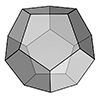
Space-filling Elongated Dodecahedra

February 22, 2024

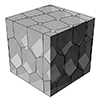
The regular dodecahedron is one of the five Platonic solids, characterized by having 12 regular pentagonal faces, 20 vertices, and 30 edges. When you elongate it, you extend its structure in one or more directions, resulting in a shape that retains the basic properties of the dodecahedron but is stretched out. The elongated dodecahedron might not catch your eye at first—it’s just a long version of a shape you’ve probably seen before, and it seems pretty basic. But don’t be…

Modeling a Dodecahedron

February 14, 2024

This is a 3d modeling tutorial for the platonic solid of dodecahedron. Modeling a dodecahedron is a good exercise for the basic transformation commands such as Rotate3D in Rhinoceros. You will see that it is possible to calculate the rotation angle by using sphere intersections. I learned this elegant method while teaching Architectural Geometry classes 12 years ago. It is based on the fact that, given a rotation axis and the rotation point, you can draw the path traced by…

Space-filling Rhombic Dodecahedra

February 10, 2024

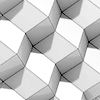
The rhombic dodecahedron is a polyhedron with twelve rhombus-shaped faces, where each face has four sides of equal length. It is possible to construct the space-filling variant of the rhombic dodecahedron by arranging multiple such rhombic dodecahedra in a regular pattern so that they fill space without leaving any gaps. In his 1611 work on snowflakes titled “Strena seu de Nive Sexangula,” Johannes Kepler observed that honey bees utilize the geometric structure of rhombic dodecahedra to construct honeycombs. These honeycombs…

Star Polyhedra

January 26, 2024

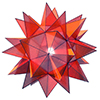
Stellated polyhedra are three-dimensional geometric shapes formed by extending the faces of a regular polyhedron (a solid with flat faces) beyond their original boundaries until they intersect with each other. The term “stellate” comes from the Latin word “stella,” meaning star and these polyhedra often have a star-like appearance due to their extended faces. They are popular because of their aesthetic qualities. I studied these forms many times before. This time, I implemented the stellations and negative stellations (the excavated…

Catalan Lamps

January 11, 2024

Catalan Solids are the duals of Archimedean Solids. They were first described by mathematician Eugène Charles Catalan in the 19th century. There are 13 Catalan solids, and they exhibit interesting symmetries and unique characteristics. While coding the vertex coordinates of these solids in Grasshopper, I made a simple lamp design to exercise the programming language. The code generates the 13 Catalan Lamps with flaps. Since the polyhedra have planar faces, they can be cut out by hand or a laser…

Archimedean Planters

December 30, 2023

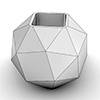
Archimedean Solids are convex polyhedra with faces of regular polygons and vertex-transitive. There are 13 such objects (excluding prisms and antiprisms which are probably less exciting). In this study, I experimented with these solids and designed a family of planters. Since they are convex and look cool, I decided to give it a try. I call this algorithm Archimedean Planters. The first part of the definition deals with the generation of the chosen solid. A list will help the user…

Polyhedra Unroller with Flaps

December 22, 2023

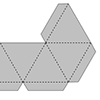
The Polyhedra Unroller with Flaps is a simple tool I developed for the obvious purpose. It picks any polyhedra (closed polysurface) from the user and unrolls it flat on the XY plane. This part is easy because a short Python script is sufficient. The important function of the script is the generation of the production drawings from the unrolled net. It means, the generation of the flaps. Here, the continuous lines represent the cutting paths and the dashed lines represent…

Weaire-Phelan Space-filling Structure

December 20, 2023

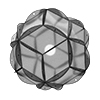
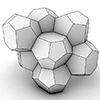
The Weaire-Phelan structure is an optimal solution to the problem of partitioning space into equal volumes with the least surface area. Denis Weaire and Robert Phelan discovered it in 1993. This structure gained attention due to its efficiency in filling space, offering a configuration that achieves a more balanced distribution of volume and surface area compared to other known structures at the time. Here is my model for the Weaire-Phelan space-filling structure. The Weaire-Phelan structure consists of two different shapes:…

Folding a Truncated Tetrahedron

February 12, 2023

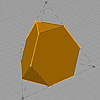
While digging through the lecture archive, I found this video I made in 2017. We introduce Platonic solids and Archimedean solids in the Design Geometry course at Istanbul Bilgi University. This video shows how we can create an Archimedean solid, the Truncated Tetrahedron, by folding it from a flat sheet. While doing this, I intersected the spheres by using the relations between the side lengths of the solid, and I calculated the rotation angles accordingly. First of all, I drew…

« 1 2 3 4 5 6 7 »
  • Chapters

    • Algorithms
    • Discourses
    • Escapes
    • Fabrications
    • Studios
  • Explore

    • Table of Contents
    • Monthly Archive

    • All Keywords
    • #boolean
    • #optimization
    • #eps-foam
    • #noise
    • #hoopsnake
    • #calculus
    • #3d-printing
    • #frege
    • #aperiodic
    • #mosque
    • #dürer
    • #buckminster-fuller
    • #icosidodecahedron
    • #3d-model
    • #computational-geometry
    • #buckyball
    • #koch
    • #golden-ratio
    • #bezier-curve
    • #archimedean-solid
  • Search

  • Support designcoding!

  • Enjoying designcoding? Support me on Patreon to keep it growing. Thank you!

  • copyright 2026 designcoding.net | about | privacy policy | end user license agreement