designcoding
About Table of Contents Keywords Monthly Archive
Support designcoding!

#parametric-curve

20 posts

Graph of Parametric Functions

April 6, 2018
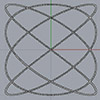
This RhinoPython script handles the simple graphs of two-dimensional parametric functions. Therefore, it approximates these functions by drawing parametric curves. It generates many points by solving the functions. The graph of parametric functions is a major topic in most Design Mathematics courses. Because it looks like the building block of many concepts of CAD. However, there is much more to learn before saying that the third degree NURBS is a degree-3 polynomial function. I am curious about learning the underlying…
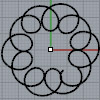
Cycloid Curves with Rhino Python

August 7, 2017

Studied earlier in Grasshopper here, creating a cycloid-like curve actually mimics the physical process of rotating disks on a path. Below is a test in Rhino Python (I know the variable names are not conventional).

Fractal Curves with Rhino Python

July 31, 2017

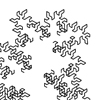
A simple Rhino Python script that generates fractal curves. An example is a test with the Gosper-Peano curve. However the script is not supporting segment directions, which is why the result is not the intended curve. Curve directions could be implemented in the future.

Cycloid Experiment

May 9, 2014

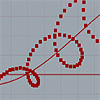
This is a Cycloid-like family of curves, generated by its classical description: a rolling circle. I had several other studies on similar topics before. In this cycloid experiment, I used Grasshopper in which, we don’t need to roll the circle. Instead, we can divide a parametric curve, utilizing data lists to simply rotate a circle around it. Finally, evaluating the circle repeatedly creates a Cycloid-like result. I found this as the most simplistic way of showing and studying these special…

Edge Bundling

February 17, 2014

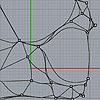
I’ve been searching for a way to implement edge bundling on Grasshopper. It is an effective visualization technique that you can use in connectivity diagrams. There are a couple of different approaches to this problem. It is a nice way to analyze common paths within crowded graphs. I’ve found several entries in the Grasshopper blog about this subject, but only implementing Kangaroo seemed to be a complete solution. My approach is of course not a scientific one, but after the…

Mirror by Curve

November 21, 2013

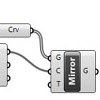
In today’s drawing class, we taught methods of drawing basic transformations by hand. Mirror was one interesting subject of that. However, then I opened Grasshopper and Rhino to test the effects of curved mirror planes. Unfortunately, I realized that there is already a curved mirror component in Grasshopper :( This might be one of the simplest ways of introducing generative deformations for design geometry.

Curve Farthest Point

August 26, 2013

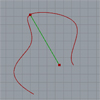
Today’s tip is about two-dimensional curve-point calculations. It is very handy to use “closest point” components in Grasshopper. You can calculate distances and directions between curves, surfaces, and points. Then, place point objects in relation to the proximity of another object. However, there is no “farthest point” implemented yet. I tried to calculate the farthest point from a curve. First, I tried to translate the curve in a fashion that would result in the opposite of the closest point calculation….

Albrecht Dürer

July 22, 2013

In the 14th century, Albrecht Dürer basically seems to capture some of the fundamentals of contemporary parametric design. Apart from other thinkers of his age, he refused to accept one single definition of beauty, based on proportions. His famous physiognomical studies reflected very early examples of referential systems that generate diverse design outputs, even a half-century before Descartes published the coordinate system and four centuries before D’Arcy draw the formal studies on species. I don’t know if he is mentioned…

Designing with Grasshopper

May 2, 2012

Today, there are pedagogical and practical challenges on the use of algorithms in architectural design, as computer puts not only a physical but also a cognitive layer between designer and the subject. Formulation of this cognitive layer is becoming important, regarding which model of computing is used to connect designer with the subject. Is it a “designerly” search, or design exploration in a visual programming environment? As most of the researchers admit that visual programming environments are very effective in generating variations,…

Taenia Solium

March 14, 2012

Today, we’ve discussed ways of subdividing entities to create parametric definitions. Curves can be divided into segments, creating snake-like object definitions. This exercise is important regarding the management of data. Vectors and planes are used as reference entities here. Nowadays, it became clear to me that, reference planes are very important because they both include reference points and related vectors as well. The definition studied in this post includes a curve subdivision and a combination of vector / plane management to…

« 1 2
  • Chapters

    • Algorithms
    • Discourses
    • Fabrications
    • Studios
  • Explore

    • All Keywords
    • Table of Contents
    • Monthly Archive
    • #koch
    • #maxscript
    • #archimedean-solid
    • #robot
    • #packing
    • #kuka-prc
    • #dome
    • #tensegrity
    • #snub-square
    • #logic
    • #arduino
    • #aluminium
    • #vbnet
    • #wittgenstein
    • #space-filling
    • #tiling
    • #text
    • #enneahedron
    • #islamic-pattern
    • #animation
  • Search

  • Support designcoding!

  • Enjoying designcoding? Support me on Patreon to keep it growing. Thank you!

  • copyright 2026 designcoding.net | about | privacy policy | end user license agreement