
Emergent Polygons Revisited
15 years ago today, on my older son Mete’s 5th birthday, I started writing the designcoding.net blog. My first post was titled “Emergent Polygons.” Back then, I had just started learning a new language called Grasshopper. I was working on defining emergent polygons, one of the key issues in the theory of Shape Grammars, using Grasshopper. I updated the GHX code to GH and re-posted it in 2024.
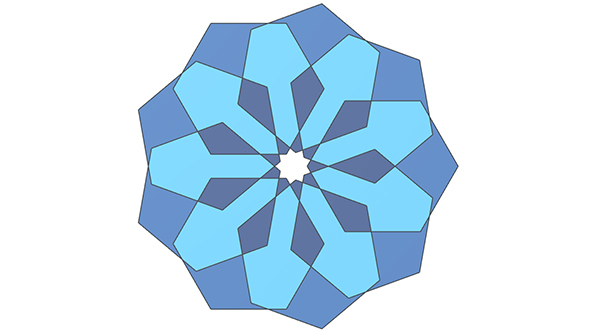
Now, exactly 15 years and exactly 600 posts later, Mete turned 20 today, and I have started learning Grasshopper 2.0. While many things remain the same as in the first version, I see some very important improvements and developments. I started rewriting the same “Emergent Polygons” code in Grasshopper 2.0 to learn new concepts (such as metadata). Although I struggled a bit, I finally managed to build the same code. Below, I am sharing my very first Grasshopper 2.0 GHZ code on this blog for its 15th anniversary. I still have about 60 draft posts in hand that I haven’t published yet. Therefore, those will still be shared in the Grasshopper 1.0 format. However, I plan to gradually transition to Grasshopper 2.0.

Cite this post
Related Posts
Sierpinski Triangle
February 20, 2024
Today’s computational curve is the beautiful Sierpinski Triangle. It is a fractal named after the Polish mathematician Waclaw Sierpinski, who described it in 1915, though it had been previously described by other mathematicians. It is a self-replicating pattern that arises from a simple recursive process. To construct the fractal, you start with an equilateral triangle and then repeatedly remove smaller equilateral triangles from its interior, leaving holes. Each iteration involves dividing each triangle into four smaller triangles and removing the…
Star Lattice
May 15, 2023
This is the six-pointed star lattice definition in Grasshopper. The definition is generating CNC or laser-ready results as seen below. In this code, first, I developed a common star pattern by exploding a hexagonal grid. The tricky part of this definition is the last part. There, you can see how you can use the Region Union (RUnion) component to add thickness to a pattern we have drawn before. The operation here will require trimming and extending commands under normal conditions….
Emergent Polygons
November 14, 2011
This is my first post in designcoding, dated 14.11.2011. I revisited the code and decided to re-publish it in 2024. Hello World! This is the Emergent Polygons definition, one of the first Grasshopper studies I made while learning the language. This is a very efficient programming language for designers and architects since it utilizes geometric relationships very intuitively. I think it will be more popular and widely used in the upcoming years. Last year, I started my experiments on this….
Polygon Fractals with Rhino Python
August 2, 2017
We will see a simple Rhino Python exercise here. I called these Polygon Fractals (or Pentaflakes sometimes). It is both educational and fun to play with them. In Rhino, it can be a good exercise for basic CAD commands and transformations such as move, copy, and scale, and precision drawing operations such as object snapping. Also, in Grasshopper, it can be a good challenge for looping. In Rhino Python, it is already a good exercise for understanding Python and the…
Constructing Irregular Tiling
December 11, 2024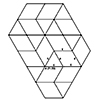
Using a compass and straightedge enables precise geometric constructions, allowing for the creation of complex tessellations. To begin these constructions, a single starting point is sufficient. Circles, which represent a collection of points at a specific distance from the center, and straight lines, which represent a collection of points in a particular direction, are utilized for geometric constructions. In this short tutorial, we move on with the beginner-level drawing exercises. This time, I am drawing an irregular tiling with triangles…