
Hexagonal Star Pattern
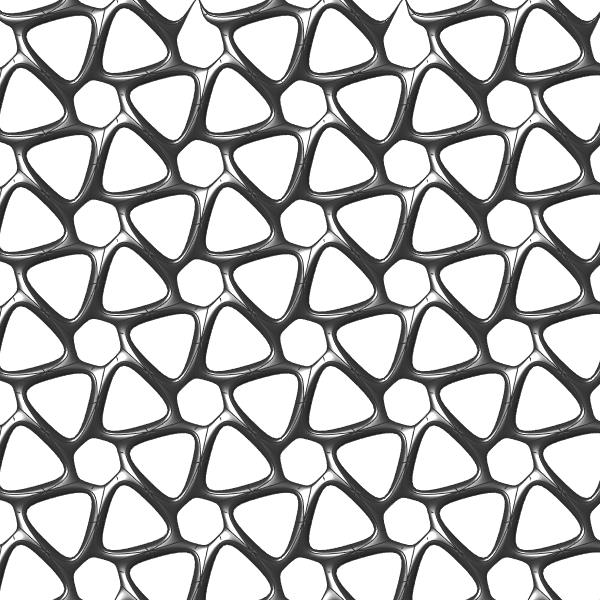
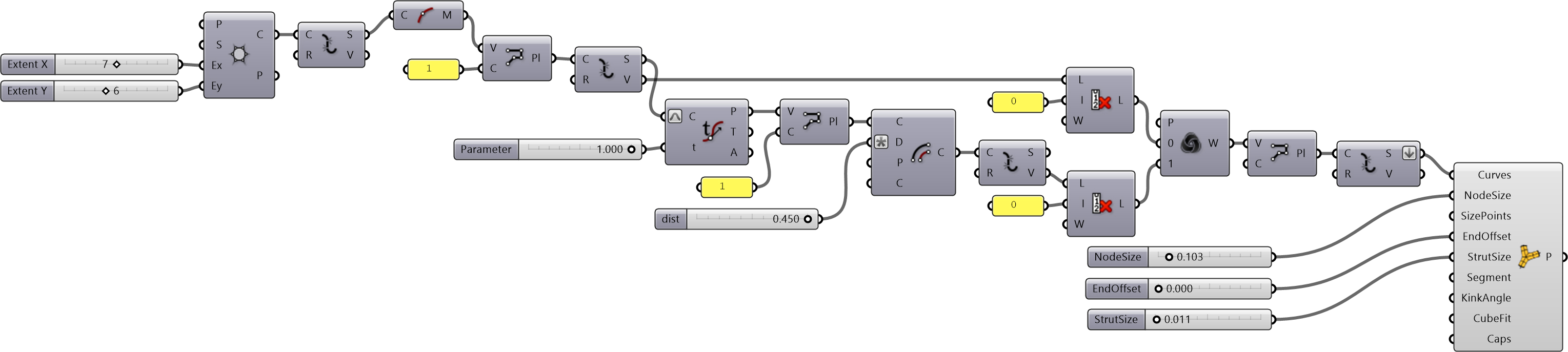
Sharing the latest scary pattern from my old pattern archive. This time, instead of using Parakeet, I designed it using only standard Grasshopper components. We start with a hexagonal grid. We exploded the cells of this grid and found the midpoint of each edge. By connecting these midpoints, we again created closed polylines. Then, we exploded these closed polylines, turning them into a sequence of data lists. Next, we place a point on each exploded segment (reparameterized with a t-value between 0 and 1) and reconnect these points to form a new polyline. This creates a second hexagon that we can slide along the edges of the original ones. We offset these slightly inwards and explode them. By combining this resulting vertex list with the vertices from before finding the parametric point, we create a point structure that forms a six-pointed star. We then convert these stars into SubD surfaces using the Multipipe component.
Actually, this is a twistable hexagonal star pattern. Thanks to Multipipe, it transforms into those organic, bone-like surfaces. Since I didn’t use Parakeet and the geometric construction process is very straightforward, I think this definition can be used as a basic-level pattern exercise in Grasshopper. I hope it comes in handy for someone one day.
Cite this post
Related Posts
Hexagonal Star Lattice
December 18, 2023
Here are the variations of classical six-pointed star patterns generated by Grasshopper. Generally, you can see these patterns under the title “Islamic patterns” because they are frequent in the decorations of mosques and palaces. I studied these patterns in Grasshopper earlier in these posts. I always find this an interesting geometry exercise. This time, my main goal was to develop a useful code only with the native Grasshopper components that create laser-cut-ready products of hexagonal star lattice. Thus, I made…
Drawing Hexaflake
December 11, 2024
The term “hexa” generally refers to the number six, derived from the Greek word. It is commonly used in mathematics, geometry, and other scientific fields to indicate six-sided shapes or structures. A hexagon is a polygon with six sides and six angles. It is one of the regular polygons, meaning all of its sides and angles are equal. A hexahedron is a polyhedron with six faces. The most well-known example is the cube, which has six square faces, twelve edges,…
Vector Fields
December 28, 2012
Back to the basics. I finally had time to test the vector fields components in Grasshopper. It was a couple of updates ago, a new tool group emerged in the vector tab, introducing different types of vector fields to users. Then, these fields could be merged to form more complex effects. However, I created a very simple example of how we can use those components to distort a system (such as a regular tessellation). Using attractor forces (usually in geometric…
Parquet Deformation of Star Patterns
February 3, 2012
This is another starting point for pattern generation study in a dataflow environment. I tried to implement the parquet deformation of Islamic patterns in Grasshopper. I studied Hankin’s method of Islamic Pattern generation. Then I tried to simulate his process beginning with basic regular tiling (regular hexagonal tessellation). Craig S. Kaplan (here) explains this and other methods in his dissertation. A Simple Foundation We have already experienced the result of exploding any hexagonal grid, shifting its points with the help…
Emergent Polygons Revisited
November 14, 2026
15 years ago today, on my older son Mete’s 5th birthday, I started writing the designcoding.net blog. My first post was titled “Emergent Polygons.” Back then, I had just started learning a new language called Grasshopper. I was working on defining emergent polygons, one of the key issues in the theory of Shape Grammars, using Grasshopper. I updated the GHX code to GH and re-posted it in 2024. Now, exactly 15 years and exactly 600 posts later, Mete turned 20…