
Design in the Forest
This is the first assignment named Design in the Forest of the new “Computation-based Basic Design” curriculum at İstanbul Bilgi University Faculty of Architecture. We are excited to see the students merging their conceptions of natural structures with the skills they start gaining in geometry classes. In the next assignments, we expect to generate patterns and structures by the abstraction of these initial sketches.
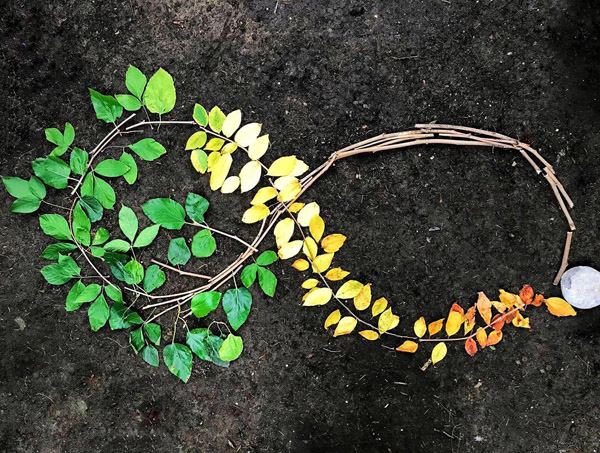
Humay Aliyeva
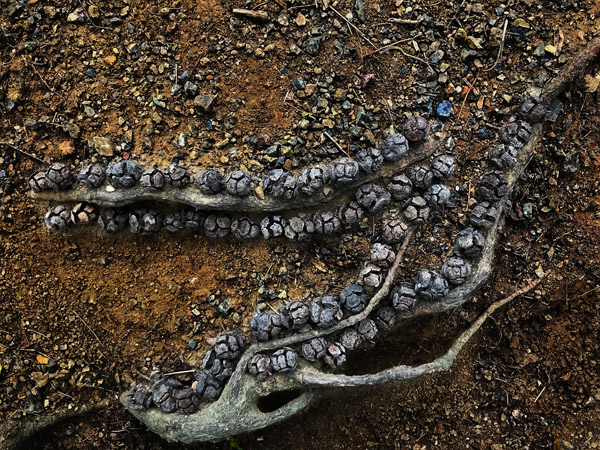
Sude Akay
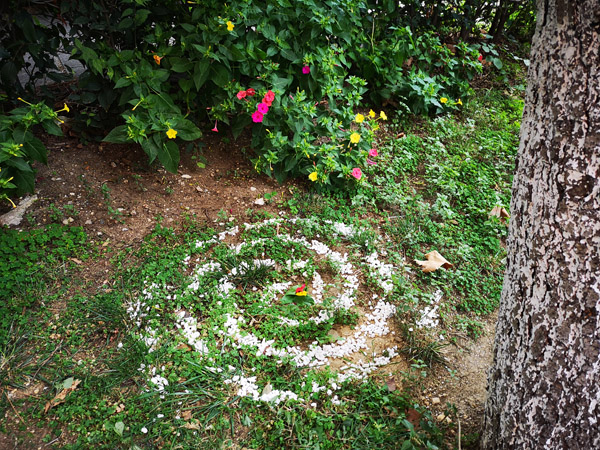
Here is an interesting paragraph from a similar art movement in Wikipedia:
Land art, variously known as Earth art, environmental art, and Earthworks, is an art movement that emerged in the 1960s and 1970s. As a trend, “land art” expanded the boundaries of art through the materials used and the siting of the works. The materials used were often the materials of the Earth, including the soil, rocks, vegetation, and water found on-site, and the sites of the works were often distant from population centers. Concerns of the art movement centered around the rejection of the commercialization of art-making and enthusiasm for an emergent ecological movement. The art movement coincided with the popularity of the rejection of urban living and its counterpart, enthusiasm for that which is rural.
Here is a paragraph from the assignment brief:
“In the Design in the Forest assignment, you are required to put nature in order in a 1mx1m area. Each design decision should be a part of a geometrical layout and destined order. How you put each material in relation to the other will be questioned. You are asked to use found natural elements/materials you pick in the city parks, forests, and beaches. You can use leaves, sticks, branches, soil, lichen, seeds, etc. You should observe and try to understand the formal and tectonic qualities of the materials you choose/pick. Not disturbing nature would be an objective of this assignment, therefore, do not break branches, move large tracts of soil, etc.”
Cite this post
Related Posts
Self-Organizing Patterns Exercise
October 24, 2018
One of the new assignments of our Computation-based Basic Design studio is called “Self-Organizing Patterns”. Although I’m not very sure about their self-organization potential, there are several good examples of systematic pattern-making. In the third week of their design education, some of the students proved themselves very well in analyzing and re-configuring natural structures in 2D abstract compositions. Selina Şişik Kardelen Kurt Sude Aydın
Metamorphosis
November 28, 2014
Here are some of the student works from this year’s Computation-based Basic Design Studio, centered around the captivating theme of Metamorphosis. Throughout the course, we tasked the students with pushing the boundaries of their creativity and innovation and encouraged them to construct designs that transcend conventional limitations and embody the essence of shapeshifting systematic wholes. The metamorphosis concept catalyzed their artistic exploration. Then, urged them to delve deep into the realm of design possibilities. A pivotal aspect of this studio…
Bits and Pieces
November 2, 2013
Below are some of the student works from the 4th-week exercise Bits and Pieces of this semester’s Basic Design studio. The gestalt notion of “figure-ground phenomenon” refers to the characteristic organization of perception into a figure that ‘stands out’ against an undifferentiated background. What is figural at any one moment depends on patterns of sensory stimulation. And on the momentary interests of the perceiver. Thus, the figure-ground relationship is an important element of the way we organize reality in our…
Wiry Wonder
January 8, 2023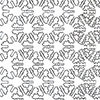
The Parquet Deformation named “Wiry Wonder” was designed by Michael Cuttita in William Huff’s studio at the State University of New York in 1989. The below figure shows the original drawing made by the student. Similar to the previous one, this composition is based on a hexagonal lattice. In this composition there are three significant prototiles, marking the three key moments in the shape-shifting process. There is also one invisible prototile. It accommodates the transition between the last two prototiles….
I at the Center
September 30, 2013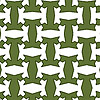
I at the Center is a multiple-axes vertex deformation based on a quadrangular hyperframe, designed by David Oleson at the studio of William Huff in 1964. Below, you see the original drawing and my Grasshopper animation based on a single-point attractor, creating the “I” wherever it is. It was a pleasure to read and repeat this deformation, which is a nice exercise in data tree operations and also one of the first examples I see about point attractor algorithms in design…